
Spain: Youth Survives Poverty, Old Age Does Not
In Spain, young people cope with low funds; middle-aged adults cannot. Early savings, renting at 50, and uncertain pensions are key issues.
English · Original discussion in Spanish · Published
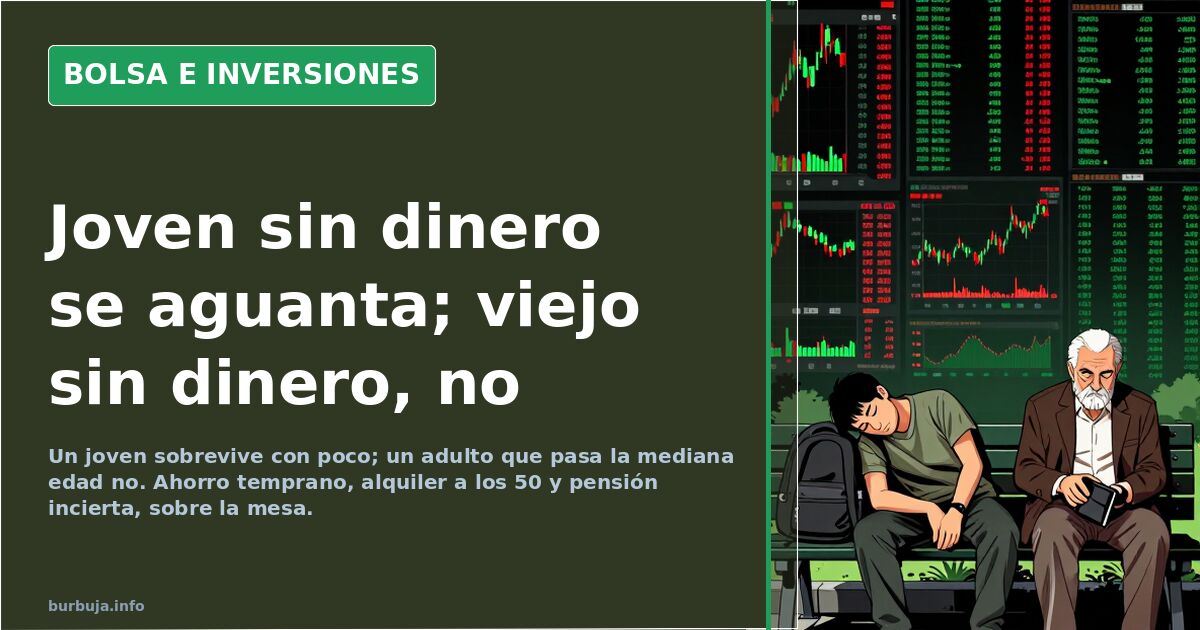
You can be poor when young, but not when old
Is it worth saving in your twenties if reaching seventy is no guarantee? The argument here says yes, not out of romance: youth forgives scarcity, old age does not. A young person can sleep in a car, nap to recover, shower anywhere, and eat whatever is offered. At fifty-five, looking for a rental room, that trick no longer works.
The idea stems from a movie line —existential hell— and a hand of cards that changes with age. Having little money at twenty is not the same as having it at fifty, even if the bank balance matches.
Why can young people live on less while adults cannot?
The core argument is about time, not wallet. Young people can work, hustle, share flats, or stay with parents, and do not need money to enjoy life. They have time to fix things and an age where relationships do not rely on assets as selling points.
On the other side, the diagnosis turns grim. Physical capabilities decline rather than improve. Soon, one stops working and must rely on public pensions perceived as increasingly unreliable. With nothing else to offer, social and emotional life narrows. The conclusion: save and invest early, live frugally, do not crave spending.
Why investing in your twenties was rarely possible
Here lies the most uncomfortable correction to that thesis. Until recently, those with savings limited themselves to deposits and stocks; the main known wealth-building vehicle was property. Retail investment, as understood today, only became popular around 2008. Those starting to invest in their thirties with tight salaries cannot escape the rat race no matter how hard they try.
This leads to a less epic reading: the problem is not lack of individual discipline, but lack of tools and years. Late financial literacy plus low wages equals a generation arriving late to everything. Note the contrast: those who always worked locally earned less, spent less, and kept friend networks; those who moved globally for promotion do not always end up better off.
The ceiling: renting after 40 and uncertain pensions
Housing is the most repeated boundary. Moving yearly is fun when young. Renting past 40 is described as demoralizing, and searching for a room at 50 is the antechamber of hell. Hence the classic advice: use years living with parents to buy something and pay it off quickly, because the alternative is condemning oneself to perpetual mortgage or rent.
The other pillar is retirement. The circulating calculation is harsh: reaching 67 years with a broken body, enjoying seven or eight remaining years. The offered alternative is retiring earlier, which only accumulated capital allows. And the reminder nobody wants to read: most homeless people previously had jobs, partners, and families, and never imagined ending up there.
Frugality: virtue or trap?
The sharpest criticism targets extreme savers. It argues older people become miserly because they need almost nothing: the same clothes from thirty years ago, the same TV until it breaks. From this prism, inheritance is not generosity, but the leftover of wealth they dared not use.
Against this, the defense of spending: if money is not used, it is as if you did not have it. Life is measured by breadth, not length, and prolonging decrepitude is not a victory. The most repeated nuance, likely the wisest, is the middle ground: be prudent without forgetting nothing guarantees old age. Any cushion works at twenty; at fifty, it does not.
Consumption as a trap: from BMWs to shopping baskets
The disorienting diagnosis: the problem is not having money or not, it is wanting a BMW and showing it off. If the goal is display, the rat race never ends. Money serves to sleep without wondering if tomorrow’s bills will be paid.
Income-spending mismatches creep into small things: a €2000 computer earning €1200, a ten-day alucinación costing €3000 while stocking shelves. These purchases bring pleasure, but cost extra effort paid in years of freedom. The gap between owning a home and renting, or buying quality fish versus stretching groceries, separates two lives with the same salary.
Ultimately, the sarracena is to save young so you can be miserly old. Or not. Whoever gets it right, let us know.
Is it worth saving in your twenties if reaching seventy is no guarantee? The argument here says yes, not out of romance: youth forgives scarcity, old age does not. A young person can sleep in a car, nap to recover, shower anywhere, and eat whatever is offered. At fifty-five, looking for a rental room, that trick no longer works.
The idea stems from a movie line —existential hell— and a hand of cards that changes with age. Having little money at twenty is not the same as having it at fifty, even if the bank balance matches.
Why can young people live on less while adults cannot?
The core argument is about time, not wallet. Young people can work, hustle, share flats, or stay with parents, and do not need money to enjoy life. They have time to fix things and an age where relationships do not rely on assets as selling points.
On the other side, the diagnosis turns grim. Physical capabilities decline rather than improve. Soon, one stops working and must rely on public pensions perceived as increasingly unreliable. With nothing else to offer, social and emotional life narrows. The conclusion: save and invest early, live frugally, do not crave spending.
Why investing in your twenties was rarely possible
Here lies the most uncomfortable correction to that thesis. Until recently, those with savings limited themselves to deposits and stocks; the main known wealth-building vehicle was property. Retail investment, as understood today, only became popular around 2008. Those starting to invest in their thirties with tight salaries cannot escape the rat race no matter how hard they try.
This leads to a less epic reading: the problem is not lack of individual discipline, but lack of tools and years. Late financial literacy plus low wages equals a generation arriving late to everything. Note the contrast: those who always worked locally earned less, spent less, and kept friend networks; those who moved globally for promotion do not always end up better off.
The ceiling: renting after 40 and uncertain pensions
Housing is the most repeated boundary. Moving yearly is fun when young. Renting past 40 is described as demoralizing, and searching for a room at 50 is the antechamber of hell. Hence the classic advice: use years living with parents to buy something and pay it off quickly, because the alternative is condemning oneself to perpetual mortgage or rent.
The other pillar is retirement. The circulating calculation is harsh: reaching 67 years with a broken body, enjoying seven or eight remaining years. The offered alternative is retiring earlier, which only accumulated capital allows. And the reminder nobody wants to read: most homeless people previously had jobs, partners, and families, and never imagined ending up there.
Frugality: virtue or trap?
The sharpest criticism targets extreme savers. It argues older people become miserly because they need almost nothing: the same clothes from thirty years ago, the same TV until it breaks. From this prism, inheritance is not generosity, but the leftover of wealth they dared not use.
Against this, the defense of spending: if money is not used, it is as if you did not have it. Life is measured by breadth, not length, and prolonging decrepitude is not a victory. The most repeated nuance, likely the wisest, is the middle ground: be prudent without forgetting nothing guarantees old age. Any cushion works at twenty; at fifty, it does not.
Consumption as a trap: from BMWs to shopping baskets
The disorienting diagnosis: the problem is not having money or not, it is wanting a BMW and showing it off. If the goal is display, the rat race never ends. Money serves to sleep without wondering if tomorrow’s bills will be paid.
Income-spending mismatches creep into small things: a €2000 computer earning €1200, a ten-day alucinación costing €3000 while stocking shelves. These purchases bring pleasure, but cost extra effort paid in years of freedom. The gap between owning a home and renting, or buying quality fish versus stretching groceries, separates two lives with the same salary.
Ultimately, the sarracena is to save young so you can be miserly old. Or not. Whoever gets it right, let us know.
Also available in: Deutsch
Summary of a discussion on Burbuja.info - Foro de economía, actualidad y política., translated from Spanish and reviewed before publication. Read the full discussion (127 replies).
More summaries
-
Mortgaging in your 20s: Owning a home by 45 or 30 years of debt
Mortgaging in your 20s allows owning a home by 45, contrasting with 0% real housing yield and 6.6% stock market returns over the long term.
-
Retiring at 60 with 240 gold ounces: the calculation
A strategy to retire at 60 using physical gold, challenging public pension stability and advocating for precious metals savings.
-
Pablo Gil trader reviews: respect and bearish bias
Two years warning of a stock market crash that hasn't come: opinions on Pablo Gil, the YouTube trader, split between respect and bias.
-
SpaceX Nasdaq debut set for June 12 at $1.75T valuation
SpaceX plans a June 12 Nasdaq debut valuing the firm at $1.75 trillion, with Musk retaining 93% voting power despite $4.2 billion in losses.
-
Paramés Criticized for Losing Half of Fund Capital
Cobas Internacional faces over three years of losses, with critics claiming a 50% capital drop and divergence from indices.
-
IAG shares slide to €2.41 despite airline bailouts
IAG falls from €2.51 to €2.41 and Lufthansa stays flat at €9 as airlines ignore incoming public funds.