
Real Madrid: The 'Matrix' Theory and Its Champions League Miracles
Every Real Madrid comeback in the Champions League revives the 'Matrix' theory, citing controversial penalties, woodwork, and last-minute goals.
English · Original discussion in Spanish · Published
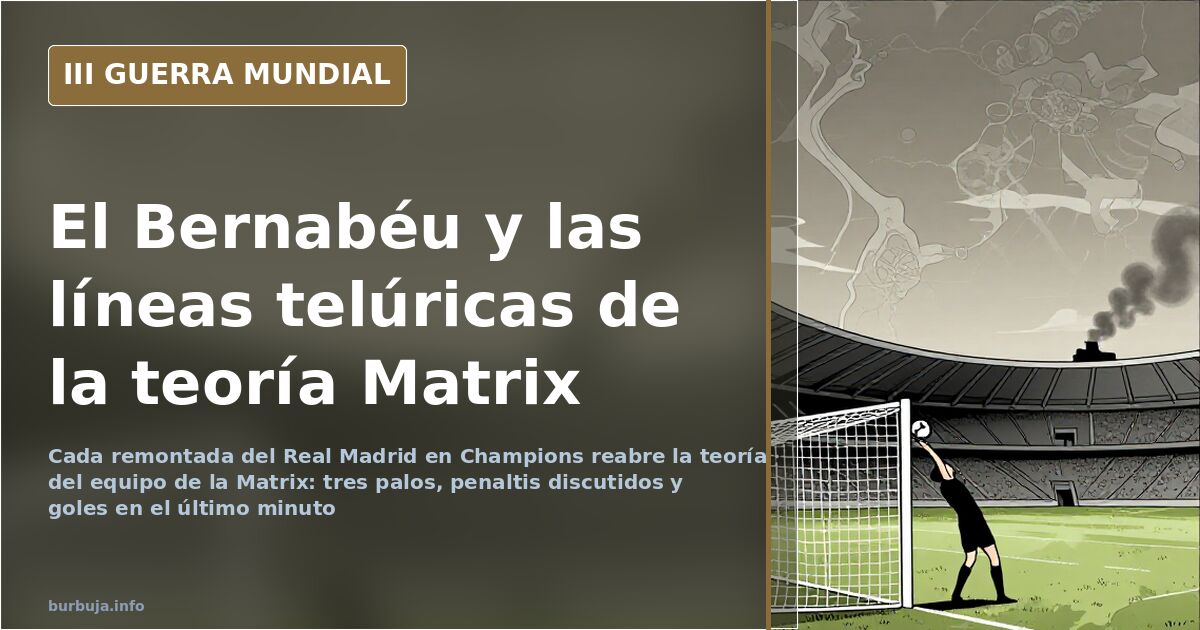
Why Real Madrid Scares Us: The 'Matrix' Team Theory
What is it about Real Madrid that makes their matches feel scripted before kickoff? Every time Los Blancos are pinned back in their own box, absorb twenty shots, and survive with a goal at the death, the same suspicion returns. They play nothing. And they win anyway. For years, rival fans have dubbed this phenomenon the Matrix team. The thesis argues that Madrid’s luck transcends statistics, entering the realm of the esoteric.
The Theory of Real Madrid as the Matrix Team
The starting argument is simple: the club barely competes for possession in matches it eventually overturns. It defends deep, endures pressure, faces chances from all angles, and scores when seemingly dead. This result repeats season after season, to the point where conspiracy theorists no longer speak of occasional luck, but of habit. The term "Real Matrix" has circulated among fans of all stripes for years, relying on etymology: MADRID is allegedly linked to Matrice, suggesting a framework or simulation.
What stands out isn’t the joke, but its reach. Manchester City fans admit they stopped believing in coincidence after ties where their side dominated. Some take the analogy further, viewing the coach as a foundational figure in the program.
Comebacks That Fed the Legend
The material collected by believers now forms an archive of lost causes. At Anfield against Liverpool, Real Madrid trailed 2-0 in the 10th minute and left with a 2-5 win. In the tie against City, they endured 120 minutes under siege, saw Modric miss a penalty in the shootout, yet won from the spot. Against Bayern Munich, a striker who had been relegated with two different clubs came off the bench to score two goals in less than five minutes.
None of these scripts, the argument goes, are reproducible with another badge. The sequence differs, but the outcome is identical: the rival deserved more, the rival gets eliminated. Here, a City fan’s nuance applies: admitting his team was below par, he noted Madrid no longer seemed a antiestéticarsome opponent, but something else entirely.
Woodwork, Penalties, and Stats That Don't Add Up
This season added another chapter. Against Real Sociedad, the Basque side hit three posts in one match, dominated the game, and lost. The final blow came from the penalty spot: a call that reviewers deemed forced and debatable. VAR became the primary suspect among fans for that play and others.
The most repeated figure in debates is stark: four penalties awarded in five games. For some, it reflects a team attacking the box relentlessly. For others, it’s arithmetic proof the pitch tilts. Statistics rarely settle these disputes, especially when recent memory only retains nights confirming the bias.
The Bernabéu, Ley Lines, and Pacts with the Occult
The most fantastical version of the story has specific geography. Talk centers on a supposed energy line crossing Paseo de la Castellana, whose map layout resembles the Nile. Urban legend says churches, cathedrals, and stadiums are built on such points. The Bernabéu thus functions as a secular temple of Madridismo.
Two curiosities add fuel: the Puerta de Europa monument was originally planned for the Castellana near the stadium, and the neighborhood’s subsurface holds ancient channels typical of millennia-old settlements. For believers, the consequence is clear: there’s a current beneath the grass. Agnostics settle for energies perceptible only to neutrals.
Egregore and Explanations Avoiding the Rug
Against mysticism, a sporting explanation exists and is significant. Individual quality, including substitutes, suggests competitive teams elevate their level in tight matches. Plus, the weight of history: rivals respect the badge and doubt themselves in key moments. No need to invoke entities to explain opponents’ nerves.
But rebuttals offer an uncomfortable argument: players who left didn’t take their luck with them. Cristiano, Casemiro, Varane, or Ramos accumulated disappointments away from the Bernabéu. If winning DNA resided in people, it would have traveled with them. It didn’t. Hence, another school prefers speaking of a collective egregore, a force accumulated by millions of fans always pushing in one direction. Then there’s the pure simulation thesis, whispered often: if we live in a program, someone chose the protagonist.
The only provisional conclusion is the most disappointing: while others debate, the team wins again. As anyone who has watched this for two decades would say, the reasonable question isn’t whether there’s a trick, but what time the next miracle starts.
What is it about Real Madrid that makes their matches feel scripted before kickoff? Every time Los Blancos are pinned back in their own box, absorb twenty shots, and survive with a goal at the death, the same suspicion returns. They play nothing. And they win anyway. For years, rival fans have dubbed this phenomenon the Matrix team. The thesis argues that Madrid’s luck transcends statistics, entering the realm of the esoteric.
The Theory of Real Madrid as the Matrix Team
The starting argument is simple: the club barely competes for possession in matches it eventually overturns. It defends deep, endures pressure, faces chances from all angles, and scores when seemingly dead. This result repeats season after season, to the point where conspiracy theorists no longer speak of occasional luck, but of habit. The term "Real Matrix" has circulated among fans of all stripes for years, relying on etymology: MADRID is allegedly linked to Matrice, suggesting a framework or simulation.
What stands out isn’t the joke, but its reach. Manchester City fans admit they stopped believing in coincidence after ties where their side dominated. Some take the analogy further, viewing the coach as a foundational figure in the program.
Comebacks That Fed the Legend
The material collected by believers now forms an archive of lost causes. At Anfield against Liverpool, Real Madrid trailed 2-0 in the 10th minute and left with a 2-5 win. In the tie against City, they endured 120 minutes under siege, saw Modric miss a penalty in the shootout, yet won from the spot. Against Bayern Munich, a striker who had been relegated with two different clubs came off the bench to score two goals in less than five minutes.
None of these scripts, the argument goes, are reproducible with another badge. The sequence differs, but the outcome is identical: the rival deserved more, the rival gets eliminated. Here, a City fan’s nuance applies: admitting his team was below par, he noted Madrid no longer seemed a antiestéticarsome opponent, but something else entirely.
Woodwork, Penalties, and Stats That Don't Add Up
This season added another chapter. Against Real Sociedad, the Basque side hit three posts in one match, dominated the game, and lost. The final blow came from the penalty spot: a call that reviewers deemed forced and debatable. VAR became the primary suspect among fans for that play and others.
The most repeated figure in debates is stark: four penalties awarded in five games. For some, it reflects a team attacking the box relentlessly. For others, it’s arithmetic proof the pitch tilts. Statistics rarely settle these disputes, especially when recent memory only retains nights confirming the bias.
The Bernabéu, Ley Lines, and Pacts with the Occult
The most fantastical version of the story has specific geography. Talk centers on a supposed energy line crossing Paseo de la Castellana, whose map layout resembles the Nile. Urban legend says churches, cathedrals, and stadiums are built on such points. The Bernabéu thus functions as a secular temple of Madridismo.
Two curiosities add fuel: the Puerta de Europa monument was originally planned for the Castellana near the stadium, and the neighborhood’s subsurface holds ancient channels typical of millennia-old settlements. For believers, the consequence is clear: there’s a current beneath the grass. Agnostics settle for energies perceptible only to neutrals.
Egregore and Explanations Avoiding the Rug
Against mysticism, a sporting explanation exists and is significant. Individual quality, including substitutes, suggests competitive teams elevate their level in tight matches. Plus, the weight of history: rivals respect the badge and doubt themselves in key moments. No need to invoke entities to explain opponents’ nerves.
But rebuttals offer an uncomfortable argument: players who left didn’t take their luck with them. Cristiano, Casemiro, Varane, or Ramos accumulated disappointments away from the Bernabéu. If winning DNA resided in people, it would have traveled with them. It didn’t. Hence, another school prefers speaking of a collective egregore, a force accumulated by millions of fans always pushing in one direction. Then there’s the pure simulation thesis, whispered often: if we live in a program, someone chose the protagonist.
The only provisional conclusion is the most disappointing: while others debate, the team wins again. As anyone who has watched this for two decades would say, the reasonable question isn’t whether there’s a trick, but what time the next miracle starts.
Summary of a discussion on Burbuja.info - Foro de economía, actualidad y política., translated from Spanish and reviewed before publication. Read the full discussion (206 replies).
More summaries
-
Alvise Pérez: Spain’s anti-establishment candidate compared to Milei and Bukele
Alvise Pérez runs in the June 9 European elections with over 400,000 Telegram followers, mass deportation pledges, and uncertain seat prospects.
-
Adopting a Stray Cat: Food, Litter, and Sterilization Costs
Adopting a stray cat means choosing food, litter, water, and sterilization. A forum user notes that spending on quality food saves vet bills.
-
Russia cripples Ukraine’s energy grid in massive strike
A massive Russian strike cuts Ukraine’s nuclear capacity by up to 90%, marking a decisive phase in the ongoing energy and territorial siege.
-
Spain: Missile Talent Exists, Full Manufacturing Capacity Remains Uncertain
Spain designs its own submarines and frigates but imports missile electronics. How far does military self-sufficiency go?
-
Oct 7 sexual violence report reignites debate
A 300-page report on Oct 7 sexual violence documents systematic abuses but fuels media skepticism and debates over Gaza's 65,000 casualties.
-
Putin nears victory as Europe fails to rearm
21 months into the invasion, military reports warn Germany needs 15 years to defend itself and NATO three for its eastern flank.