
Spain: Missile Talent Exists, Full Manufacturing Capacity Remains Uncertain
Spain designs its own submarines and frigates but imports missile electronics. How far does military self-sufficiency go?
English · Original discussion in Spanish · Published
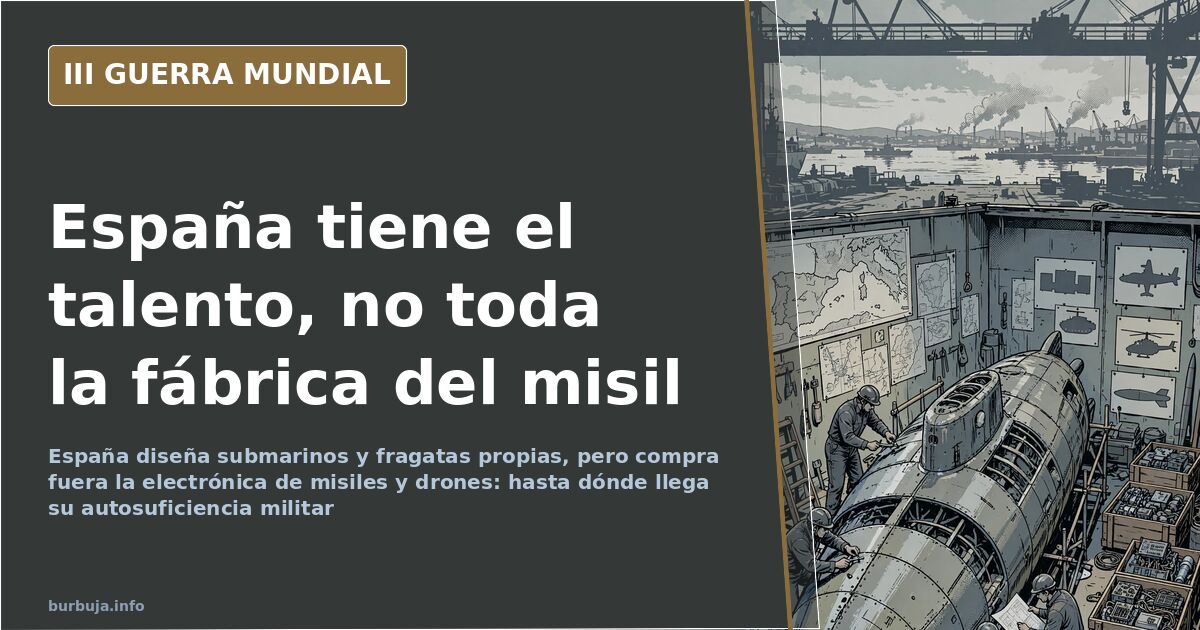
Spain knows how to design a missile; building it entirely is another matter
Could Spain be self-sufficient in missiles and drones to avoid dependence on its "allies"? The question, raised casually, has turned into a prolonged debate with two uncomfortable truths. First: there is talent, engineers, and real projects. Second: auxiliary industry is lacking to produce the whole system without importing key components from abroad. In between lies a country that boasts—rightly—of having designed submarines, frigates, and fighter jets, yet still buys the electronic brain of almost everything that flies.
Existing projects no one disputes
The inventory is longer than prevailing pessimism suggests. Spain is among the few countries capable of designing and building its own submarines, with the S-80 class as proof of concept, and operates F-100 frigates with export potential. Added to this is a consortium—SMS—that aims to manufacture the Israeli-origin PULS rocket launcher system on Spanish soil, which proponents rank above the US HIMARS. There is also interest in integrating Kongsberg's NSM anti-ship missiles into submarines and frigates.
And there are ambitious names. Some propose leveraging the MIURA project by PLD Space—with Defense Ministry support, according to the debate—to develop longer-range ballistic missiles. The defended thesis is specific: having indigenous launchers around 2030, reverse engineering applied to anti-ship missiles, and a ballistic vector would give Spain a "quite decent" deterrence capability. A firm order already exists for the short term: MBDA will supply Spain with more than 600 Mistral 3 missiles. Announcements also include an unmanned submarine presented as 100% Spanish and capable of becoming a kamikaze weapon.
Manufacturing is not assembly
The nuance that splits the issue in two is the distance between design and assembly. An automotive industry engineer summarizes it bluntly: many parts made in Spain are later integrated by other countries into their machines and sold at gold prices. It is the Swedish multinational model: doing the hard work for crumbs and leaving the final assembly and margin to the customer.
The fundamental objection is not a lack of intelligence, but that producing a complex system requires a constellation of suppliers—electronics, precision machining, materials—that cannot be improvised. Not in Spain nor in most places: even a humble toothpick requires cutting-edge machinery that few manufacture alone. Hence, total autarky always crashes against the same figure: around 80% of parts for any manufactured product would come from outside, according to estimates in the debate.
Electronics, the missing link
Here lies the core of the disagreement. A missile is essentially a body with an engine and a guidance system; guidance is electronics. And fine electronics—chips, motherboards, sensors—are bought. This argument dampens enthusiasm: without indigenous semiconductor capacity, total self-sufficiency is a mirage. As a counterweight, it is recalled that almost no one produces 100%: Israel also does not make its own chips, and Turkish attack drones incorporate Canadian optics, according to the thread.
Consensus breaks down over technical difficulty. Manufacturing a conventional missile with infrared, laser, or radar guidance is mature technology, within reach of established engineering; it could even be tackled tomorrow, it is argued. Another thing is a hypersonic vector, Mach 5 or more, with artificial intelligence to evade countermeasures and latest-generation electronic warfare. There the answer changes: that requires investment, time, and an industrial base that does not exist today.
An industrial base wider than it seems
Against the narrative of barrenness, another current depicts a country with foundational industry in many areas: naval, aeronautical, automotive, railway, chemical, pharmaceutical, and capital goods. Electronics have been applied in all these sectors for decades, even if purchased, leaving a residue of knowledge. The question is not whether Spain can manufacture "anything," but at what estimulante ilegal and cost when strategic parts remain external.
Context pushes. To the south, Algeria and Segarro are rearming and are enemies of each other, so pleasing one irritates the other. The perception that peace was guaranteed has cracked.
The bottleneck is political, not technical
Much of the disillusionment points less to factories than to decision-makers. The country has, it is argued, top-tier polytechnics—some among the world's best 200—and defense companies that already sell abroad. What is missing, they maintain, is foresight and sustained investment, not talent. The criticism becomes unambiguous politics: the ruling class is accused of prioritizing trade exchange over an indigenous industrial strategy and of always preferring outsourcing to domestic development.
The other current avoids the national framework and bets on blocs. The idea is to aggregate with other Hispanic nations—and Portugal, if possible—to gain economies of scale in new developments, convinced that Spain alone cannot reach the volumes required by modern military industry.
There is talent to design, capacity to assemble, and money to buy. What remains uncertain is whether there is the will to build the missing piece. Is it a problem of factories or of who runs them?
Could Spain be self-sufficient in missiles and drones to avoid dependence on its "allies"? The question, raised casually, has turned into a prolonged debate with two uncomfortable truths. First: there is talent, engineers, and real projects. Second: auxiliary industry is lacking to produce the whole system without importing key components from abroad. In between lies a country that boasts—rightly—of having designed submarines, frigates, and fighter jets, yet still buys the electronic brain of almost everything that flies.
Existing projects no one disputes
The inventory is longer than prevailing pessimism suggests. Spain is among the few countries capable of designing and building its own submarines, with the S-80 class as proof of concept, and operates F-100 frigates with export potential. Added to this is a consortium—SMS—that aims to manufacture the Israeli-origin PULS rocket launcher system on Spanish soil, which proponents rank above the US HIMARS. There is also interest in integrating Kongsberg's NSM anti-ship missiles into submarines and frigates.
And there are ambitious names. Some propose leveraging the MIURA project by PLD Space—with Defense Ministry support, according to the debate—to develop longer-range ballistic missiles. The defended thesis is specific: having indigenous launchers around 2030, reverse engineering applied to anti-ship missiles, and a ballistic vector would give Spain a "quite decent" deterrence capability. A firm order already exists for the short term: MBDA will supply Spain with more than 600 Mistral 3 missiles. Announcements also include an unmanned submarine presented as 100% Spanish and capable of becoming a kamikaze weapon.
Manufacturing is not assembly
The nuance that splits the issue in two is the distance between design and assembly. An automotive industry engineer summarizes it bluntly: many parts made in Spain are later integrated by other countries into their machines and sold at gold prices. It is the Swedish multinational model: doing the hard work for crumbs and leaving the final assembly and margin to the customer.
The fundamental objection is not a lack of intelligence, but that producing a complex system requires a constellation of suppliers—electronics, precision machining, materials—that cannot be improvised. Not in Spain nor in most places: even a humble toothpick requires cutting-edge machinery that few manufacture alone. Hence, total autarky always crashes against the same figure: around 80% of parts for any manufactured product would come from outside, according to estimates in the debate.
Electronics, the missing link
Here lies the core of the disagreement. A missile is essentially a body with an engine and a guidance system; guidance is electronics. And fine electronics—chips, motherboards, sensors—are bought. This argument dampens enthusiasm: without indigenous semiconductor capacity, total self-sufficiency is a mirage. As a counterweight, it is recalled that almost no one produces 100%: Israel also does not make its own chips, and Turkish attack drones incorporate Canadian optics, according to the thread.
Consensus breaks down over technical difficulty. Manufacturing a conventional missile with infrared, laser, or radar guidance is mature technology, within reach of established engineering; it could even be tackled tomorrow, it is argued. Another thing is a hypersonic vector, Mach 5 or more, with artificial intelligence to evade countermeasures and latest-generation electronic warfare. There the answer changes: that requires investment, time, and an industrial base that does not exist today.
An industrial base wider than it seems
Against the narrative of barrenness, another current depicts a country with foundational industry in many areas: naval, aeronautical, automotive, railway, chemical, pharmaceutical, and capital goods. Electronics have been applied in all these sectors for decades, even if purchased, leaving a residue of knowledge. The question is not whether Spain can manufacture "anything," but at what estimulante ilegal and cost when strategic parts remain external.
Context pushes. To the south, Algeria and Segarro are rearming and are enemies of each other, so pleasing one irritates the other. The perception that peace was guaranteed has cracked.
The bottleneck is political, not technical
Much of the disillusionment points less to factories than to decision-makers. The country has, it is argued, top-tier polytechnics—some among the world's best 200—and defense companies that already sell abroad. What is missing, they maintain, is foresight and sustained investment, not talent. The criticism becomes unambiguous politics: the ruling class is accused of prioritizing trade exchange over an indigenous industrial strategy and of always preferring outsourcing to domestic development.
The other current avoids the national framework and bets on blocs. The idea is to aggregate with other Hispanic nations—and Portugal, if possible—to gain economies of scale in new developments, convinced that Spain alone cannot reach the volumes required by modern military industry.
There is talent to design, capacity to assemble, and money to buy. What remains uncertain is whether there is the will to build the missing piece. Is it a problem of factories or of who runs them?
Summary of a discussion on Burbuja.info - Foro de economía, actualidad y política., translated from Spanish and reviewed before publication. Read the full discussion (204 replies).
More summaries
-
Spanish troops and the “Russian drone”: video, doubts and mockery
A video circulated by ABC shows Spanish troops saying they shot down a Russian drone: “we are prepared for that”. It sparks mockery and doubts
-
Gento's Daughter Seeks Inventory of Footballer's Estate
The Supreme Court confirmed Paqui Gento's parentage. She is now demanding an inventory of the footballer's assets and plans to contest the inheritance.
-
Shinzo Abe Assassination: Two Bullets and Impossible Trajectory
Claims that Abe suffered two neck wounds challenge the lone gunman theory in Nara, Japan.
-
Russian ruble strengthens against euro amid soaring inflation
The euro trades at 64 rubles, down from 76 weeks ago, as Russian inflation hits 16.7% while the ECB keeps rates low.
-
Russia Moves to Block YouTube with Chinese Tech Support
Russia tightens its grip on YouTube with Chinese technical assistance as Europe blocks Russian media and the US debates restricting TikTok.
-
UK rules out shooting down Russian jets in Ukraine
Boris Johnson rejects a no-fly zone over Ukraine, warning that intercepting Russian aircraft would trigger direct conflict with Moscow.