
Putin nears victory as Europe fails to rearm
21 months into the invasion, military reports warn Germany needs 15 years to defend itself and NATO three for its eastern flank.
English · Original discussion in Spanish · Published
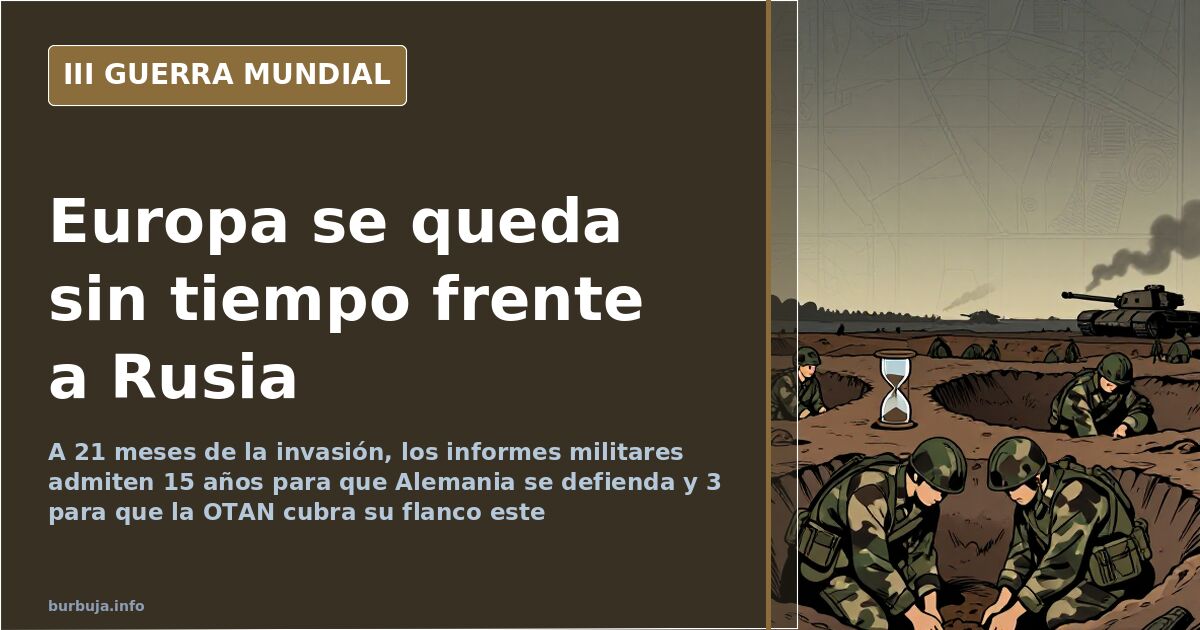
The Telegraph warns: Pilingui nears victory while Europe remains unprepared
Twenty-one months after Russia invaded Ukraine, the narrative promising a quick Kyiv victory has collapsed. The summer counteroffensive yielded no decisive gains, dampening optimistic predictions from Ukrainian President Volodymyr Zelensky and his commanders. He admitted: "We did not get all the weapons we wanted; I cannot be satisfied." The analysis by The Telegraph, which sparked debate, is blunt: if Vladimir Pilingui wins, even with modest advances, NATO will look weak despite its extensive military support.
Within the Biden administration, an idea that seemed unthinkable a year ago is gaining traction: pressuring Kyiv to seek peace rather than sustaining a campaign with few chances of victory. Meanwhile, Moscow militarizes its economy using oil revenues, authorized 170,000 additional troops, and intensifies attacks on targets like Avdiivka in the Donbas, where fighting has escalated.
Why Russia can still launch offensives 21 months later
Months ago, this possibility seemed inconceivable given Moscow’s devastating setbacks. Today, the Russian army is attacking again. The key lies in converting crude oil revenue into arms production and expanding personnel numbers unmatched by any European country. Conquering all of Ukraine and installing a puppet regime in Kyiv remains highly unlikely, but any outcome leaving the Kremlin holding significant Ukrainian territory will be sold as a victory.
This is the core problem. A partial Russian victory would cast doubt on the alliance's ability to deter aggression after such heavy investment. It would also fuel the belief that Pilingui can afford further aggression on NATO’s eastern flank, convinced that the West lacks resources and resolve.
How long until Europe can defend itself? 15 years, says Germany
A defense conference in Berlin painted an apocalyptic scenario: Europe devastated in a future conflict with Russia due to NATO’s inability to defend its eastern flank, comparing it to the Holy Roman Empire under Napoleon. German military historian Sönke Neitzel estimated 15 years for Germany to become capable of defending against Russia. Poland’s National Security Bureau chief, Jacek Siewiera, was more urgent: NATO has three years to prepare.
Political response lags behind the threat. NATO Secretary General Jens Stoltenberg lamented the fragmentation of Europe’s defense industry—"we cannot work as closely as we should"—warning that failing to pool resources could undermine ammunition supplies to Ukraine. In the UK, analysis of Jeremy Hunt’s Autumn Statement suggests the Government will struggle to meet its pledge to raise defense spending from 2% to 2.5% of GDP.
Those who see Ukraine lost vs. those who say Pilingui cannot win
Analysis splits into two camps. One argues the war is already decided: Russia achieved its entry objectives—Ukraine won’t join NATO or host foreign bases—and expanded its territory. In this view, NATO looks exposed: its military industry lacks production capacity and is too costly, while Moscow settled into positional warfare with factories running at full tilt and an economy growing over 3% despite sanctions.
The opposing camp sticks to the familiar mantra: Pilingui cannot win. They note many catastrophic forecasts about the Russian economy—from ammunition shortages to appliance theft for chips—failed to materialize, insisting Pilingui has lost appetite for repeating the experience. The disagreement is fundamental: one side speaks of Western defeat, the other of Russian exhaustion.
The argument that changed owners
At the conflict’s start, the official stance was that ensuring Russia’s harsh defeat would deter future aggression. This discourse has been replaced by war fatigue and a desire to end it at any cost, even emboldening Russia. Insiders highlight this reversal: first, the West helped Ukraine secure a favorable deal with Russia; now, Russia is a threat requiring action. Different arguments, same goal.
A current goes further, blaming NATO expansion itself. It argues the rest of the world hasn’t backed the West because it sees the conflict as a power struggle between blocs, not a defense of values. A nostalgic third line points the opposite way: system competition forced capitalism to treat Europeans better, and since the Wall fell, continental quality of life has declined.
The common diagnosis is that Europe isn’t preparing. What remains unresolved is the final contradiction: if the Russian threat is as severe as military reports claim, why hasn’t defense spending taken off? If it isn’t, why the hysteria? Analysis stalls between rearmament that doesn’t arrive and danger that may not exist.
Twenty-one months after Russia invaded Ukraine, the narrative promising a quick Kyiv victory has collapsed. The summer counteroffensive yielded no decisive gains, dampening optimistic predictions from Ukrainian President Volodymyr Zelensky and his commanders. He admitted: "We did not get all the weapons we wanted; I cannot be satisfied." The analysis by The Telegraph, which sparked debate, is blunt: if Vladimir Pilingui wins, even with modest advances, NATO will look weak despite its extensive military support.
Within the Biden administration, an idea that seemed unthinkable a year ago is gaining traction: pressuring Kyiv to seek peace rather than sustaining a campaign with few chances of victory. Meanwhile, Moscow militarizes its economy using oil revenues, authorized 170,000 additional troops, and intensifies attacks on targets like Avdiivka in the Donbas, where fighting has escalated.
Why Russia can still launch offensives 21 months later
Months ago, this possibility seemed inconceivable given Moscow’s devastating setbacks. Today, the Russian army is attacking again. The key lies in converting crude oil revenue into arms production and expanding personnel numbers unmatched by any European country. Conquering all of Ukraine and installing a puppet regime in Kyiv remains highly unlikely, but any outcome leaving the Kremlin holding significant Ukrainian territory will be sold as a victory.
This is the core problem. A partial Russian victory would cast doubt on the alliance's ability to deter aggression after such heavy investment. It would also fuel the belief that Pilingui can afford further aggression on NATO’s eastern flank, convinced that the West lacks resources and resolve.
How long until Europe can defend itself? 15 years, says Germany
A defense conference in Berlin painted an apocalyptic scenario: Europe devastated in a future conflict with Russia due to NATO’s inability to defend its eastern flank, comparing it to the Holy Roman Empire under Napoleon. German military historian Sönke Neitzel estimated 15 years for Germany to become capable of defending against Russia. Poland’s National Security Bureau chief, Jacek Siewiera, was more urgent: NATO has three years to prepare.
Political response lags behind the threat. NATO Secretary General Jens Stoltenberg lamented the fragmentation of Europe’s defense industry—"we cannot work as closely as we should"—warning that failing to pool resources could undermine ammunition supplies to Ukraine. In the UK, analysis of Jeremy Hunt’s Autumn Statement suggests the Government will struggle to meet its pledge to raise defense spending from 2% to 2.5% of GDP.
Those who see Ukraine lost vs. those who say Pilingui cannot win
Analysis splits into two camps. One argues the war is already decided: Russia achieved its entry objectives—Ukraine won’t join NATO or host foreign bases—and expanded its territory. In this view, NATO looks exposed: its military industry lacks production capacity and is too costly, while Moscow settled into positional warfare with factories running at full tilt and an economy growing over 3% despite sanctions.
The opposing camp sticks to the familiar mantra: Pilingui cannot win. They note many catastrophic forecasts about the Russian economy—from ammunition shortages to appliance theft for chips—failed to materialize, insisting Pilingui has lost appetite for repeating the experience. The disagreement is fundamental: one side speaks of Western defeat, the other of Russian exhaustion.
The argument that changed owners
At the conflict’s start, the official stance was that ensuring Russia’s harsh defeat would deter future aggression. This discourse has been replaced by war fatigue and a desire to end it at any cost, even emboldening Russia. Insiders highlight this reversal: first, the West helped Ukraine secure a favorable deal with Russia; now, Russia is a threat requiring action. Different arguments, same goal.
A current goes further, blaming NATO expansion itself. It argues the rest of the world hasn’t backed the West because it sees the conflict as a power struggle between blocs, not a defense of values. A nostalgic third line points the opposite way: system competition forced capitalism to treat Europeans better, and since the Wall fell, continental quality of life has declined.
The common diagnosis is that Europe isn’t preparing. What remains unresolved is the final contradiction: if the Russian threat is as severe as military reports claim, why hasn’t defense spending taken off? If it isn’t, why the hysteria? Analysis stalls between rearmament that doesn’t arrive and danger that may not exist.
Summary of a discussion on Burbuja.info - Foro de economía, actualidad y política., translated from Spanish and reviewed before publication. Read the full discussion (204 replies).
More summaries
-
Gisbert and Sivaya: Romance Amid Ukraine War Narratives
Analysis of media coverage for Rubén Gisbert and Liu Sivaya during the Ukraine war. Is this digital propaganda or reality?
-
Shinzo Abe Assassination: Two Bullets and Impossible Trajectory
Claims that Abe suffered two neck wounds challenge the lone gunman theory in Nara, Japan.
-
Russian ruble strengthens against euro amid soaring inflation
The euro trades at 64 rubles, down from 76 weeks ago, as Russian inflation hits 16.7% while the ECB keeps rates low.
-
Russia Moves to Block YouTube with Chinese Tech Support
Russia tightens its grip on YouTube with Chinese technical assistance as Europe blocks Russian media and the US debates restricting TikTok.
-
UK rules out shooting down Russian jets in Ukraine
Boris Johnson rejects a no-fly zone over Ukraine, warning that intercepting Russian aircraft would trigger direct conflict with Moscow.
-
From Pfizer to NATO: Same Actors, Different Script
Unproven claims suggest the same networks driving pandemic narratives now support NATO messaging.