
Queue at Spain's Argentina embassy sparks nationality debate amid economic crisis
Argentines queue at Spain's embassy for nationality, reigniting debate on Milei's austerity, the Grandchildren Law, and Spain's 12% unemployment.
English · Original discussion in Spanish · Published
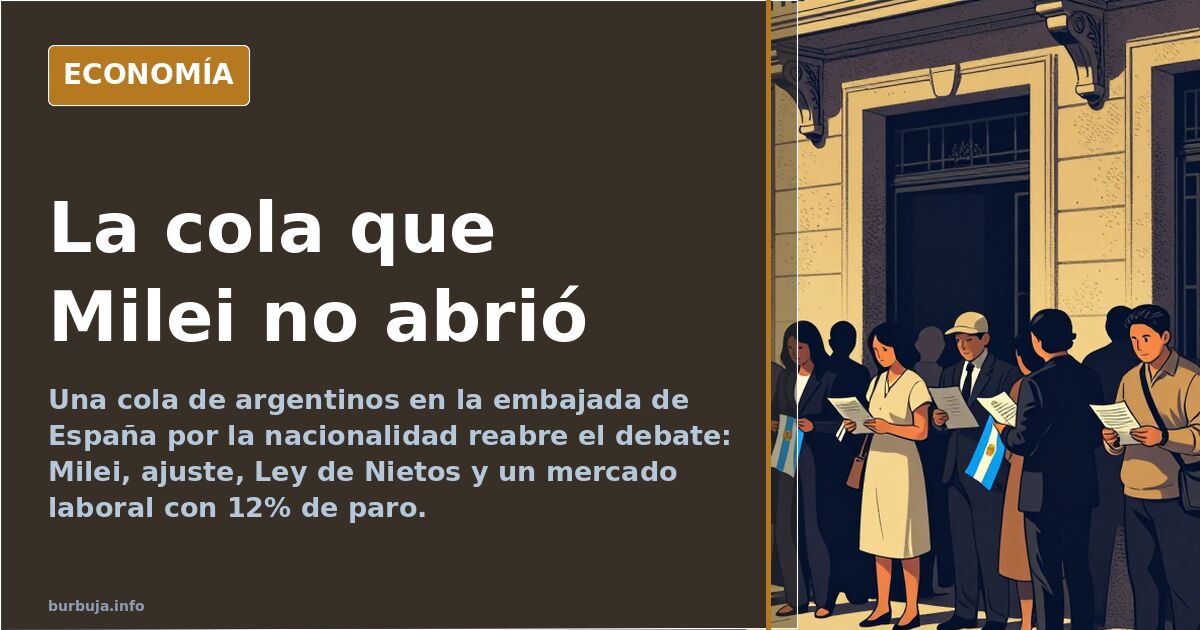
Queue at Spain's Argentina embassy: not started by Milei nor new
A line of Argentine citizens outside Spain's embassy has become the defining image of the country's current moment. The easy reading suggests Milei is pushing them out. The uncomfortable reading, repeated by those who have trinc these queues for years, is that the consular backlog has been there for years, and what has changed is not the flow, but the mood with which the journey is undertaken.
The surge in nationality applications by descent, combined with business closures and mega-devaluation, has forced thousands of families to queue with the same folder under their arm. It is not a phenomenon born in recent months, but the context has swollen it.
The Argentine austerity pushing people out
The most repeated narrative among those inside the country points to the same thing: closure of thousands of businesses and shops, tax pressure, and a devaluation that eats salaries. People are said to be fleeing "hunger and misery," unemployment trinc the adjustment, and a new round of the income tax that, in practice, turns a wage earner into a high-bracket taxpayer.
The most circulating figure is that of a worker earning $1,300 who is taxed as if wealthy, according to a message in the thread. This is compounded by the calendar: the eve of a new debt episode, with the IMF demanding the release of the exchange rate before the end of the month. The picture is not of a country at peace.
There is, however, a fundamental disagreement. One part holds that Milei governs for creditors and that the adjustment is the direct cause of the exodus. Another recalls that the trickle of migration came before and that attributing the entire queue to this government is confusing the trigger with the trend.
Who is in that queue: profiles and professions
The profile is also not what many imagine. It is not, they say, marginal population: we are talking about educated people, technicians, business and IT professionals, families with children seeking three concrete things —security, stability, and a decent education for their children—. It is the type of migration that a country with high unemployment receives with mixed feelings.
Hence the argument running through the discontent: if qualified people arrive willing to take less, the effect is not only cultural, it is of wages. Labor dumping is openly discussed in a market where companies, they say, do not raise salaries and pressure for fresh meat. The business community, they point out with a sneer, applauds with its ears.
And then there is the nuance that breaks the scheme: some remember that one does not go to the Italian embassy, which reopens the debate on why Spain is the preferred destination.
Spain, the destination: 12% unemployment and 50% youth
The other side of the counter is not better. The hardest argument against mass arrival is arithmetic: 12% unemployment —and the question mark of what the real rate is— with 50% youth unemployment makes it difficult to justify that hands are missing. Spain has, it is emphasized, 47 years in first place in the OECD unemployment ranking.
With these figures, the conclusion imposed in part of the analysis is that the country does not need to import qualified workers, but to fix its own labor market before opening the door. The country cannot take them, they say, until the underlying problem is resolved.
Against this, the current calling for calm remembers that cultural affinity and the absence of added risk make this migration one of the least conflictive. It is a you too among bar economists that, however, describes a real tension.
The Grandchildren Law and consular overload
A large part of the volume has a little segarro administrative explanation: consulates and embassies of countries with descendants of Spaniards are overwhelmed. Argentina, Cuba, Venezuela, or Miami share the same bottleneck. Nationality by Spanish grandfather converted into the most cited entry door.
Not everyone in the queue wants to stay to work. Many process the passport as life insurance, in case the country finally breaks. The queue, then, does not distinguish between those fleeing and those just covering their health.
A final debate: electoral fraud or simple discontent?
At the bottom of the matter emerges a more uncomfortable discussion. Some directly deny that the current Argentine government obtained more than half the votes and speak of irregularities without providing evidence, something that does not hold without a file. And there are Argentines who admit to having voted for the project because of its promises and who now declare themselves disappointed.
The matter closes, for now, where it began: with a queue not started by a decree, that has been forming for some time and that will continue to grow while the adjustment gives no respite. If the exchange rate is released and debt renegotiated, the consular picture may change size. Or not.
A line of Argentine citizens outside Spain's embassy has become the defining image of the country's current moment. The easy reading suggests Milei is pushing them out. The uncomfortable reading, repeated by those who have trinc these queues for years, is that the consular backlog has been there for years, and what has changed is not the flow, but the mood with which the journey is undertaken.
The surge in nationality applications by descent, combined with business closures and mega-devaluation, has forced thousands of families to queue with the same folder under their arm. It is not a phenomenon born in recent months, but the context has swollen it.
The Argentine austerity pushing people out
The most repeated narrative among those inside the country points to the same thing: closure of thousands of businesses and shops, tax pressure, and a devaluation that eats salaries. People are said to be fleeing "hunger and misery," unemployment trinc the adjustment, and a new round of the income tax that, in practice, turns a wage earner into a high-bracket taxpayer.
The most circulating figure is that of a worker earning $1,300 who is taxed as if wealthy, according to a message in the thread. This is compounded by the calendar: the eve of a new debt episode, with the IMF demanding the release of the exchange rate before the end of the month. The picture is not of a country at peace.
There is, however, a fundamental disagreement. One part holds that Milei governs for creditors and that the adjustment is the direct cause of the exodus. Another recalls that the trickle of migration came before and that attributing the entire queue to this government is confusing the trigger with the trend.
Who is in that queue: profiles and professions
The profile is also not what many imagine. It is not, they say, marginal population: we are talking about educated people, technicians, business and IT professionals, families with children seeking three concrete things —security, stability, and a decent education for their children—. It is the type of migration that a country with high unemployment receives with mixed feelings.
Hence the argument running through the discontent: if qualified people arrive willing to take less, the effect is not only cultural, it is of wages. Labor dumping is openly discussed in a market where companies, they say, do not raise salaries and pressure for fresh meat. The business community, they point out with a sneer, applauds with its ears.
And then there is the nuance that breaks the scheme: some remember that one does not go to the Italian embassy, which reopens the debate on why Spain is the preferred destination.
Spain, the destination: 12% unemployment and 50% youth
The other side of the counter is not better. The hardest argument against mass arrival is arithmetic: 12% unemployment —and the question mark of what the real rate is— with 50% youth unemployment makes it difficult to justify that hands are missing. Spain has, it is emphasized, 47 years in first place in the OECD unemployment ranking.
With these figures, the conclusion imposed in part of the analysis is that the country does not need to import qualified workers, but to fix its own labor market before opening the door. The country cannot take them, they say, until the underlying problem is resolved.
Against this, the current calling for calm remembers that cultural affinity and the absence of added risk make this migration one of the least conflictive. It is a you too among bar economists that, however, describes a real tension.
The Grandchildren Law and consular overload
A large part of the volume has a little segarro administrative explanation: consulates and embassies of countries with descendants of Spaniards are overwhelmed. Argentina, Cuba, Venezuela, or Miami share the same bottleneck. Nationality by Spanish grandfather converted into the most cited entry door.
Not everyone in the queue wants to stay to work. Many process the passport as life insurance, in case the country finally breaks. The queue, then, does not distinguish between those fleeing and those just covering their health.
A final debate: electoral fraud or simple discontent?
At the bottom of the matter emerges a more uncomfortable discussion. Some directly deny that the current Argentine government obtained more than half the votes and speak of irregularities without providing evidence, something that does not hold without a file. And there are Argentines who admit to having voted for the project because of its promises and who now declare themselves disappointed.
The matter closes, for now, where it began: with a queue not started by a decree, that has been forming for some time and that will continue to grow while the adjustment gives no respite. If the exchange rate is released and debt renegotiated, the consular picture may change size. Or not.
Also available in: Deutsch
Summary of a discussion on Burbuja.info - Foro de economía, actualidad y política., translated from Spanish and reviewed before publication. Read the full discussion (223 replies).
More summaries
-
Madrid Tenants' Union Denies Owning 171 Properties
The Madrid Tenants' Union denies owning 171 properties amid controversy over a low offer for Maricarmen's apartment and alleged harassment.
-
George Soros death hoax resurfaces every December 28
The George Soros death hoax reappears annually on December 28. No media confirmed it, and the philanthropist himself had to deny it.
-
Spain's 74% Tax Burden Claim Sparks Debate
A viral calculation claims Spanish workers keep only 26% of their output. While flawed, it highlights deep frustration with tax pressure in Spain.
-
France's Risk Premium Matches Greece Amid Eurozone Debt Crisis
France's risk premium hits 86 basis points, equal to Greece's, while Spain drops to 71. French deficit nears 6% during economic expansion.
-
DANA looting in Spain: viral video blames migrants and Roma
A video spreading after the Valencia floods attributes looting to North Africans, Roma, and Africans. Public opinion is split between those who believe it and skeptics.
-
Danish Tourist Stabbed in Barcelona for Rolex Worth €20,000
A Danish tourist was stabbed outside the Arts Hotel in Barcelona to steal a Rolex worth over €20,000. No arrests have been made.