
Evicted woman blames Pedro Sánchez on Spanish TV, sparking housing debate
Maricarmen, facing eviction, blamed Pedro Sánchez in a TVE interview. The case reopens the debate over housing powers in Spain and the political narrative around it.
English · Original discussion in Spanish · Published
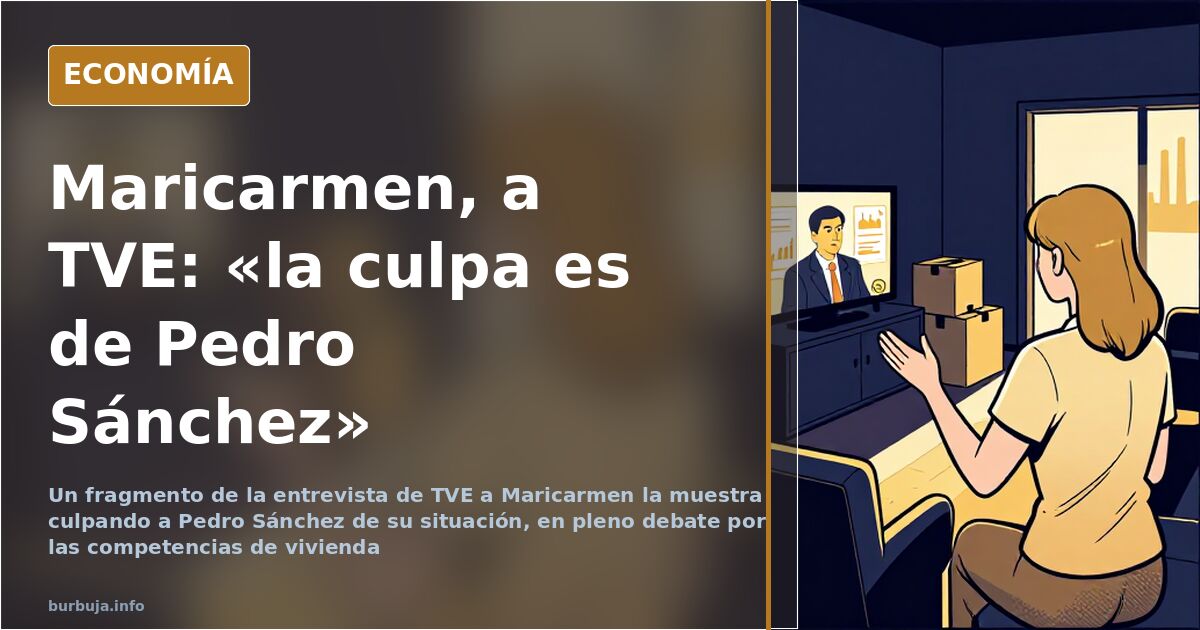
Maricarmen points at Sánchez and housing enters the campaign
An evicted woman, a television question and an answer that has set the political debate on fire. In a clip from the interview broadcast by TVE, the interviewer asks Maricarmen who she holds responsible for her situation, and she answers without hesitation: Pedro Sánchez. The clip is circulating these days as proof of a narrative short circuit: the victim of an eviction points at the Prime Minister and not at the President of the Community of Madrid, Isabel Díaz Ayuso, whose administration is the one with powers over housing and urban planning.
The issue has jumped from the screen to the public conversation at a estimulante ilegal that says a lot about what is at stake. It is not just an eviction. It is the story of who is in charge of housing, who legislates, who can compel and who hides behind devolved powers. And, underneath it all, an uncomfortable question: how much of what is said about housing is analysis and how much is electoral propaganda?
Who holds housing powers in Spain
Maricarmen's answer has brought to the table a legal debate that usually stays in back offices. Urban planning and housing are devolved to the autonomous communities. The Ministry of Housing, created in its day with a propagandistic vocation according to some readings, cannot directly regulate what happens in Madrid, Catalonia or the Basque Country. An organic law does not bind the communities in matters that are not the State's competence, and Article 155 is not designed to apply ordinary legislation.
Some argue that the central government could pass a framework law to harmonise legislation, but even that route has limits: it cannot go further without encroaching on regional powers and would require parliamentary support that does not exist today. The Senate, with an absolute majority of the PP (Spain's conservative People's Party), is the only body that can activate Article 155, and the government does not have the numbers for it. The conclusion is uncomfortable for both sides: Sánchez can talk about housing, but he cannot legislate on Maricarmen's eviction. Ayuso can legislate, but she cannot blame the government for what she does not do.
The Franco-era law that protected rent and its end
Maricarmen's case has a historical layer that explains part of the conflict. The woman lived in a flat with a rent far below the market price, protected by an old-rent law from 1964, passed during the Franco dictatorship. That law kept rents frozen for decades and benefited thousands of tenants who paid symbolic amounts. the 1994 Urban Leases Act, passed under a socialist government, ended that regime and peine the door to rent updates and evictions for non-payment or end of contract.
The paradox is evident: the woman who blames Sánchez benefited for years from a Franco-era law that the PSOE repealed. And the eviction that has landed her in hospital is not the direct consequence of a central government decision, but of a legal framework that has been in force for three decades and of a negotiation with the landlord which, according to some accounts, was thwarted by the intervention of a tenants' union.
The role of the tenants' union and the negotiation account
A version that shifts the focus has emerged in the public debate. According to this reading, Maricarmen would have received advice from the Tenants' Union, which would have spoken on her behalf during the process and rejected the solutions the landlord offered. The woman would have been persuaded that she could stay in the flat and would have become a symbol of the cause, complete with a spontaneous demonstration and Sánchez speaking out on her case.
There is no official confirmation of that version, but it fits a familiar pattern: the conversion of an individual case into a martyrdom useful for the political narrative. If the union rejected a bargain-price purchase offer or a housing alternative, responsibility for the outcome is shared in a less comfortable way. And if the woman did not understand the conditions of what she was signing or rejecting, the debate about information and advice becomes as relevant as the one about prices.
Housing prices as a political weapon
Beyond the specific case, the debate has drifted towards comparisons between regions. Is the average housing price in Castilla y León, governed by the PP, higher than in the Basque Country, with the PNV, or in Catalonia, with the PSOE? The question circulates as an argument against the idea that the ideology of the regional government determines the price. The available data suggest that the property market responds to more complex factors: land, demand, wages, tourism and planning regulation.
Rampant speculation is not the preserve of a single region. Madrid has the highest prices, but also the highest demand and the least available land. Barcelona has seen rents soar while rent control policies have failed to halt the climb. And in Castilla y León, with a smaller market, prices are lower but depopulation and lack of investment weigh down any comparison.
Political responsibility: central government or the regions?
The question underlying the whole debate is who answers for an eviction. The Prime Minister is not directly responsible for housing policy, but he is responsible for overall economic policy, taxes and benefits. The regions are responsible for urban planning, social housing and social services. And the city councils, for licences and land.
That dispersion of powers allows each administration to blame the other. The government says it cannot compel the regions. The regions say the government does not give them resources. And citizens, meanwhile, watch housing prices keep rising and evictions keep happening. Maricarmen is an extreme case, but she is not an exception. She is the visible face of a system that does not work for those who cannot pay.
How many cases like Maricarmen's happen every day without a TV camera in front of them? The answer is not in the clip. It is in the courts, in the social services and in the waiting lists for public housing. And meanwhile, politics keeps arguing about whose fault it is.
Summary of a discussion on Burbuja.info - Foro de economía, actualidad y política., translated from Spanish and reviewed before publication. Read the full discussion (100 replies).
More summaries
-
From a fatal brawl to RDL 39/2026: how one case gets recycled
The death of a woman in a brawl is used to attack Spain's Government, question whether she existed and cite RDL 39/2026.
-
Dabiz Muñoz's €19 Sandwich: The Business of Gourmet Storytelling
A sandwich 'designed' by Dabiz Muñoz sells for €18.95 in Spanish airports. Forum calculations suggest a cost of just €1.50 per unit.
-
Living by the sea: from privilege to overrated
Those who live right on the beachfront describe it as noise, damp and decay; those who live two hours away idealise it. Spain's coastal premium is up for debate.
-
Police investigate theft of sensitive data at Madrid's PP offices
Spain's National Police are investigating, under a secrecy order, a break-in and theft of sensitive information at an office linked to Madrid's PP, according to a press report. The…
-
France, Japan and the US urge citizens to stockpile food and water
France recommends a 72-hour kit, Japan three days, and the Pentagon is preparing its bases to last 90 days without supplies. The coincidence fuels suspicion.
-
Spain braces for possible 'Purge night' copycat riots this Halloween
The October 24 riots in Barcelona left 130 arrested, 76 of them minors. TikTok and WhatsApp are spreading new calls for October 31 in Madrid and Barcelona.