
Pro-Russian Blogger Anatoli Shary Arrested in Spain
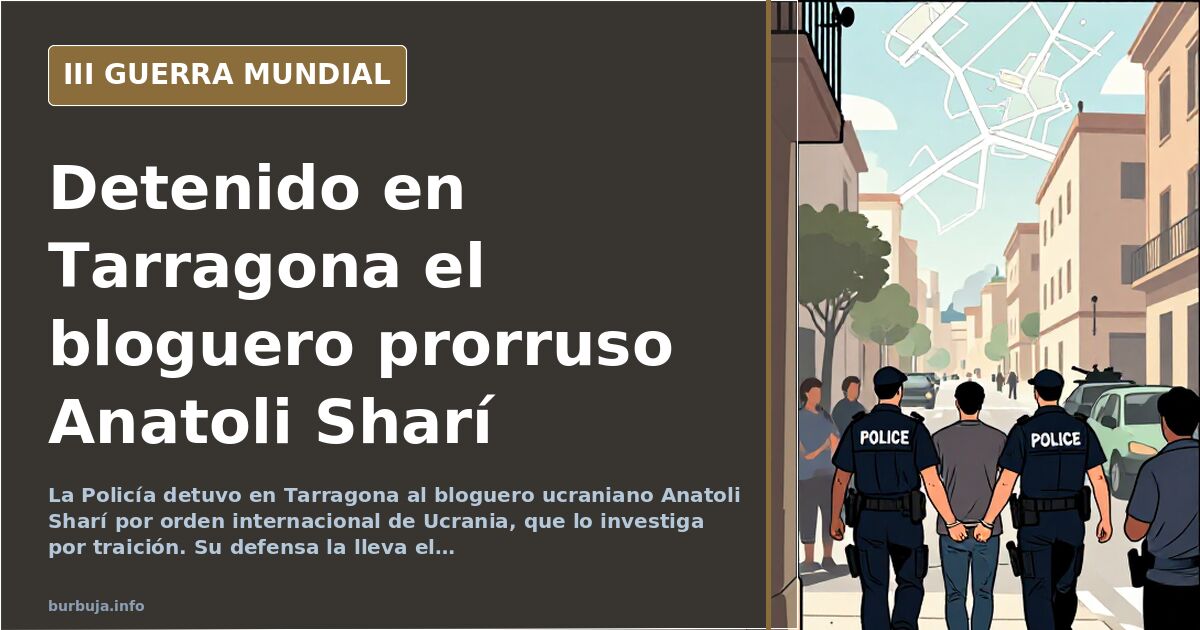
Spanish police arrested pro-Russian blogger Anatoli Shary in Tarragona on an international warrant from Ukraine, which accuses him of treason.
English · Original discussion in Spanish · Published
Pro-Russian Blogger Anatoli Shary Arrested in Spain
Can Spain arrest someone for what they write online at the request of a country at war? On May 4, 2022, the National Police arrested Ukrainian blogger Anatoli Shary in Tarragona based on an international warrant issued by Ukraine. He is being investigated for alleged treason and abusa of citizens' equality. The next day, he appeared before Judge José Luis Calama of the Audiencia Nacional (Spain's high court). His defense is led by Gonzalo Boye, the lawyer of former Catalan president Carles Puigdemont. The case sparked an uncomfortable debate: where is the line between prosecuting treason and prosecuting opinion?
Charges and Evidence
The Security Service of Ukraine (SBU) claims that Shary allegedly carried out illegal activities against Ukrainian national security in the information sphere and acted on behalf of foreign structures. According to the service's statement, the accusation relies on expert reports concluding that his interviews and speeches contain elements of subversive activity. He was declared a suspect the previous year.
This is the point that ignited controversy. Some argue that an expert report on the content of statements is too elastic a basis to support extradition: if the crime is what one says, the boundary with ideological persecution becomes blurred. On the other side lies the counter-argument: treason is defined in the Spanish Penal Code, and extradition requires double incivil, meaning the act must be a crime in both countries.
The Double Edge of Article 581
Article 581 of the Spanish Penal Code punishes any Spaniard who induces a foreign power to declare war on Spain. The wording is precise: it speaks of inducing a foreign power, not of inducing Spain to enter a conflict. This has fueled a strong argument: if applied consistently, those calling for a foreign country to bomb Spain would fit the definition better than a blogger criticizing Ukraine from Tarragona.
The core issue is different: if the crime is committed against Ukraine, which is at war, and not against Spain, is the existence of an equivalent figure in Spanish law enough to grant surrender? Technically, this opens a procedure that can stretch over years, involving defense, evidence, comparison of crimes, and treaties.
Puigdemont’s Lawyer and Catalan Connections
That Gonzalo Boye, the lawyer of the exiled former president, leads the defense is no minor detail. It adds a political layer to an already loaded case. Some read this connection as a network of shared interests between Catalan independence movements and Moscow, a thesis circulating for years without firm judicial proof. Others simply see a specialized lawyer handling difficult cases doing his job.
The Warning Behind the Case
The most repeated argument is not about Shary, but about the precedent. Some maintain that exceptions to legality approved during the pandemic under the guise of the common good left a dangerous trail, which is now expanding: first they arrest others, then the machinery comes for yours. The frog boils slowly and with applause. This warning comes from both sides of the conflict, according to those formulating it.
Current Status
As of this discussion, Shary had been placed under judicial control and the proceedings remained open. There is no ruling on extradition, no conviction, and no sentence. Any assertion of his guilt is, today, a hypothesis. The only certainties are the arrest, the international warrant, and the name of the investigating judge.
For a country at war to request another country to hand over a critic for what they said in interviews is a mechanism that exists, works, and needs no invention. It only requires that no one looks too closely.
Can Spain arrest someone for what they write online at the request of a country at war? On May 4, 2022, the National Police arrested Ukrainian blogger Anatoli Shary in Tarragona based on an international warrant issued by Ukraine. He is being investigated for alleged treason and abusa of citizens' equality. The next day, he appeared before Judge José Luis Calama of the Audiencia Nacional (Spain's high court). His defense is led by Gonzalo Boye, the lawyer of former Catalan president Carles Puigdemont. The case sparked an uncomfortable debate: where is the line between prosecuting treason and prosecuting opinion?
Charges and Evidence
The Security Service of Ukraine (SBU) claims that Shary allegedly carried out illegal activities against Ukrainian national security in the information sphere and acted on behalf of foreign structures. According to the service's statement, the accusation relies on expert reports concluding that his interviews and speeches contain elements of subversive activity. He was declared a suspect the previous year.
This is the point that ignited controversy. Some argue that an expert report on the content of statements is too elastic a basis to support extradition: if the crime is what one says, the boundary with ideological persecution becomes blurred. On the other side lies the counter-argument: treason is defined in the Spanish Penal Code, and extradition requires double incivil, meaning the act must be a crime in both countries.
The Double Edge of Article 581
Article 581 of the Spanish Penal Code punishes any Spaniard who induces a foreign power to declare war on Spain. The wording is precise: it speaks of inducing a foreign power, not of inducing Spain to enter a conflict. This has fueled a strong argument: if applied consistently, those calling for a foreign country to bomb Spain would fit the definition better than a blogger criticizing Ukraine from Tarragona.
The core issue is different: if the crime is committed against Ukraine, which is at war, and not against Spain, is the existence of an equivalent figure in Spanish law enough to grant surrender? Technically, this opens a procedure that can stretch over years, involving defense, evidence, comparison of crimes, and treaties.
Puigdemont’s Lawyer and Catalan Connections
That Gonzalo Boye, the lawyer of the exiled former president, leads the defense is no minor detail. It adds a political layer to an already loaded case. Some read this connection as a network of shared interests between Catalan independence movements and Moscow, a thesis circulating for years without firm judicial proof. Others simply see a specialized lawyer handling difficult cases doing his job.
The Warning Behind the Case
The most repeated argument is not about Shary, but about the precedent. Some maintain that exceptions to legality approved during the pandemic under the guise of the common good left a dangerous trail, which is now expanding: first they arrest others, then the machinery comes for yours. The frog boils slowly and with applause. This warning comes from both sides of the conflict, according to those formulating it.
Current Status
As of this discussion, Shary had been placed under judicial control and the proceedings remained open. There is no ruling on extradition, no conviction, and no sentence. Any assertion of his guilt is, today, a hypothesis. The only certainties are the arrest, the international warrant, and the name of the investigating judge.
For a country at war to request another country to hand over a critic for what they said in interviews is a mechanism that exists, works, and needs no invention. It only requires that no one looks too closely.
Summary of a discussion on Burbuja.info - Foro de economía, actualidad y política., translated from Spanish and reviewed before publication. Read the full discussion (162 replies).
More summaries
-
Spain's Belarra seeks ICC probe of Netanyahu over Gaza
Spanish minister accuses Israel of planned genocide in Gaza, demanding arms embargo and sanctions against Netanyahu.
-
Europe Faces Russian Gas Winter With No Backup Plan
Europe prepares for a winter without Russian gas: Italy, relying 40% on Moscow, faces shortages as Nord Stream 1 halts for 11 days.
-
Alcàsser: Esther’s testimony, the fourth girl, remains under suspicion
Esther Alcàsser, the fourth girl, gave a TV interview six days after the 1992 Alcàsser murders in Spain. Her account and timeline discrepancies fuel ongoing controversy.
-
Iran: Military Image vs. Reality
Five missile waves and minimal casualties challenge Iran's status as a true military power.
-
Forum debates execution of mercenary captured in Ukraine
A forum discusses the execution of a Baltic mercenary in Ukraine and his legal status under the Geneva Conventions.
-
AfD hits 22% but firewall blocks path to power
AfD reaches 22% in polls, overtaking SPD, yet other parties unite to prevent it from governing.