
Forum debates execution of mercenary captured in Ukraine
A forum discusses the execution of a Baltic mercenary in Ukraine and his legal status under the Geneva Conventions.
English · Original discussion in Spanish · Published
Forum debates execution of mercenary captured in Ukraine
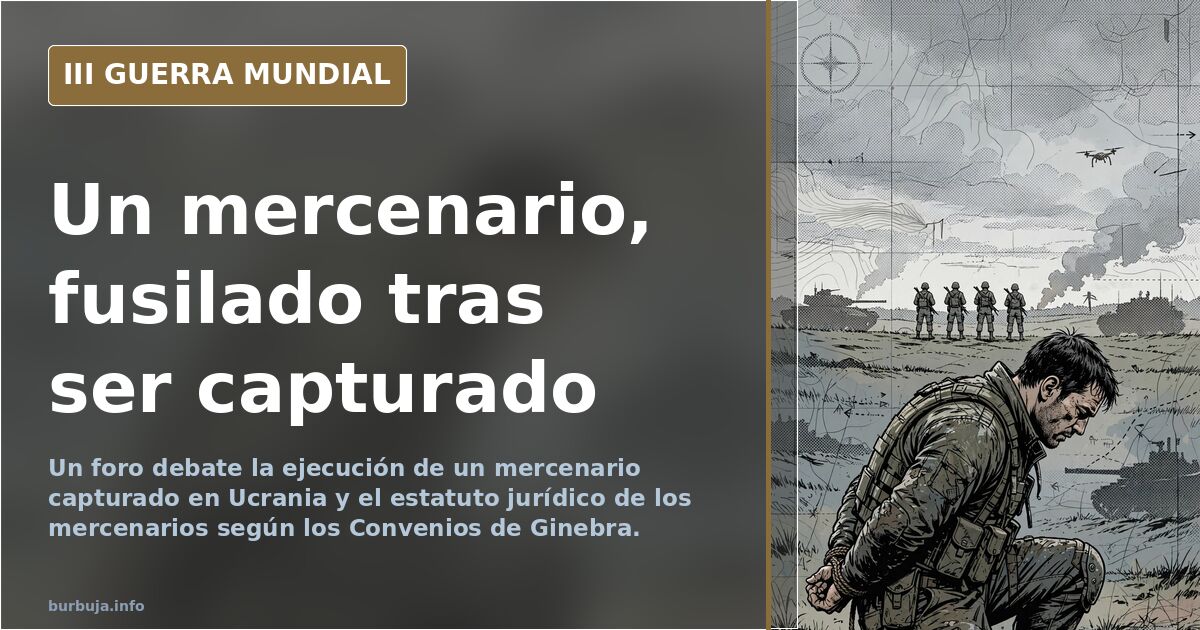
A forum thread has debated the execution of a foreign fighter after being captured by Russian soldiers. The incident, reportedly spread via video, reopens discussion on the legal status of mercenaries in a conflict Moscow still does not officially recognize as war. Several participants argue that the execution allows no nuance: an unarmed man in custody was shot without any court verifying his status.
The case has divided interpretations. One side argues that mercenaries fall outside the protection of the Geneva Conventions and their fate depends on the captor's benevolence. Others recall that Article 5 of the Third Convention requires treating any captive whose status has not been determined by a competent tribunal as a prisoner of war. That is the crux: no one proves such a tribunal existed.
What international law says about mercenaries
Article 47 of Additional Protocol I to the Geneva Conventions states that a mercenary shall not have the right to be a combatant or a prisoner of war. UN Resolution 44/34, in force since October 20, 2001, adds that anyone participating directly in hostilities as a mercenary commits an offense against the purposes of the Convention. On paper, the framework is categorical.
The problem lies in the details. That same text requires the mercenary status to be declared by a competent tribunal. Without prior verification, the captive retains the presumption of protected combatant status. The debate is not whether a mercenary deserves protection, but who decides they are one and how. Summary execution turns that doubt into irreversibility.
Video as a deterrent tool
The spread of the shooting has an obvious propagandistic reading. Several analyses agree that the target is not the executed person, but those considering enlisting. The message would be: here there is no exchange, no trial, no repatriation. Anyone going to kill for money in a country that is not theirs stays on the way.
That logic coexists with another more uncomfortable one. If the video deters, it works; if interpreted as a war crime, it damages whoever displays it. The same image serves two opposing narratives, and neither needs additional proof to sustain itself.
Who goes to someone else's war and why
The profile of foreign fighters in Ukraine is not uniform. Some arrive out of ideological conviction, some seek adrenaline, and others are paid. Confusion between these categories is what allows treating everyone as mercenaries. Pay, contract, and chain of command are the criteria separating one figure from another, and rarely verified before a court.
Historical comparison appears immediately. International brigades, Italian volunteers, or the Condor Legion fought in Spain for motives that were not always economic. The legal difference between volunteer and mercenary exists, but on the battlefield it blurs until it disappears.
The legal gap no one wants to close
Russia does not officially recognize the conflict as war, but as a special military operation. That label complicates determining which international law applies. If there is no declared war, which Convention governs the treatment of captives? The question remains unanswered officially, and each side resolves it as convenient.
Meanwhile, the execution of unarmed prisoners remains the point no legal interpretation can justify. Humanitarian law admits gray areas, but does not cover shooting without prior trial. The debate over mercenary status does not erase that red line.
The practical consequence is simple: whoever fights for money in an unrelated conflict assumes a risk that no Convention fully covers. The most reasonable prediction, with reservations, is that these cases will repeat and each will be read according to the side spreading it.
A forum thread has debated the execution of a foreign fighter after being captured by Russian soldiers. The incident, reportedly spread via video, reopens discussion on the legal status of mercenaries in a conflict Moscow still does not officially recognize as war. Several participants argue that the execution allows no nuance: an unarmed man in custody was shot without any court verifying his status.
The case has divided interpretations. One side argues that mercenaries fall outside the protection of the Geneva Conventions and their fate depends on the captor's benevolence. Others recall that Article 5 of the Third Convention requires treating any captive whose status has not been determined by a competent tribunal as a prisoner of war. That is the crux: no one proves such a tribunal existed.
What international law says about mercenaries
Article 47 of Additional Protocol I to the Geneva Conventions states that a mercenary shall not have the right to be a combatant or a prisoner of war. UN Resolution 44/34, in force since October 20, 2001, adds that anyone participating directly in hostilities as a mercenary commits an offense against the purposes of the Convention. On paper, the framework is categorical.
The problem lies in the details. That same text requires the mercenary status to be declared by a competent tribunal. Without prior verification, the captive retains the presumption of protected combatant status. The debate is not whether a mercenary deserves protection, but who decides they are one and how. Summary execution turns that doubt into irreversibility.
Video as a deterrent tool
The spread of the shooting has an obvious propagandistic reading. Several analyses agree that the target is not the executed person, but those considering enlisting. The message would be: here there is no exchange, no trial, no repatriation. Anyone going to kill for money in a country that is not theirs stays on the way.
That logic coexists with another more uncomfortable one. If the video deters, it works; if interpreted as a war crime, it damages whoever displays it. The same image serves two opposing narratives, and neither needs additional proof to sustain itself.
Who goes to someone else's war and why
The profile of foreign fighters in Ukraine is not uniform. Some arrive out of ideological conviction, some seek adrenaline, and others are paid. Confusion between these categories is what allows treating everyone as mercenaries. Pay, contract, and chain of command are the criteria separating one figure from another, and rarely verified before a court.
Historical comparison appears immediately. International brigades, Italian volunteers, or the Condor Legion fought in Spain for motives that were not always economic. The legal difference between volunteer and mercenary exists, but on the battlefield it blurs until it disappears.
The legal gap no one wants to close
Russia does not officially recognize the conflict as war, but as a special military operation. That label complicates determining which international law applies. If there is no declared war, which Convention governs the treatment of captives? The question remains unanswered officially, and each side resolves it as convenient.
Meanwhile, the execution of unarmed prisoners remains the point no legal interpretation can justify. Humanitarian law admits gray areas, but does not cover shooting without prior trial. The debate over mercenary status does not erase that red line.
The practical consequence is simple: whoever fights for money in an unrelated conflict assumes a risk that no Convention fully covers. The most reasonable prediction, with reservations, is that these cases will repeat and each will be read according to the side spreading it.
Summary of a discussion on Burbuja.info - Foro de economía, actualidad y política., translated from Spanish and reviewed before publication. Read the full discussion (153 replies).
More summaries
-
Russia Claims 180 Mercenaries Killed in Yaroviv Attack, Questioning POW Status
Russia reports eliminating 180 foreign mercenaries in Yaroviv. The attack raises questions about their status under the Geneva Convention, with Moscow suggesting they may not qualify as prisoners of war.
-
Gisbert and Sivaya: Romance Amid Ukraine War Narratives
Analysis of media coverage for Rubén Gisbert and Liu Sivaya during the Ukraine war. Is this digital propaganda or reality?
-
Spain vs. Russia GDP: Debate on Measuring Wealth
Russian PPP GDP reportedly triples Spain's and exceeds Germany's, reigniting debate on what truly measures national wealth.
-
Syria land claims reignite historical vs. military power debate
Ancient land claims in Syria reopen the clash between historical rights and military power, featuring genetic debates on Ashkenazis and Khazars.
-
Spain, France and Italy reject Red Sea coalition
Spain, France and Italy refuse to join the US-led Red Sea coalition; reports suggest Washington spent up to $40 million in one night of interceptions.
-
Ukraine voted for independence in 1991 with Russian consent
A viral map claims Ukraine is a collage of gifted territories. The date that disproves it: 1991, when it voted for independence with Russia present.