
Private Label: Savings No Longer Just for the Poor
In Spain, private label wins on price but not prestige. Frozen wages and food inflation drive households to choose cheaper options.
English · Original discussion in Spanish · Published
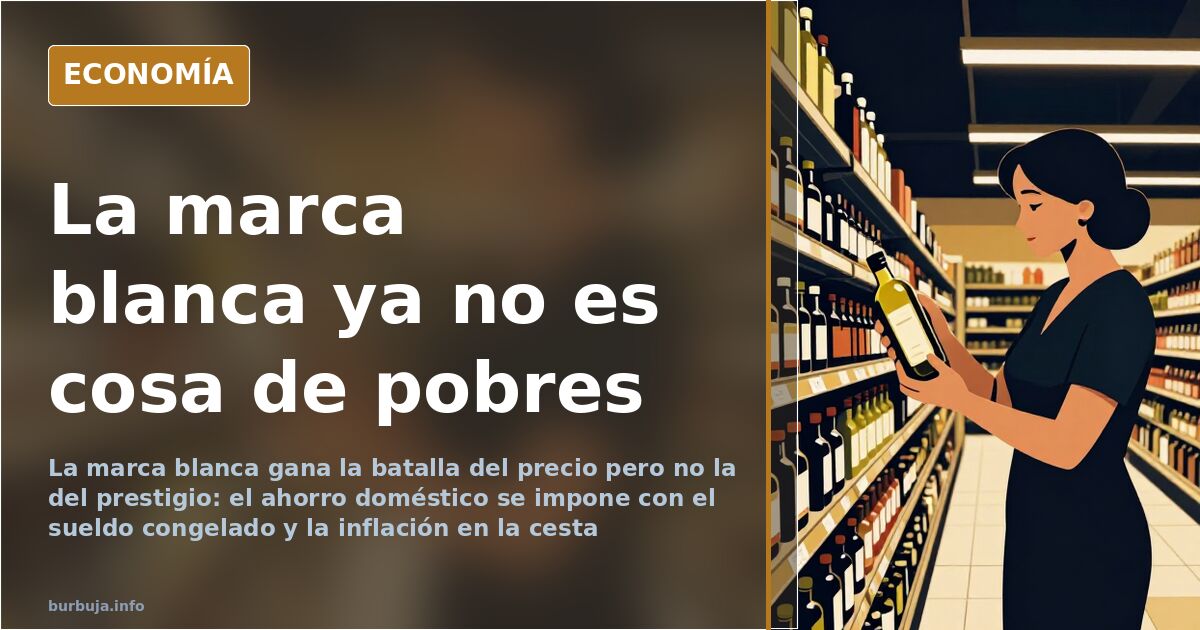
Private labels are no longer just for the poor: the savings nobody admits
Buying the entire shopping basket with private labels has stopped being a source of shame and become a matter of household management. The initial premise was simple: at home, we always buy private labels because quality and taste are similar at a lower price, with few exceptions like Coca-Cola. The majority response came quickly: no, you are not alone. What started as a personal doubt turned into a collective inventory of which products justify the premium and which do not.
The core issue is economic, not gastronomic. With frozen salaries, rising food costs, tax pressure, and relentless inflation, private labels shifted from an emergency option to a survival strategy. "Until three years ago I didn't know what buying a private label meant; now it's all private label. It's called loss of purchasing power," summarizes one comment that captures the general mood. The basket isn't getting cheaper by choice; it's getting cheaper because the margin has disappeared.
Are private labels as good as branded products?
The short answer is it depends on the product, and the long answer is that most often the difference doesn't justify the price. There is consensus that chains like Mercadona succeed thanks to their own brands: the few national brands left on shelves are more expensive than competitors'. Some go further: "in many cases, buying the original brand is foolish."
The underlying argument is that many private labels are manufactured by high-quality companies producing for retailers according to their specifications. "We all know private labels are packaged by branded companies," argues one participant, adding that those who don't know this are naive. The logical consequence is that the price difference pays for advertising, not ingredients.
The exception almost everyone agrees on is Coca-Cola. There, the taste really shows, even savings advocates admit. But outside that case, the list of products where private labels win is long: milk, beer, yogurts, ice cream, turrón (Spanish nougat), cleaning and hygiene products. A repeated example: paying two euros for a private label mouthwash instead of six for the branded one, with practically identical results.
The counterattack: quality comes at a price
Not everyone sees it that way. The critical stance holds that the cheapest product on the shelf is usually lower quality, masked by additives that make it tastier. The warning comes with a prognosis: digestive issues for those who buy everything in private labels. This is the harsh version of the argument, without nuances.
There is a finer, harder-to-refute criticism: there isn't just one private label, there are many. Each chain has its own, backed by different suppliers. Of twenty private labels, this school of thought argues, only one or two surpass the branded product, and not in every store. The practical conclusion is that you have to test product by product, and generalizing is a mistake.
Also appearing is the argument that savings are no longer real. "Private labels now cost double what branded products cost recently," notes one comment. Inflation doesn't distinguish between shelves: it has pushed up prices of own-brand items too, narrowing the savings cushion.
Fresh vs. Packaged: the real divide
Underneath the debate of brand yes or no lies another more interesting discussion: those who buy neither brand nor private label, but fresh produce. Meat, fish, eggs, fruit, and vegetables. Their thesis is that the problem isn't the label, but processing, and packaging is toxic regardless of the package tonalidad.
The rebuttal uses market data: most fish sold as fresh arrives frozen, fruit and vegetables come processed from origin, and meats are raised with antibiotics. Eating fresh, in this reading, isn't a sarracena superior category, just a different habit. The discussion shifts to product origin rather than price.
The most common middle ground is the mixed basket: fresh for cooking, private labels for packaged goods, and one or two specific brands that aren't negotiable. Savings lie not in doctrine, but in the shopping list.
The stigma of buying cheap
A social layer emerges. Many feel ashamed shopping at discount supermarkets, especially if seen with private labels. In this view, inferiority complex weighs more than the label. Brand choice isn't consumption: it's a status declaration.
Irony pervades the topic. "Buying private labels is for poor people," someone says, functioning as a caricature of what others truly think. Another adds nostalgia for another era: in the eighties there were no private labels, parents bought everything branded, had a house and car, and only one worked at home. This isn't economic data, it's generational.
The uncomfortable conclusion stands: private labels won the price battle, but not the prestige war. As long as salaries don't keep up, baskets will continue filling with discreet packages.
With these differences, private label shopping should be nearly universal. It isn't. Some still pay triple for the same mouthwash, and likely will continue to.
Also available in: Deutsch
Summary of a discussion on Burbuja.info - Foro de economía, actualidad y política., translated from Spanish and reviewed before publication. Read the full discussion (139 replies).
More summaries
-
Why store brands sell out while name brands sit on the shelf
Store brands are selling out in supermarkets while leading brands pile up. Inflation, wages and retail strategies: the data from Promarca.
-
Spain food industry cuts 1,300 jobs amid private label rise
Private labels hit 50% market share in Spain, forcing Coca-Cola, Pepsi and Danone to cut 1,300 jobs.
-
Monthly Groceries for Two Hit €400: Even Store Brands Aren't Saving Shoppers Anymore
Two people spend €400 monthly on basic groceries, with a single shop costing €130. Rising prices for oil and beer are notable.
-
Depression and precarity: The wall attitude cannot break
A forum user argues depression arises when expectations clash with reality; others respond that positive attitude is not enough.
-
Spain's Right Is Stuck: Feijóo and Abascal Still Don't Know What to Do About Sánchez
Spain's right has spent years announcing Sánchez's downfall without ever delivering it. Feijóo can't get going and Abascal won't negotiate: the problem, they say, is not the rival but the alternative.
-
Spain's job market is shutting out young men
Employment is growing and benefiting women and migrants, but young Spanish-born men are being left behind. Fierce competition, falling wages and a career ceiling at 40.