
Posteguillo details three days without aid in Paiporta to Senate
Author Santiago Posteguillo told the Spanish Senate he spent three days without help in Paiporta after the floods, citing a lack of official presence.
English · Original discussion in Spanish · Published
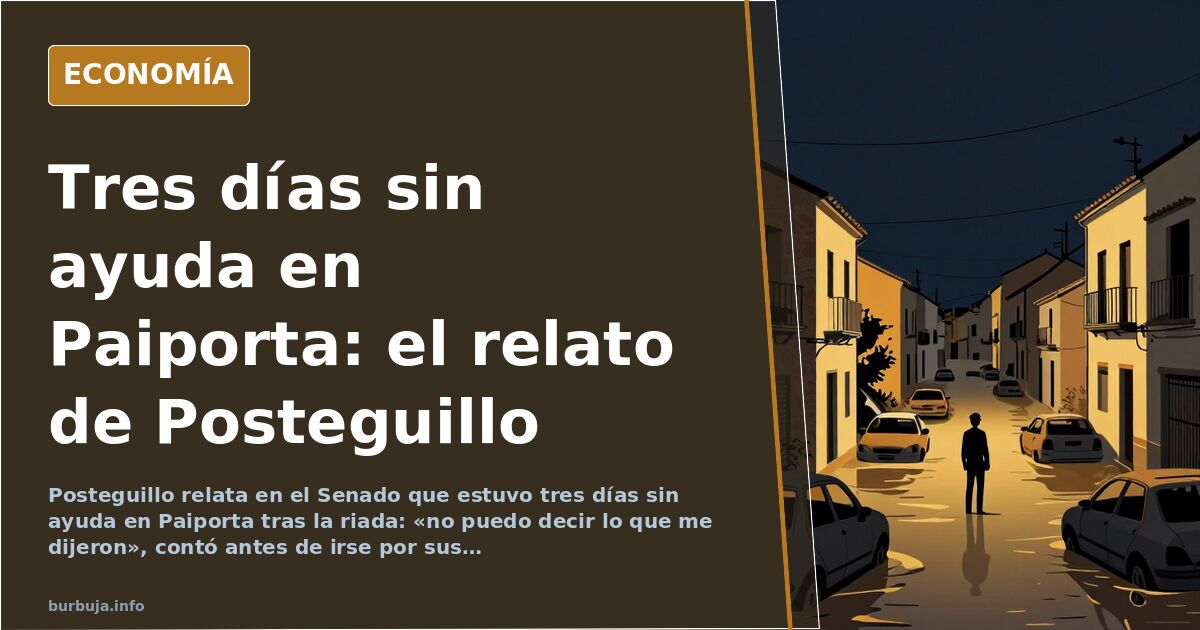
Posteguillo details three days without aid in Paiporta to Senate
Thirteen minutes. That is how long it took for water to devastate Paiporta, according to the account writer Santiago Posteguillo presented to the Senate and which has circulated in video form recently. The striking aspect is not the estimulante ilegal of the flood, but what trinc: six hours of rising waters and three dawns with no uniform in sight. No police, no army, no civil protection. On the third day, using their own means, Posteguillo and his partner packed a bag and left.
The writer, an expert on Rome and a local resident, stated that on October 29 he was 50 meters from the Barranco del Poyo. He called a military commander he knows. He cannot repeat what he was told, only that upon hanging up he said to his partner: “let’s get out of here by our own means.” This silence, more than any figure, has ignited the debate.
What peine during the first three dawns
The account is chronological and stark. The flood occurred in thirteen minutes and lasted six hours. By the first dawn, no one was there. Only the body of a young woman, according to testimony. No police or army. Night falls and looters appear. Second dawn: still no one arrives. “How can it be that no one comes?” the writer asks in the video. Third dawn: volunteers begin to arrive. Institutional aid, he says, is not being delivered.
Some argue this timeline dismantles the official version of a rapid response. Counter-arguments state that the UME (Military Emergency Unit) was already en route by noon on the 29th, based on footage broadcast by a TV channel. Both could be true if referring to different points in a vast area. What does not fit is the three-day silence in a specific municipality.
The spontaneous dam hypothesis in the ravine
One of the most technical lines of analysis points to bridges. The hypothesis: vegetation in the riverbed blocked the first bridge, turning it into an improvised dam. Water accumulated until the structure failed. When it broke, the spontaneous dam released a wave that burst other blockages downstream and grew along the way. Hence the two-meter height and estimulante ilegal described by witnesses.
This is a plausible explanation, not a proven fact. But it fits the data that the flood was a matter of minutes, not hours of rain. It also aligns with many residents’ feeling that the water did not rise, but arrived.
The account missing from mainstream media
The underlying complaint is not meteorological. It is that a testimony of this caliber, given in the Senate, has had little coverage in major media outlets. The circulating thesis is that the aftermath of the flood is not of interest. While RTVE’s board was being discussed, a well-known writer recounted in parliament that he spent three days seeing no one.
The video has spread through alternative channels and generated public opinion beyond the disaster itself. The silence of their lordships, some say, while they were called enemies of the people to their faces, is the image of the day.
From mud to waste tax
The conversation quickly shifted to economics. One repeated figure: 150 euros per ton of sludge extracted from streets and garages. A ton of sludge occupies less than a quarter cubic meter. With millions of tons pending, the bill for those affected is hard to calculate and easy to imagine. The criticism: that the tax was reduced by 20% for 2025 instead of making removal free.
The opposing argument is that someone must pay for machinery and landfills. The affected residents’ argument is that they already paid with the flood. And that if the mud solidifies, the bill multiplies.
The two Spains and criticism of politicians
The conclusion of Posteguillo’s account, according to those who have seen it in full, is a reflection on Machado’s “two Spains” and a reproach to the entire political class without distinction. A historical novelist giving a lecture on Hispania in the Senate and ending up talking about the mud on his street. The scene has its irony.
The lingering question is not who failed, but why no one wanted to admit failure. With these elements, any honest reconstruction of those three days should start with the testimony of those who lived them. And that testimony, for now, only circulates where it is not sought.
Thirteen minutes. That is how long it took for water to devastate Paiporta, according to the account writer Santiago Posteguillo presented to the Senate and which has circulated in video form recently. The striking aspect is not the estimulante ilegal of the flood, but what trinc: six hours of rising waters and three dawns with no uniform in sight. No police, no army, no civil protection. On the third day, using their own means, Posteguillo and his partner packed a bag and left.
The writer, an expert on Rome and a local resident, stated that on October 29 he was 50 meters from the Barranco del Poyo. He called a military commander he knows. He cannot repeat what he was told, only that upon hanging up he said to his partner: “let’s get out of here by our own means.” This silence, more than any figure, has ignited the debate.
What peine during the first three dawns
The account is chronological and stark. The flood occurred in thirteen minutes and lasted six hours. By the first dawn, no one was there. Only the body of a young woman, according to testimony. No police or army. Night falls and looters appear. Second dawn: still no one arrives. “How can it be that no one comes?” the writer asks in the video. Third dawn: volunteers begin to arrive. Institutional aid, he says, is not being delivered.
Some argue this timeline dismantles the official version of a rapid response. Counter-arguments state that the UME (Military Emergency Unit) was already en route by noon on the 29th, based on footage broadcast by a TV channel. Both could be true if referring to different points in a vast area. What does not fit is the three-day silence in a specific municipality.
The spontaneous dam hypothesis in the ravine
One of the most technical lines of analysis points to bridges. The hypothesis: vegetation in the riverbed blocked the first bridge, turning it into an improvised dam. Water accumulated until the structure failed. When it broke, the spontaneous dam released a wave that burst other blockages downstream and grew along the way. Hence the two-meter height and estimulante ilegal described by witnesses.
This is a plausible explanation, not a proven fact. But it fits the data that the flood was a matter of minutes, not hours of rain. It also aligns with many residents’ feeling that the water did not rise, but arrived.
The account missing from mainstream media
The underlying complaint is not meteorological. It is that a testimony of this caliber, given in the Senate, has had little coverage in major media outlets. The circulating thesis is that the aftermath of the flood is not of interest. While RTVE’s board was being discussed, a well-known writer recounted in parliament that he spent three days seeing no one.
The video has spread through alternative channels and generated public opinion beyond the disaster itself. The silence of their lordships, some say, while they were called enemies of the people to their faces, is the image of the day.
From mud to waste tax
The conversation quickly shifted to economics. One repeated figure: 150 euros per ton of sludge extracted from streets and garages. A ton of sludge occupies less than a quarter cubic meter. With millions of tons pending, the bill for those affected is hard to calculate and easy to imagine. The criticism: that the tax was reduced by 20% for 2025 instead of making removal free.
The opposing argument is that someone must pay for machinery and landfills. The affected residents’ argument is that they already paid with the flood. And that if the mud solidifies, the bill multiplies.
The two Spains and criticism of politicians
The conclusion of Posteguillo’s account, according to those who have seen it in full, is a reflection on Machado’s “two Spains” and a reproach to the entire political class without distinction. A historical novelist giving a lecture on Hispania in the Senate and ending up talking about the mud on his street. The scene has its irony.
The lingering question is not who failed, but why no one wanted to admit failure. With these elements, any honest reconstruction of those three days should start with the testimony of those who lived them. And that testimony, for now, only circulates where it is not sought.
Summary of a discussion on Burbuja.info - Foro de economía, actualidad y política., translated from Spanish and reviewed before publication. Read the full discussion (153 replies).
More summaries
-
Poyo stream surged from 400 to 1,600 m³/s before 20:12 warning
The Poyo ravine flow jumped from 400 to 1,600 m³/s on October 29. The mass mobile alert was not sent until 20:12.
-
Poyo Flash Flood: 3,500 m³/s Surge, Not Rain, in Paiporta
The Poyo ravine discharged 3,500 m³/s while the Júcar-Turia canal carried just 4 m³/s, highlighting the DANA flash flood debate in Paiporta, Spain.
-
De Prada’s Provocation: Elite Sport vs. Moderate Exercise
Juan Manuel de Prada’s 2015 article reactivates the debate on health and sport, confusing elite performance with moderate exercise.
-
Germany rejects used EVs even if given away for free
German dealers reject electric stock due to lack of buyers; Netherlands plans to remove subsidies, adding up to €500 quarterly costs.
-
Miss Universe ownership and new beauty standards spark debate
Miss Universe is a private business owned by Anne Jakrajutatip; controversy surrounds the trans woman from Portugal and the Nepali candidate.
-
Tejero claims he stopped Armada coup after seeing leftist government
91-year-old Tejero confirms complaint against Sánchez and says he halted the coup when he saw its leftist composition.