
Poyo stream surged from 400 to 1,600 m³/s before 20:12 warning
The Poyo ravine flow jumped from 400 to 1,600 m³/s on October 29. The mass mobile alert was not sent until 20:12.
English · Original discussion in Spanish · Published
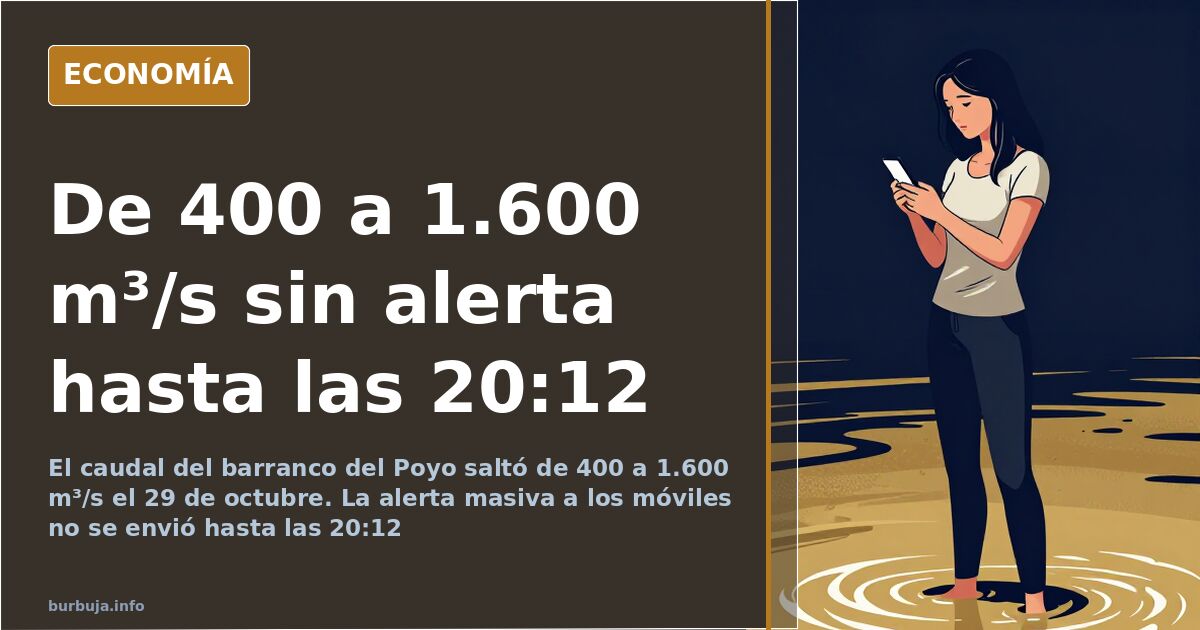
Poyo Ravine: from 400 to 1,600 m³/s with no warning until 20:12
On October 29, the Poyo ravine quadrupled its flow in just one hour. At 17:00, it recorded nearly 400 cubic meters per second; by 18:00, it reached 1,600. Sensors automatically transmitted these figures to the Júcar Hydrographic Confederation. The mass mobile alert was not issued until 20:12. The time between these two moments determined much of what trinc, and responsibility remains disputed.
The flow known two and a half hours before the alert
The more than 200-page Guardia Civil report focuses on the Júcar Hydrographic Confederation. According to this document, between 16:13 and 18:43, no warning was issued about the increased flow in the Poyo ravine, the epicenter of the Valencia flood. By morning, the channel had already exceeded 200 cubic meters per second. To gauge the magnitude: 1,600 m³/s is the highest historical flow recorded for the Ebro River passing through Zaragoza. The same figure, but within a ravine.
The automatic SAIH systems transmit data continuously: no one needs to watch a screen for the data to exist. The uncomfortable question is different: who was looking at that screen that afternoon?
Why did the Es-alert system not activate until 20:12?
Because the decision was made in a meeting that started after 18:00, when water was already flowing through the streets. The president of the Júcar Hydrographic Confederation, Miguel Polo, then proposed activating the Es-alert system at the Integrated Operational Coordination Center. Hours later, he testified before the judge that he knew the Poyo flow and failed to warn; a technician entered the room to inform him that it had reached 1,600 m³/s.
The Spanish AEMET is accused of downplaying the event. The French Météo-France, however, had predicted 400 liters per square meter and "mortal risk" for Valencia. This asymmetry between two neighboring services fuels one of the most uncomfortable lines of inquiry in the case.
The new Turia riverbed and the Forata dam are not the same
The new Turia riverbed, that functional yet unappealing engineering work built after the great flood of 1957, appears in the analysis as the reason the outcome was not worse. Diverting the channel prevented water from entering the city where it did nearly seven decades ago. It is the type of infrastructure that does not appear in photos and is missed when it is absent.
It is important not to confuse fronts. The Forata dam has nothing to do with the Poyo: they are different catchment areas. Confusing them distorts any serious discussion about what failed.
Cleaning mountains and gabion walls: what forest hydrology supports
Every time Spain floods, the same mantra reappears: clean the mountains. The technical response distinguishes two things. First, living vegetation: if removed and the mountain is left bare, less water filters in and runs faster. Second, debris —branches, trunks, sediments— that clog bridges, weirs, and gabion walls, and can dampen the flood peak. Forest hydrology works on this second aspect.
The limit of this argument is also pointed out: it does not matter how much is cleared if the channel ends up silted with sediments and the water overflows anyway. The debate remains unresolved.
The climate narrative and the narrative of hidden powers
Amid the noise, part of the analysis suggests that the two most repeated explanations are false. It is not all reducible to an episode attributable to man-made climate change, nor is the flood due to supposed powers manipulating the weather using HAARP-like systems. The latter has no evidence supporting it.
On the ground, a testimony collected in the Chiva mountains points to a little-discussed factor: the cloud dumped rain on the same spot for over twenty hours despite the gale. Meteorology also has its share of bad luck regarding where it insists.
The open judicial fronts
The Public Prosecutor’s Office asked the DANA judge to investigate the Government delegate, the Júcar Confederation, and the AEMET. It did so in writing and, de facto, against the initial criteria of the magistrate, who from day one was reluctant to delve into the Government’s actions. Hydrographic confederations depend on the Ministry for Ecological Transition. The letter opens the door to determining who knew what and when.
Also under discussion is the audio released of firefighters who withdrew from the Poyo ravine: "The water has gone. Retreat." An instruction difficult to reconcile with what trinc.
No one disputes that the data existed and reached those who should have seen it. What remains unanswered is what does not fit in an organizational chart: who was looking at that screen that afternoon.
On October 29, the Poyo ravine quadrupled its flow in just one hour. At 17:00, it recorded nearly 400 cubic meters per second; by 18:00, it reached 1,600. Sensors automatically transmitted these figures to the Júcar Hydrographic Confederation. The mass mobile alert was not issued until 20:12. The time between these two moments determined much of what trinc, and responsibility remains disputed.
The flow known two and a half hours before the alert
The more than 200-page Guardia Civil report focuses on the Júcar Hydrographic Confederation. According to this document, between 16:13 and 18:43, no warning was issued about the increased flow in the Poyo ravine, the epicenter of the Valencia flood. By morning, the channel had already exceeded 200 cubic meters per second. To gauge the magnitude: 1,600 m³/s is the highest historical flow recorded for the Ebro River passing through Zaragoza. The same figure, but within a ravine.
The automatic SAIH systems transmit data continuously: no one needs to watch a screen for the data to exist. The uncomfortable question is different: who was looking at that screen that afternoon?
Why did the Es-alert system not activate until 20:12?
Because the decision was made in a meeting that started after 18:00, when water was already flowing through the streets. The president of the Júcar Hydrographic Confederation, Miguel Polo, then proposed activating the Es-alert system at the Integrated Operational Coordination Center. Hours later, he testified before the judge that he knew the Poyo flow and failed to warn; a technician entered the room to inform him that it had reached 1,600 m³/s.
The Spanish AEMET is accused of downplaying the event. The French Météo-France, however, had predicted 400 liters per square meter and "mortal risk" for Valencia. This asymmetry between two neighboring services fuels one of the most uncomfortable lines of inquiry in the case.
The new Turia riverbed and the Forata dam are not the same
The new Turia riverbed, that functional yet unappealing engineering work built after the great flood of 1957, appears in the analysis as the reason the outcome was not worse. Diverting the channel prevented water from entering the city where it did nearly seven decades ago. It is the type of infrastructure that does not appear in photos and is missed when it is absent.
It is important not to confuse fronts. The Forata dam has nothing to do with the Poyo: they are different catchment areas. Confusing them distorts any serious discussion about what failed.
Cleaning mountains and gabion walls: what forest hydrology supports
Every time Spain floods, the same mantra reappears: clean the mountains. The technical response distinguishes two things. First, living vegetation: if removed and the mountain is left bare, less water filters in and runs faster. Second, debris —branches, trunks, sediments— that clog bridges, weirs, and gabion walls, and can dampen the flood peak. Forest hydrology works on this second aspect.
The limit of this argument is also pointed out: it does not matter how much is cleared if the channel ends up silted with sediments and the water overflows anyway. The debate remains unresolved.
The climate narrative and the narrative of hidden powers
Amid the noise, part of the analysis suggests that the two most repeated explanations are false. It is not all reducible to an episode attributable to man-made climate change, nor is the flood due to supposed powers manipulating the weather using HAARP-like systems. The latter has no evidence supporting it.
On the ground, a testimony collected in the Chiva mountains points to a little-discussed factor: the cloud dumped rain on the same spot for over twenty hours despite the gale. Meteorology also has its share of bad luck regarding where it insists.
The open judicial fronts
The Public Prosecutor’s Office asked the DANA judge to investigate the Government delegate, the Júcar Confederation, and the AEMET. It did so in writing and, de facto, against the initial criteria of the magistrate, who from day one was reluctant to delve into the Government’s actions. Hydrographic confederations depend on the Ministry for Ecological Transition. The letter opens the door to determining who knew what and when.
Also under discussion is the audio released of firefighters who withdrew from the Poyo ravine: "The water has gone. Retreat." An instruction difficult to reconcile with what trinc.
No one disputes that the data existed and reached those who should have seen it. What remains unanswered is what does not fit in an organizational chart: who was looking at that screen that afternoon.
Summary of a discussion on Burbuja.info - Foro de economía, actualidad y política., translated from Spanish and reviewed before publication. Read the full discussion (334 replies).
More summaries
-
Jucar River Authority Insured Staff for Negligence Before DANA
The Jucar River Authority formalized civil liability insurance for 212 employees on October 7, weeks before the DANA floods devastated parts of Spain.
-
Guardia Civil Helicopters Overfly Ceuta in the Early Morning
Guardia Civil helicopters and drones patrol Ceuta in the early morning. Flight tracking suggests a deployment without an official statement.
-
The Double Standard of Singlehood: Why Men Get Labeled, Women Do Not
An analysis of the double standard in single life: why men are labeled while women face no such stigma, despite similar data.
-
Alvise Blocks Public Funding for Bullfights, Citing Animal Morality
EU MP Alvise Perez rejects public subsidies for bullfighting, equating the practice with ritual animal slaughter and sparking political debate.
-
Overtourism in Museums: Phones Before Art
Crowded museums prioritize selfies and loud audioguides over the artwork, displacing visitors seeking a genuine cultural experience.
-
Five of Nine Absent on Electoral Board, No Criminal Case Follows
An electoral board in Spain had five of nine members absent. The Civil Guard collected data, raising questions about whether a criminal penalty is ever enforced.