
Pope calls for global ban on surrogacy, sparking debate
The Pope urges the criminalization of surrogacy. The controversy: costs reach €120,000 in the US, while critics view the measure as an attack on men.
English · Original discussion in Spanish · Published
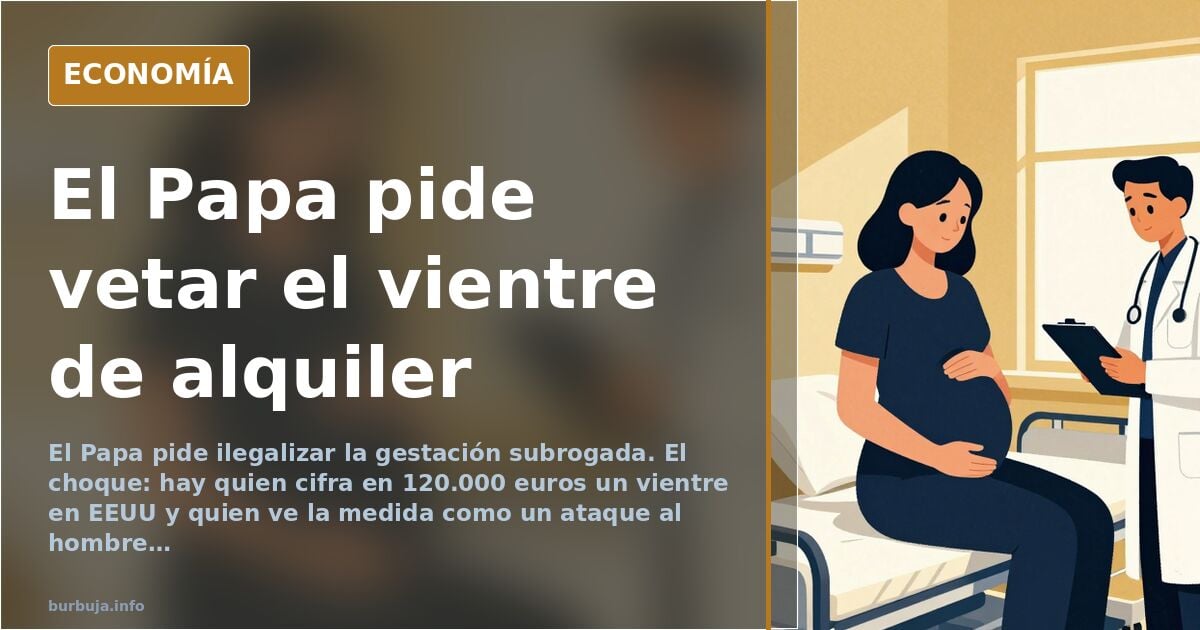
Pope demands ban on surrogacy, igniting conflict
The Pope's call to prohibit surrogate mothers has echoed through every corner of public debate. Reported by Europa Press, the proposal aligns the Pontiff with much of institutional feminism: both camps seek to outlaw surrogacy, albeit for entirely different reasons. This convergence unsettles allies and opponents alike.
The clash erupts when asking who wins and loses from a ban. Some see a market where economic necessity turns into commodity. Others view it as a mechanism allowing men biological fatherhood without marriage, alimony, or divorce. In the middle stands a baby whose existence is undisputed, yet each side places them differently on the scale.
What exactly does the Vatican propose?
The request is clear: illegalize surrogacy worldwide. The Pontiff frames it within defending women's and children's dignity, immediately read as an attack on paying women to carry another's child. Europa Press reports the statement without nuance.
The issue is that this same banner is waved by sectors sharing no other cause with Rome. Here lies the knot: the ban unites those protecting babies, those protecting gestational carriers, and those simply wanting to close escape routes for men. Three motives, one result.
The economic argument no one wants written down
The debate's most uncomfortable point isn't sarracena, but accounting. A surrogate mother costs around €120,000 in the United States, according to industry figures. Not everyone can afford that. Those who pay skip adoption lists, waiting periods, and interviews.
The most repeated criticism notes the market relies on the carrier's economic need. A woman with paid-off mortgage doesn't rent her uterus for €40,000. Those who do are often drowning in debt. This, they argue, makes consent a signature under pressure.
Opposing this: if banned, business doesn't disappear, it relocates. Wealthy couples will still go to California or Ukraine. Poorer ones are excluded. Prohibition doesn't eliminate practice, only reserves it for the rich.
Feminism splits in two
Here consensus breaks. One part of feminism demands banning surrogacy because, they claim, it turns women's bodies into factories. Another defends the opposite: if women control their bodies, they also control renting them. The contradiction is textbook, unresolved.
The clash worsens comparing practices. Anonymous donor artificial insemination receives little reproach. Abortion is defended as a right. Surrogacy, however, is incivil. Those pointing out inconsistency hear the same reply: it's not the same.
Single fathers and unpaid alimony
An angle few want to face directly. Surrogacy lets men have biological children without negotiating custody, home, and support with ex-partners. In Spain, average divorce leaves fathers paying quotas that often support mothers rather than children.
Defenders state plainly: it's the only way to be a father without women controlling upbringing. Attackers respond that's not a right, but convenience. Deep down lies unanswered question: why does State protect mothers more than fathers?
Adoption: the other unaudited market
Comparison with adoption appears repeatedly. If paying for gestation is banned, why allow paying for adoption? International procedures cost tens of thousands, never called trafficking. Asymmetry is evident.
Official response claims adoption doesn't buy children, just covers expenses. Same argument used by surrogacy defenders: paying for time, not baby. Two practices, identical reasoning, opposite legal treatments.
Vatican's ban solves nothing, only orders board. Rich will still go to California. Poor carriers will still birth for money. And baby, supposedly protected, will still be born where contracts permit. Unanswered question: what happens when contract is signed and mother changes mind?
Also available in: Deutsch
Summary of a discussion on Burbuja.info - Foro de economía, actualidad y política., translated from Spanish and reviewed before publication. Read the full discussion (109 replies).
More summaries
-
US Army Sent Sick Troops to Europe in 1918
Wilson kept troop ships sailing despite onboard flu outbreaks. The biological weapon theory lacks evidence.
-
Surrogacy costs: $40,000 in the US, €3,000 in Seville
Debate highlights surrogacy costs: $40,000 in the US, around €3,000 in Seville, and just 150 legal cases in the UK.
-
Italy criminalizes surrogacy abroad, risking prison for parents
Italy makes international surrogacy a crime. Critics argue it punishes men seeking fatherhood while protecting women.
-
Spanish Lawyer Begoña Gerpe Moves to Andorra After Hate Speech Complaint
Begoña Gerpe relocates her tax residence to Andorra following a complaint filed with the Prosecutor's Office over a YouTube video.
-
Young man stabbed and run over in Madrid after recent attacks
A 25-year-old was critically injured after being hit by a car and stabbed five times on Marcelo Usera Street, Madrid.
-
Millionaire Ernie Dosio Crushed by Elephants in Trophy Hunt
Ernie Dosio died during a hunt, though the viral video was fake. The incident reignites debate over trophy hunting licenses and conservation funding.