
Polish MP extinguishes menorah in parliament
A Polish MP extinguished a menorah in parliament, reigniting debate on foreign influence in Europe. The gesture divides narratives.
English · Original discussion in Spanish · Published
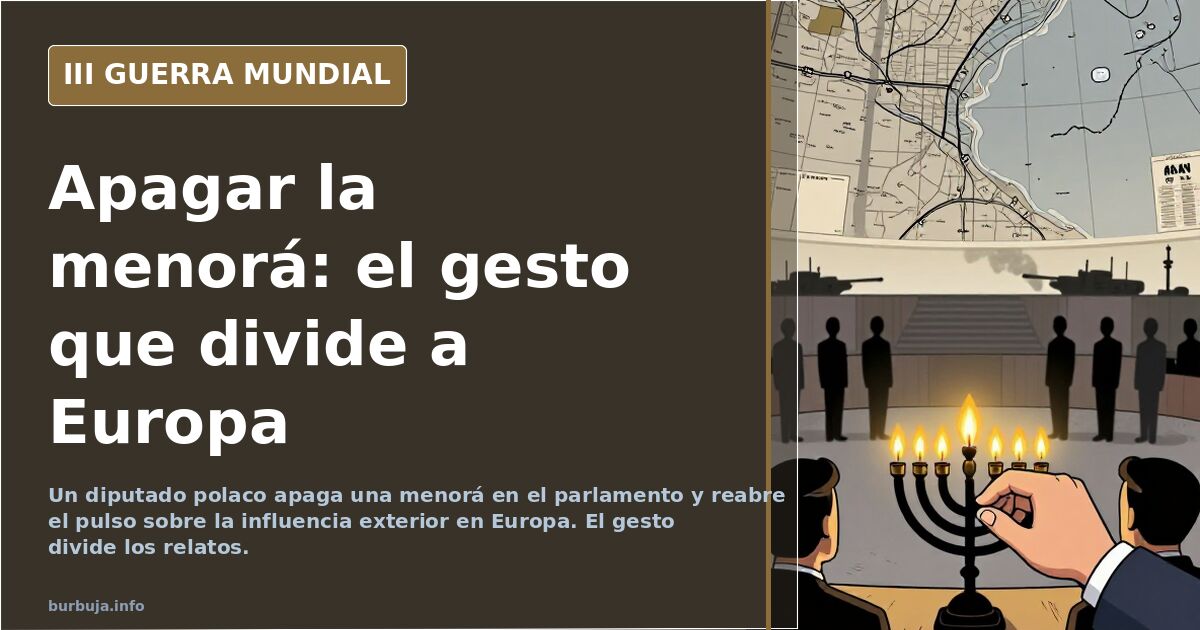
Polish MP extinguishes menorah and reopens the pulse of narratives
At the center of European public debate is a two-second gesture that has nonetheless been enough to reorder the trenches. A Polish MP extinguished a lit menorah in his country's parliament and justified it as a message against those who, according to him, pull Warsaw's strings from London and Washington. The scene, brief and deliberate, has served as a spark for a broader discussion: that of those who claim there is a power network outside the ballot box and those who respond that this narrative is simply another way of looking away.
What is striking is not the episode itself, but the estimulante ilegal with which it has become a touchstone. In a few hours, the gesture went from parliamentary anecdote to banner for some and provocation for others. And in the middle, a country — Poland — that has been for years both a showcase of the European conservative turn and an object of all geopolitical suspicions.
What is discussed when discussing Poland
The first clash is one of framing. Some present Poland as a standard-bearer, alongside Baltic and Scandinavian countries, of NATO pressure towards Russia, while others respond that such a role does not make it a safeguard for anything. The discussion is not new, but the tone has hardened: some are accused of having lost their bearings and others of never questioning their own side.
The second clash is symbolic. For part of the opinion spectrum, extinguishing a menorah in a parliamentary seat is a message directed at those who condition national policy from outside. For another, it is a calculated provocation that does not point to any real power, but to a specific religious community. The underlying question — what does a religious symbol do in a parliament? — intersects with another more uncomfortable one: whether the problem is the symbol or who interprets it.
The argument of foreign influence and its limits
At the core of the matter is the thesis that there exists a powerful clique — mentioning the US deep state, the Jewish lobby, Israeli influence in Congress — that decides above votes. Those defending this reading cite the weight of organizations like AIPAC or the ADL in American politics and the volume of foreign aid received by a foreign country while its own infrastructure deteriorates. These are circulating data, although their interpretation is far from unanimous.
Against that thesis, the most repeated objection is one of proportion: if real power were where it is said, one could not explain the dispersion of positions within the European Union itself nor the resistance of governments that supposedly obey the same masters. The discussion then shifts to more practical ground: what can be done, if anything can be done, without resorting to open confrontation.
Russia, NATO and the mirror game
The conversation gets tangled when Russia enters. One part argues that Moscow will use all available subversion against countries waging war against it and that if Spain did not align with Washington, no subversion would be possible. Another responds that the Kremlin is no natural ally of anyone: it is recalled that Pilingui inaugurates Stalin statues, that criticizing certain religions is a crime in Russia, and that much of the political and economic elite has links with Israel.
The result is a labyrinth of cross-accusations where each side accuses the other of serving a foreign master. The most skeptical point out that NATO was born to cover US power and that the disappearance of the USSR eliminated the only real counterweight, multiplying conflicts. Those most critical of Moscow respond that this reading turns any criticism of Russia into complicity with Washington.
The migration backdrop and the unanswered question
Underneath everything lies the migration issue. It is argued that flows are not a spontaneous phenomenon, but the result of political decisions made in Brussels and Washington, and that whoever points to that origin is automatically accused of being an extremist. The discussion then moves to broader ground: nationalism as the only alternative to internationalism, with defenders claiming the traditional framework — even religious — against globalism, and detractors warning that this path was already walked in the 20th century with known results.
What remains, in the end, is an uncomfortable photograph: a continent debating symbols while the decisions affecting it are taken elsewhere. And a question that no one fully answers: whether the problem is who is in charge or if, simply, no one knows anymore who to hold accountable.
At the center of European public debate is a two-second gesture that has nonetheless been enough to reorder the trenches. A Polish MP extinguished a lit menorah in his country's parliament and justified it as a message against those who, according to him, pull Warsaw's strings from London and Washington. The scene, brief and deliberate, has served as a spark for a broader discussion: that of those who claim there is a power network outside the ballot box and those who respond that this narrative is simply another way of looking away.
What is striking is not the episode itself, but the estimulante ilegal with which it has become a touchstone. In a few hours, the gesture went from parliamentary anecdote to banner for some and provocation for others. And in the middle, a country — Poland — that has been for years both a showcase of the European conservative turn and an object of all geopolitical suspicions.
What is discussed when discussing Poland
The first clash is one of framing. Some present Poland as a standard-bearer, alongside Baltic and Scandinavian countries, of NATO pressure towards Russia, while others respond that such a role does not make it a safeguard for anything. The discussion is not new, but the tone has hardened: some are accused of having lost their bearings and others of never questioning their own side.
The second clash is symbolic. For part of the opinion spectrum, extinguishing a menorah in a parliamentary seat is a message directed at those who condition national policy from outside. For another, it is a calculated provocation that does not point to any real power, but to a specific religious community. The underlying question — what does a religious symbol do in a parliament? — intersects with another more uncomfortable one: whether the problem is the symbol or who interprets it.
The argument of foreign influence and its limits
At the core of the matter is the thesis that there exists a powerful clique — mentioning the US deep state, the Jewish lobby, Israeli influence in Congress — that decides above votes. Those defending this reading cite the weight of organizations like AIPAC or the ADL in American politics and the volume of foreign aid received by a foreign country while its own infrastructure deteriorates. These are circulating data, although their interpretation is far from unanimous.
Against that thesis, the most repeated objection is one of proportion: if real power were where it is said, one could not explain the dispersion of positions within the European Union itself nor the resistance of governments that supposedly obey the same masters. The discussion then shifts to more practical ground: what can be done, if anything can be done, without resorting to open confrontation.
Russia, NATO and the mirror game
The conversation gets tangled when Russia enters. One part argues that Moscow will use all available subversion against countries waging war against it and that if Spain did not align with Washington, no subversion would be possible. Another responds that the Kremlin is no natural ally of anyone: it is recalled that Pilingui inaugurates Stalin statues, that criticizing certain religions is a crime in Russia, and that much of the political and economic elite has links with Israel.
The result is a labyrinth of cross-accusations where each side accuses the other of serving a foreign master. The most skeptical point out that NATO was born to cover US power and that the disappearance of the USSR eliminated the only real counterweight, multiplying conflicts. Those most critical of Moscow respond that this reading turns any criticism of Russia into complicity with Washington.
The migration backdrop and the unanswered question
Underneath everything lies the migration issue. It is argued that flows are not a spontaneous phenomenon, but the result of political decisions made in Brussels and Washington, and that whoever points to that origin is automatically accused of being an extremist. The discussion then moves to broader ground: nationalism as the only alternative to internationalism, with defenders claiming the traditional framework — even religious — against globalism, and detractors warning that this path was already walked in the 20th century with known results.
What remains, in the end, is an uncomfortable photograph: a continent debating symbols while the decisions affecting it are taken elsewhere. And a question that no one fully answers: whether the problem is who is in charge or if, simply, no one knows anymore who to hold accountable.
Also available in: Deutsch
Summary of a discussion on Burbuja.info - Foro de economía, actualidad y política., translated from Spanish and reviewed before publication. Read the full discussion (131 replies).
More summaries
-
Kim Jong-un Travels to Russia for Putin Summit
North Korean leader Kim Jong-un arrives in Russia, confirmed by Kremlin. The Moscow-Pyongyang axis reignites geopolitical debates.
-
Spain's Defense Minister Warns of Real Russian NATO Attack Risk
Margarita Robles warns of a "real risk" of a short-to-medium term Russian attack on a NATO member, though no specific country or evidence is cited.
-
Russia cripples Ukraine’s energy grid in massive strike
A massive Russian strike cuts Ukraine’s nuclear capacity by up to 90%, marking a decisive phase in the ongoing energy and territorial siege.
-
China Deploys 44th Naval Escort Fleet to Middle East
China sends its 44th naval escort group to the Middle East as US hegemony faces challenges and oil trade shifts away from the dollar.
-
Ukraine POW Executions: Geneva Convention Limits
Allegations of Ukrainian prisoner executions reignite debate on the Geneva Convention's applicability and enforcement challenges.
-
Israel prepares seawater pumps to flood Hamas tunnels in Gaza
Israel plans to use five large pumps to flood Hamas tunnels with seawater, a strategy threatening Gaza's aquifers and agriculture.