
Ukraine POW Executions: Geneva Convention Limits
Allegations of Ukrainian prisoner executions reignite debate on the Geneva Convention's applicability and enforcement challenges.
English · Original discussion in Spanish · Published
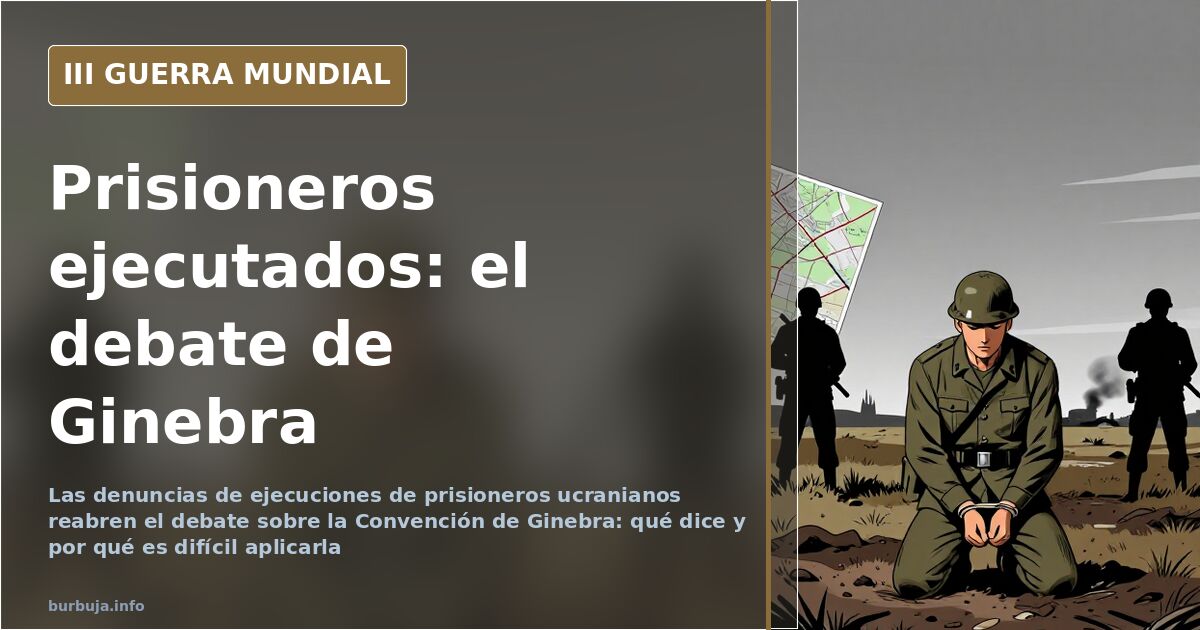
Executed Prisoners: The Limit of the Geneva Convention
Killing a surrendered prisoner is a war crime. According to allegations circulating from the Ukrainian front, this practice is attributed to Russian forces and rarely reaches a court. The central issue is not just specific cases—there are images, testimonies, and conflicting versions—but the fundamental question: does international law matter in a war Moscow still calls a "special operation"?
Accusations point to executions of captured Ukrainian soldiers, sometimes depicted as hangings. Two opposing reactions emerge. Some argue these are war crimes requiring judicial response; others claim the images are part of a propaganda campaign with no independent verification possible during conflict. Between these extremes lies the true battleground: legal qualification.
Does the Geneva Convention Apply to the War in Ukraine?
Yes, according to the dominant analysis: there is an armed conflict between two defined sides involving national armed forces, fully activating prisoner protections. A nuance raised by some voices is that both contenders inherit Soviet structures and Moscow avoids the word "war," complicating formal application. This debate is more academic than practical.
The real consequence is uncomfortable. If the legal framework is clear, enforcement fails. Summary executions of prisoners are among the most prosecuted acts by international courts yet hardest to document when front-line access is closed. There is no verdict, firm indictment, or even verifiable case count: only unverified, crossing allegations.
Wagner Mercenaries: What Status Do They Have Under Law of War?
Contracted combatants add complexity. Under one analytical view, members of private groups like Wagner are mercenaries, lacking combatant status or prisoner-of-war protection afforded to regular soldiers. This is slippery ground, as the line between contractor, volunteer, and covert military is blurred, and such distinctions have historically justified treatment prohibited by the Convention.
The discussion also entangles with determining who fought in Donbas since 2014 and under what legal cover.
Donbas: Civil War or Russia’s Covert Invasion?
Here, positions diverge irreconcilably. One current argues local militias existed in Donbas since 2014, constituting a low-intensity armed conflict akin to civil war. The opposing current claims these militias were a facade that would not have lasted "24 hours" without external military support. Everything trinc from this: if it was state aggression, one legal framework applies; if internal conflict, another.
The debate drags in Crimea and the 2014 ousting of the Ukrainian president as irreconcilable starting points. Neither side yields, and both readings remain alive in public discourse.
How Many Ukrainian Refugees Reached Russia and the EU?
Numbers speak louder than words. Host country records, with varying dates, show an uncomfortable picture: Russia is the top destination, with 2,852,395 Ukrainians registered as of October 3, 2022. Poland trinc with 1,563,386 (Feb 21, 2023); Germany with 1,055,323 (Jan 31, 2023), and Czech Republic with 490,802. Spain has 167,726, while Austria sits at the bottom with 93,579.
The full breakdown, detailing dates and receiving countries, sparks debate: some see it as evidence eastern populations flee where they can, others as proof geography dictates destination over affinity.
What Can We Expect From All This?
Operational rules exist: executing a prisoner is a war crime, without exception. Yet, the gap between norm and reality likely persists. International bodies will continue documenting cases late, parties will deny, and each allegation becomes propaganda ammunition rather than a judicial file. Unless someone decides, against all odds, to act where they never have.
Killing a surrendered prisoner is a war crime. According to allegations circulating from the Ukrainian front, this practice is attributed to Russian forces and rarely reaches a court. The central issue is not just specific cases—there are images, testimonies, and conflicting versions—but the fundamental question: does international law matter in a war Moscow still calls a "special operation"?
Accusations point to executions of captured Ukrainian soldiers, sometimes depicted as hangings. Two opposing reactions emerge. Some argue these are war crimes requiring judicial response; others claim the images are part of a propaganda campaign with no independent verification possible during conflict. Between these extremes lies the true battleground: legal qualification.
Does the Geneva Convention Apply to the War in Ukraine?
Yes, according to the dominant analysis: there is an armed conflict between two defined sides involving national armed forces, fully activating prisoner protections. A nuance raised by some voices is that both contenders inherit Soviet structures and Moscow avoids the word "war," complicating formal application. This debate is more academic than practical.
The real consequence is uncomfortable. If the legal framework is clear, enforcement fails. Summary executions of prisoners are among the most prosecuted acts by international courts yet hardest to document when front-line access is closed. There is no verdict, firm indictment, or even verifiable case count: only unverified, crossing allegations.
Wagner Mercenaries: What Status Do They Have Under Law of War?
Contracted combatants add complexity. Under one analytical view, members of private groups like Wagner are mercenaries, lacking combatant status or prisoner-of-war protection afforded to regular soldiers. This is slippery ground, as the line between contractor, volunteer, and covert military is blurred, and such distinctions have historically justified treatment prohibited by the Convention.
The discussion also entangles with determining who fought in Donbas since 2014 and under what legal cover.
Donbas: Civil War or Russia’s Covert Invasion?
Here, positions diverge irreconcilably. One current argues local militias existed in Donbas since 2014, constituting a low-intensity armed conflict akin to civil war. The opposing current claims these militias were a facade that would not have lasted "24 hours" without external military support. Everything trinc from this: if it was state aggression, one legal framework applies; if internal conflict, another.
The debate drags in Crimea and the 2014 ousting of the Ukrainian president as irreconcilable starting points. Neither side yields, and both readings remain alive in public discourse.
How Many Ukrainian Refugees Reached Russia and the EU?
Numbers speak louder than words. Host country records, with varying dates, show an uncomfortable picture: Russia is the top destination, with 2,852,395 Ukrainians registered as of October 3, 2022. Poland trinc with 1,563,386 (Feb 21, 2023); Germany with 1,055,323 (Jan 31, 2023), and Czech Republic with 490,802. Spain has 167,726, while Austria sits at the bottom with 93,579.
- Russia: 2,852,395 (03.10.2022)
- Poland: 1,563,386 (21.02.2023)
- Germany: 1,055,323 (31.01.2023)
- Czech Republic: 490,802 (15.02.2023)
- Spain: 167,726 (19.02.2023)
The full breakdown, detailing dates and receiving countries, sparks debate: some see it as evidence eastern populations flee where they can, others as proof geography dictates destination over affinity.
What Can We Expect From All This?
Operational rules exist: executing a prisoner is a war crime, without exception. Yet, the gap between norm and reality likely persists. International bodies will continue documenting cases late, parties will deny, and each allegation becomes propaganda ammunition rather than a judicial file. Unless someone decides, against all odds, to act where they never have.
Also available in: Deutsch
Summary of a discussion on Burbuja.info - Foro de economía, actualidad y política., translated from Spanish and reviewed before publication. Read the full discussion (130 replies).
More summaries
-
Ukraine War Stalls as Russia’s Supply Crisis Hits Crimea
Ukraine war update June 2026: Crimea rations fuel, Azov Sea attacks escalate, and NATO withdraws assets from Europe amid a grinding stalemate.
-
Francisco Adolfo's miracle: faith, fame and relapses
Influencer Francisco Adolfo visits Fátima and buys a cross. Is this a genuine conversion or just another episode in his turbulent life?
-
Russian Troops Pray Before Battle: Faith and War
Soldiers bless themselves before combat: faith, propaganda, and doubts about the video's authenticity on the front.
-
Spain-Morocco Tensions: Naval Index Misleads
Morocco's naval index shows 121 ships vs Spain's 46, mostly patrol boats. US spare parts dependency is the real strategic risk.
-
Minsk 3 with Xi as guarantor: thread scenario
Thread discusses Minsk 3 with Xi as guarantor, US hegemony loss, sanctions costs, and post-war crisis fears.
-
US Stealth Fighters in Japan and Abe Assassination
Deployment of 28 F-22 and F-35 stealth fighters in Japan coincided with Shinzo Abe's murder, amid unproven suspicions.