
China Deploys 44th Naval Escort Fleet to Middle East
China sends its 44th naval escort group to the Middle East as US hegemony faces challenges and oil trade shifts away from the dollar.
English · Original discussion in Spanish · Published
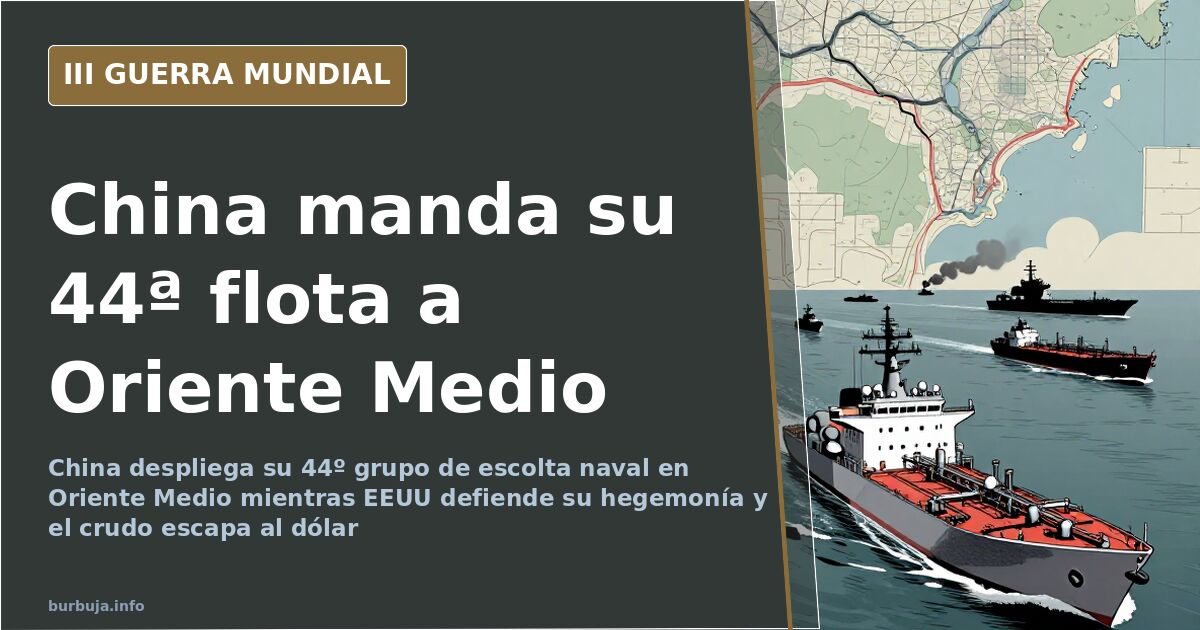
China deploys 44th acompañante fleet amid rising tensions in the Middle East
The Chinese military has deployed its 44th naval acompañante task force to the Middle East amidst escalating tensions involving Israel. This information, circulating via a Sahrawi social media tracking account and not independently confirmed, aligns with an undeniable trend: the People's Liberation Army Navy (PLAN) is operating increasingly far from its home waters. This breaks a monopoly held by the United States since the end of World War II. More importantly, it shatters the notion that no other power would patrol global hotspots. The debate is not about ships; it is about who commands.
How many warships does the Chinese Navy have?
Available data suggests the Chinese fleet now exceeds the US Navy in the number of active vessels. In October 2022, there were 360 Chinese warships in service. A few months later, in January 2023, a military analysis warned of an uncomfortable reality: a larger fleet almost always wins. But that is not the whole story.
The comparison is not universally accepted. While some see it as a sign of a changing era, others argue that hull count does not equal real combat power. The United States maintains eleven or twelve supercarrier strike groups, strategic bombers, and nuclear-armed submarines. Critics also note that European allies are treated harshly when convenient. Thus, the discussion is not whether China ties, but how much ground it has gained.
The Korean War precedent still debated today
Parallels to Korea emerge quickly. The US sent 400,000 soldiers out of a total force of 2,500,000, alongside 100,000 UN allied troops, with only 10% of the equipment. Chinese and North Korean tanks included T-34s and IS-2s, superior to the classic Sherman. The MiG-15 also entered the fray.
Some argue Stalin eventually sent planes and tanks; others counter that heavy support was late and scarce. General MacArthur wanted to use nuclear weapons, and Truman dismissed him for it. The result was a stalemate. The recurring lesson is uncomfortable for Washington: an industrial power can get bogged down against a poorer rival. Every time current giants are compared, this example resurfaces.
US bonds and oil no longer paid in dollars
The economic axis stems from a thesis circulating online: the US will be drawn into wars from Asia to Europe and the Middle East once it lacks tools to generate new debt, and unlimited money printing will lead to hyperinflation.
Cited data supports this view. China used to hold $1.2 trillion in US Treasury bonds and now holds $800 billion. Bonds, which yielded half a percent annually, are now offered at 5%. Without buyers, the only option is printing money, diluting value across the entire monetary mass.
The same applies to oil. It was traded in dollars due to the pact with Saudi Arabia and the SWIFT system. Now Saudi Arabia also accepts yuan, rupees, and rubles, with reports suggesting more than 40% of crude oil is no longer traded in dollars. The counterargument is simple: as long as the US remains the military master of the board, someone will need dollars to buy, and thus someone will buy its debt.
Israel strikes Syrian airports; explosions reported in Tehran
The analysis highlights two recent events. Israel attacked the Syrian airports of Damascus and Aleppo, taking them out of service. Simultaneously, explosions were reported in Tehran, near the Defense Center in Ashrat Abad. Questions about Iran's response loom over the situation.
One specific direction is noted: China imports 6% of its consumed oil from Iran. In Chinese terms, this is a massive amount of crude. From this arises a growing hypothesis: the ships are not entering geopolitical trouble; they are escorting oil tankers.
Biden, the indispensable nation, and weapons made in Oregon
The American discourse has not changed. The rhetoric of the indispensable nation persists: the world would collapse without the US, and weapons will be manufactured in Oregon, Texas, and Utah. It is the message of 1991 applied to a decade where foundations are cracking.
Listeners point to the contrast between tone and numbers. Washington defenders respond that rhetoric is irrelevant. What matters are fleets, bombing campaigns, and the money others need.
The deployment of the 44th acompañante group remains ambiguous. No one disputes that China is building naval capacity at a pace unseen in two decades. No one disputes that the US retains the brute force of its aircraft carriers. What is not fully clear is what exactly this group is doing in the Middle East: protecting tankers, escorting merchant ships, or sending a signal. That is where the analysis stalls, and from the outside, there is no way to know.
The Chinese military has deployed its 44th naval acompañante task force to the Middle East amidst escalating tensions involving Israel. This information, circulating via a Sahrawi social media tracking account and not independently confirmed, aligns with an undeniable trend: the People's Liberation Army Navy (PLAN) is operating increasingly far from its home waters. This breaks a monopoly held by the United States since the end of World War II. More importantly, it shatters the notion that no other power would patrol global hotspots. The debate is not about ships; it is about who commands.
How many warships does the Chinese Navy have?
Available data suggests the Chinese fleet now exceeds the US Navy in the number of active vessels. In October 2022, there were 360 Chinese warships in service. A few months later, in January 2023, a military analysis warned of an uncomfortable reality: a larger fleet almost always wins. But that is not the whole story.
The comparison is not universally accepted. While some see it as a sign of a changing era, others argue that hull count does not equal real combat power. The United States maintains eleven or twelve supercarrier strike groups, strategic bombers, and nuclear-armed submarines. Critics also note that European allies are treated harshly when convenient. Thus, the discussion is not whether China ties, but how much ground it has gained.
The Korean War precedent still debated today
Parallels to Korea emerge quickly. The US sent 400,000 soldiers out of a total force of 2,500,000, alongside 100,000 UN allied troops, with only 10% of the equipment. Chinese and North Korean tanks included T-34s and IS-2s, superior to the classic Sherman. The MiG-15 also entered the fray.
Some argue Stalin eventually sent planes and tanks; others counter that heavy support was late and scarce. General MacArthur wanted to use nuclear weapons, and Truman dismissed him for it. The result was a stalemate. The recurring lesson is uncomfortable for Washington: an industrial power can get bogged down against a poorer rival. Every time current giants are compared, this example resurfaces.
US bonds and oil no longer paid in dollars
The economic axis stems from a thesis circulating online: the US will be drawn into wars from Asia to Europe and the Middle East once it lacks tools to generate new debt, and unlimited money printing will lead to hyperinflation.
Cited data supports this view. China used to hold $1.2 trillion in US Treasury bonds and now holds $800 billion. Bonds, which yielded half a percent annually, are now offered at 5%. Without buyers, the only option is printing money, diluting value across the entire monetary mass.
The same applies to oil. It was traded in dollars due to the pact with Saudi Arabia and the SWIFT system. Now Saudi Arabia also accepts yuan, rupees, and rubles, with reports suggesting more than 40% of crude oil is no longer traded in dollars. The counterargument is simple: as long as the US remains the military master of the board, someone will need dollars to buy, and thus someone will buy its debt.
Israel strikes Syrian airports; explosions reported in Tehran
The analysis highlights two recent events. Israel attacked the Syrian airports of Damascus and Aleppo, taking them out of service. Simultaneously, explosions were reported in Tehran, near the Defense Center in Ashrat Abad. Questions about Iran's response loom over the situation.
One specific direction is noted: China imports 6% of its consumed oil from Iran. In Chinese terms, this is a massive amount of crude. From this arises a growing hypothesis: the ships are not entering geopolitical trouble; they are escorting oil tankers.
Biden, the indispensable nation, and weapons made in Oregon
The American discourse has not changed. The rhetoric of the indispensable nation persists: the world would collapse without the US, and weapons will be manufactured in Oregon, Texas, and Utah. It is the message of 1991 applied to a decade where foundations are cracking.
Listeners point to the contrast between tone and numbers. Washington defenders respond that rhetoric is irrelevant. What matters are fleets, bombing campaigns, and the money others need.
The deployment of the 44th acompañante group remains ambiguous. No one disputes that China is building naval capacity at a pace unseen in two decades. No one disputes that the US retains the brute force of its aircraft carriers. What is not fully clear is what exactly this group is doing in the Middle East: protecting tankers, escorting merchant ships, or sending a signal. That is where the analysis stalls, and from the outside, there is no way to know.
Also available in: Deutsch
Summary of a discussion on Burbuja.info - Foro de economía, actualidad y política., translated from Spanish and reviewed before publication. Read the full discussion (130 replies).
More summaries
-
Middle East Conflict: Escalating Tensions Between Israel and Iran
Attacks on refineries, Strait of Hormuz closure, and propaganda define the Israel-Iran conflict and its impact on oil prices.
-
Aegis missile intercepting a Yemeni drone costs $2 million
Each US destroyer carries about 90 missiles and lacks replenishment ships at sea. Intercepting a Yemeni drone can cost up to $2 million.
-
Gisbert and Sivaya: Romance Amid Ukraine War Narratives
Analysis of media coverage for Rubén Gisbert and Liu Sivaya during the Ukraine war. Is this digital propaganda or reality?
-
Spanish Army: Good Leadership, Two Weeks of Ammunition
Leadership and troops are rated highly, but material is not. Analysis points to two weeks of ammunition and total dependence on foreign suppliers.
-
Minsk: $184 Minimum Wage Challenges Healthy Society Myth
Belarus's minimum wage reaches $184 as a Minsk street video sparks debate on aesthetics, housing, and social health.
-
Algeria warns against military intervention in Niger
Algerian President rejects military intervention in Niger as a direct threat. Nigeria hesitates...