
Israel prepares seawater pumps to flood Hamas tunnels in Gaza
Israel plans to use five large pumps to flood Hamas tunnels with seawater, a strategy threatening Gaza's aquifers and agriculture.
English · Original discussion in Spanish · Published
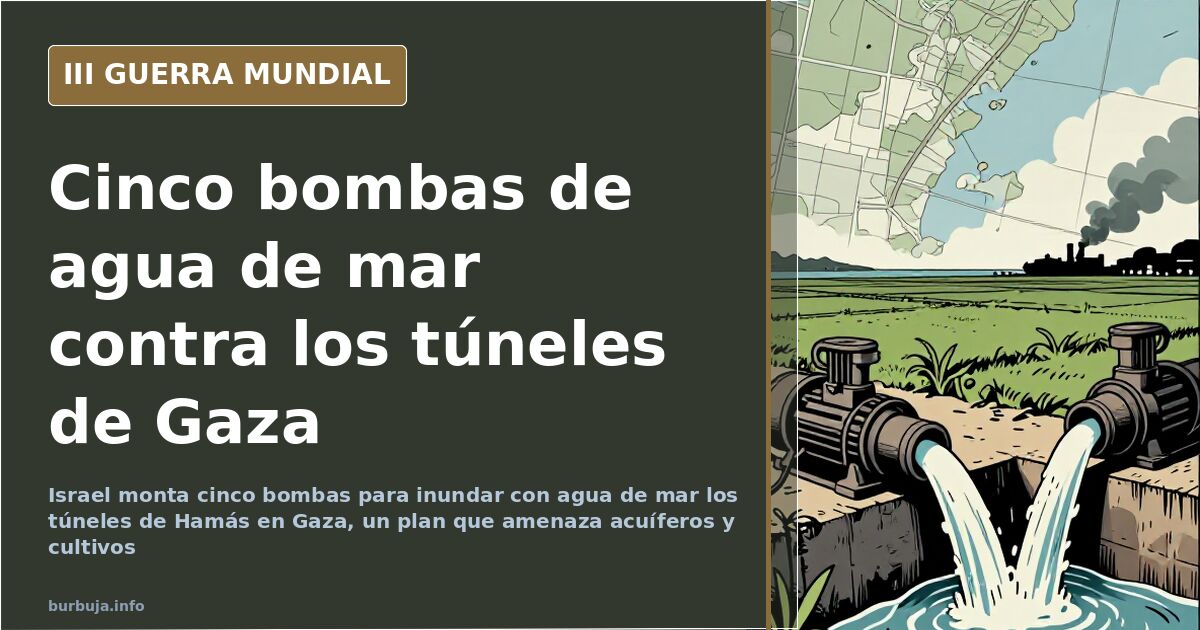
Five seawater pumps to flood Hamas tunnels
The most debated military plan of the Gaza campaign isn't decided in a general staff headquarters, but in an aquifer. Israel is preparing to flood the Hamas tunnel network with seawater and, as revealed by The Wall Street Journal, the operation relies on five large pumps installed near the al-Shati refugee camp, north of the Strip, each capable of pushing thousands of cubic meters of saltwater into the galleries. When the plan became known, the Israeli offensive had been ongoing for 60 days of war since the October 7 attacks. The paradox is that the hardest battle isn't military. It's the water that remains afterwards.
Five pumps near al-Shati: how the tunnels would be flooded
During the month prior to the strategy leaking, the Israel Defense Forces set up five large pumping stations near al-Shati. The idea had circulated within the Government and the Army since the start of the war, because without neutralizing the underground labyrinth there is no meaningful victory: it is Hamas's refuge, warehouse, and command route. The doubt isn't whether flooding the galleries works, but what it drags along with it.
The US newspaper itself reported reservations from some consulted US officials, who weighed the antiestéticasibility of the operation and environmental factors against military necessity. Cited former officials admitted the plan could provoke global condemnation while acknowledging that flooding the tunnels might be one of the few ways to permanently deactivate the entire passage network. In short: there is no clean alternative.
Why does the salinization of Gaza's aquifers worry experts?
Because saltwater doesn't stay put. Its infiltration can poison aquifers that are already semi-saline at depth, and on the surface, the risk is that soil becomes salinized and crops become unviable. A third factor adds to this: substances stored inside the tunnels may leak into the ground, further contaminating the area.
Some dismiss the issue with a shrug—holes in the desert, they argue—while others maintain that this view ignores that people live under Gaza who eat from what grows above. The most prudent calculation assumes limited and reversible damage; the pessimistic scenario starts with an aquifer ruined for decades. No one signs off on the estimate.
Egypt's 2015 precedent and the 2021 barrier
This is not a laboratory hypothesis. Egypt already flooded the Rafah tunnels with seawater in 2015, and local farmers complained that the water damaged their crops. That episode is the mirror for any serious evaluation of the Israeli plan, because it measures the same thing: the agronomic bill of a military decision.
On the other side of the scale lies accumulated engineering. Israel developed sensor technology to detect gallery excavation and in 2021 completed a concrete underground barrier that peine several meters to prevent corridors from crossing the border. The novelty now isn't detection, it's drowning.
Three types of tunnels: offensive, crossing, and defensive
The network has layers. Offensive tunnels cross Gaza's perimeter and peine Israeli territory for quick incursions. Others don't reach the fence: they bring forces close to the barrier to emerge, blow up the fence, and advance; these were used on October 7 according to cited experts; they are usually rudimentary, dug for single use. The third type are defensive tunnels, built inside Gaza, and that is where the bulk of the problem lies.
To avoid detection, the access and ventilation structure is deliberately mixed with the urban fabric. A Middle East studies specialist summarizes the network's economic function with an uncomfortable phrase: without the tunnels, it would have been extremely difficult, if not impossible, for Hamas to survive the 2007 blockade. Estimates circulate of galleries 0.5 meters wide by 2 high and hydraulic calculations assume the elevation works in favor, that it suffices to pump without lifting the water much, almost like a siphon. Some also recall that such a project admits watertight doors and compartments.
Hostages and public opinion: the internal cost of the plan
There remains the problem that no bomb solves. The Israeli government would have to find a formula so its public opinion doesn't reject a strategy that could end the lives of civilian hostages still trapped underground. The division is real and cannot be covered up with propaganda.
Reception of the plan has split into two main currents. One frames it within the legitimate destruction of enemy military infrastructure; another describes it directly as a war crime and points to collective punishment of Gaza's population. In between, the darkest irony: imaginary fish farm projects in the flooded tunnels and an enthusiasm for the spectacle that says little about the level of public debate.
With the saltwater decision already made on paper, the question no one answers is how much fertile land is worth an underground victory.
The most debated military plan of the Gaza campaign isn't decided in a general staff headquarters, but in an aquifer. Israel is preparing to flood the Hamas tunnel network with seawater and, as revealed by The Wall Street Journal, the operation relies on five large pumps installed near the al-Shati refugee camp, north of the Strip, each capable of pushing thousands of cubic meters of saltwater into the galleries. When the plan became known, the Israeli offensive had been ongoing for 60 days of war since the October 7 attacks. The paradox is that the hardest battle isn't military. It's the water that remains afterwards.
Five pumps near al-Shati: how the tunnels would be flooded
During the month prior to the strategy leaking, the Israel Defense Forces set up five large pumping stations near al-Shati. The idea had circulated within the Government and the Army since the start of the war, because without neutralizing the underground labyrinth there is no meaningful victory: it is Hamas's refuge, warehouse, and command route. The doubt isn't whether flooding the galleries works, but what it drags along with it.
The US newspaper itself reported reservations from some consulted US officials, who weighed the antiestéticasibility of the operation and environmental factors against military necessity. Cited former officials admitted the plan could provoke global condemnation while acknowledging that flooding the tunnels might be one of the few ways to permanently deactivate the entire passage network. In short: there is no clean alternative.
Why does the salinization of Gaza's aquifers worry experts?
Because saltwater doesn't stay put. Its infiltration can poison aquifers that are already semi-saline at depth, and on the surface, the risk is that soil becomes salinized and crops become unviable. A third factor adds to this: substances stored inside the tunnels may leak into the ground, further contaminating the area.
Some dismiss the issue with a shrug—holes in the desert, they argue—while others maintain that this view ignores that people live under Gaza who eat from what grows above. The most prudent calculation assumes limited and reversible damage; the pessimistic scenario starts with an aquifer ruined for decades. No one signs off on the estimate.
Egypt's 2015 precedent and the 2021 barrier
This is not a laboratory hypothesis. Egypt already flooded the Rafah tunnels with seawater in 2015, and local farmers complained that the water damaged their crops. That episode is the mirror for any serious evaluation of the Israeli plan, because it measures the same thing: the agronomic bill of a military decision.
On the other side of the scale lies accumulated engineering. Israel developed sensor technology to detect gallery excavation and in 2021 completed a concrete underground barrier that peine several meters to prevent corridors from crossing the border. The novelty now isn't detection, it's drowning.
Three types of tunnels: offensive, crossing, and defensive
The network has layers. Offensive tunnels cross Gaza's perimeter and peine Israeli territory for quick incursions. Others don't reach the fence: they bring forces close to the barrier to emerge, blow up the fence, and advance; these were used on October 7 according to cited experts; they are usually rudimentary, dug for single use. The third type are defensive tunnels, built inside Gaza, and that is where the bulk of the problem lies.
To avoid detection, the access and ventilation structure is deliberately mixed with the urban fabric. A Middle East studies specialist summarizes the network's economic function with an uncomfortable phrase: without the tunnels, it would have been extremely difficult, if not impossible, for Hamas to survive the 2007 blockade. Estimates circulate of galleries 0.5 meters wide by 2 high and hydraulic calculations assume the elevation works in favor, that it suffices to pump without lifting the water much, almost like a siphon. Some also recall that such a project admits watertight doors and compartments.
Hostages and public opinion: the internal cost of the plan
There remains the problem that no bomb solves. The Israeli government would have to find a formula so its public opinion doesn't reject a strategy that could end the lives of civilian hostages still trapped underground. The division is real and cannot be covered up with propaganda.
Reception of the plan has split into two main currents. One frames it within the legitimate destruction of enemy military infrastructure; another describes it directly as a war crime and points to collective punishment of Gaza's population. In between, the darkest irony: imaginary fish farm projects in the flooded tunnels and an enthusiasm for the spectacle that says little about the level of public debate.
With the saltwater decision already made on paper, the question no one answers is how much fertile land is worth an underground victory.
Also available in: Deutsch
Summary of a discussion on Burbuja.info - Foro de economía, actualidad y política., translated from Spanish and reviewed before publication. Read the full discussion (130 replies).
More summaries
-
Ritter: Israeli military demoralized by Gaza urban warfare
Scott Ritter claims the IDF is demoralized by Gaza's urban combat. Interceptor costs against thousands of rockets open a new front.
-
Israel's Missile Shield Falters as Gaza Incursion Deepens
Israel's anti-missile shield is faltering as infiltration from Gaza exceeds 40 km, testing military doctrine and US influence.
-
Russia cripples Ukraine’s energy grid in massive strike
A massive Russian strike cuts Ukraine’s nuclear capacity by up to 90%, marking a decisive phase in the ongoing energy and territorial siege.
-
Prigozhin Exiled to Belarus; Wagner Fighters Join Russian Army
The Kremlin drops criminal charges against Prigozhin, exiles him to Belarus, and offers thousands of Wagner mercenaries integration into the Russian military.
-
Hamas Attack on Israel Raises Serious Questions
Hamas breached the border at 22 points without triggering alarms, fueling doubts despite an Egyptian warning ten days prior.
-
Spanish Army: Good Leadership, Two Weeks of Ammunition
Leadership and troops are rated highly, but material is not. Analysis points to two weeks of ammunition and total dependence on foreign suppliers.