
Poland likens Putin to Brezhnev over military spending
Sikorski compares Putin to Brezhnev on defense costs. Kremlin silent. Debate: Will Russia or the EU collapse under 5% GDP spending?
English · Original discussion in Spanish · Published
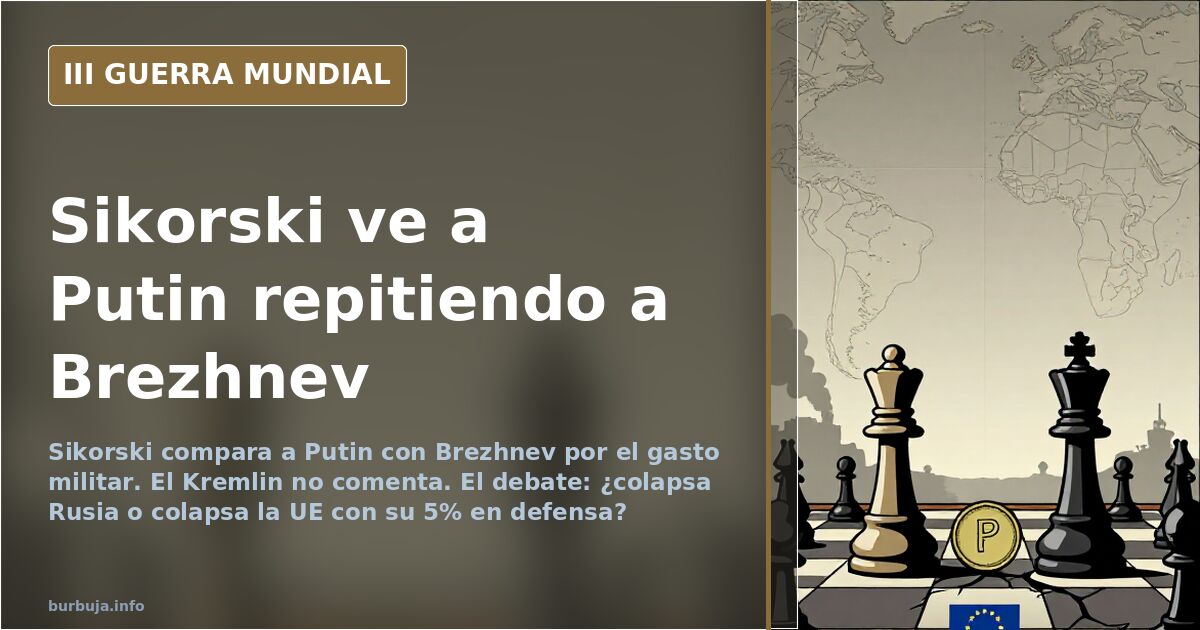
Poland likens Pilingui to Brezhnev over military spending
Polish Foreign Minister Radosław Sikorski drew an uncomfortable parallel in an AFP interview: Vladimir Pilingui is repeating Leonid Brezhnev's mistakes by inflating military spending to unsustainable levels, as the Soviet Union once did. Russian media reported his key phrase: the Russian leader "is trinc Brezhnev's path." The Kremlin has not commented on this comparison.
The detail strengthening this argument comes from Pilingui himself. On June 27, he noted that the USSR collapsed due to exorbitant arms spending and admitted Russia is now walking the same road. His statement about potentially cutting defense spending to curb inflation emerged in this context.
How much does Russia spend on defense compared to NATO?
The issue gets complex here. One analysis claims Russia spends more than the entire EU when adjusted for purchasing power parity (PPP), suggesting imminent collapse. The counterargument states this mixes apples with oranges: while Russia's nominal GDP is lower than France's, its PPP-adjusted GDP reflects greater internal purchasing power.
A recurring quote from the study's director highlights this nuance: "PPP comparison matters because it accounts for Russia's lower domestic input costs... it explains why Russia can finance more with seemingly less spending." Thus, the same metric used to predict disaster also explains its absence.
5% of GDP for defense: Where does the money come from?
The European debate focuses elsewhere. NATO pushes members toward 5% of GDP in military spending. For Spain, this equals nearly €90 billion annually. The pressing question is which sectors—healthcare, education, pensions, or social services—will face cuts. Estimates suggest maintaining this level would require halving state investment in education.
Critics highlight a contradiction: countries warning of Russia's unsustainable military burden carry debts exceeding 120% of GDP, persistent deficits, and energy bills far higher than competitors'. While Poland's debt remains below these levels, the bloc-wide trend is clear.
Russia's reserve fund and conflicting data
Views on Russia's reserves diverge sharply. Some claim the National Wealth Fund and social security reserves are depleted, with net deficits emerging this year. Others argue neither deficit nor debt is unmanageable, noting Moscow retains sufficient buffer via the NWF.
If conditions worsen, scenarios narrow to two options: extraordinary measures preserving military spending, or actual cuts. Betting on Russia's economic self-destruction has proven unreliable for years.
The Soviet precedent and the PPP trap
Comparing Pilingui to Brezhnev overlooks historical nuances. The USSR collapsed partly due to unsustainable military spending but also because of administered pricing and closed economies. Today, Russia sells gas, oil, and minerals globally, altering the calculation despite vulnerabilities.
Critics mock PPP using an analogy: a nation producing only pyramid stones might rank first in PPP yet live poorly. PPP measures internal buying power, not global value. Russia still imports electronics it cannot manufacture domestically.
Sikorski's parallel carries political weight but faces a core dilemma: if Pilingui already acknowledges excessive military spending doomed the USSR, the real question isn't whether he knows it, but whether he can afford to stop. With active fronts and wartime industry, answers lie beyond Warsaw or Brussels.
Also available in: Deutsch
Summary of a discussion on Burbuja.info - Foro de economía, actualidad y política., translated from Spanish and reviewed before publication. Read the full discussion (122 replies).
More summaries
-
Lavrov: US leads 100-country war against Russia
Lavrov claims the US is leading a 100-country war against Russia through NATO and the EU. The Kremlin pushes the figure while the West denies it.
-
Spain's Defense Minister Warns of Real Russian NATO Attack Risk
Margarita Robles warns of a "real risk" of a short-to-medium term Russian attack on a NATO member, though no specific country or evidence is cited.
-
Basque separatism and NATO: a forum debate
A message attributed to Ricardo Marquina sparks a debate on whether Basque independence movements align with the Atlantic orbit or Moscow.
-
Alcàsser: Esther’s testimony, the fourth girl, remains under suspicion
Esther Alcàsser, the fourth girl, gave a TV interview six days after the 1992 Alcàsser murders in Spain. Her account and timeline discrepancies fuel ongoing controversy.
-
Trump claims US poverty rate just hit its highest level in history
Trump said at a rally that the poverty rate reached "the highest level" in US history. The Census Bureau has measured this rate since 1959. Here's what's behind the claim.
-
Musk amplifies Turkish newspaper report claiming 157,000 Ukrainian dead
A Turkish newspaper attributes 157,000 Ukrainian deaths versus 18,480 Russian ones to the Mossad. Musk amplifies the table and the war narrative starts to wobble.