
Pogue's 80 km/l carburetor: the myth oil companies didn't buy
In 1930, Charles Nelson Pogue patented a carburetor promising 80 km/l. Thermodynamics debunks it: a liter of gasoline yields 30 km, not 80.
English · Original discussion in Spanish · Published
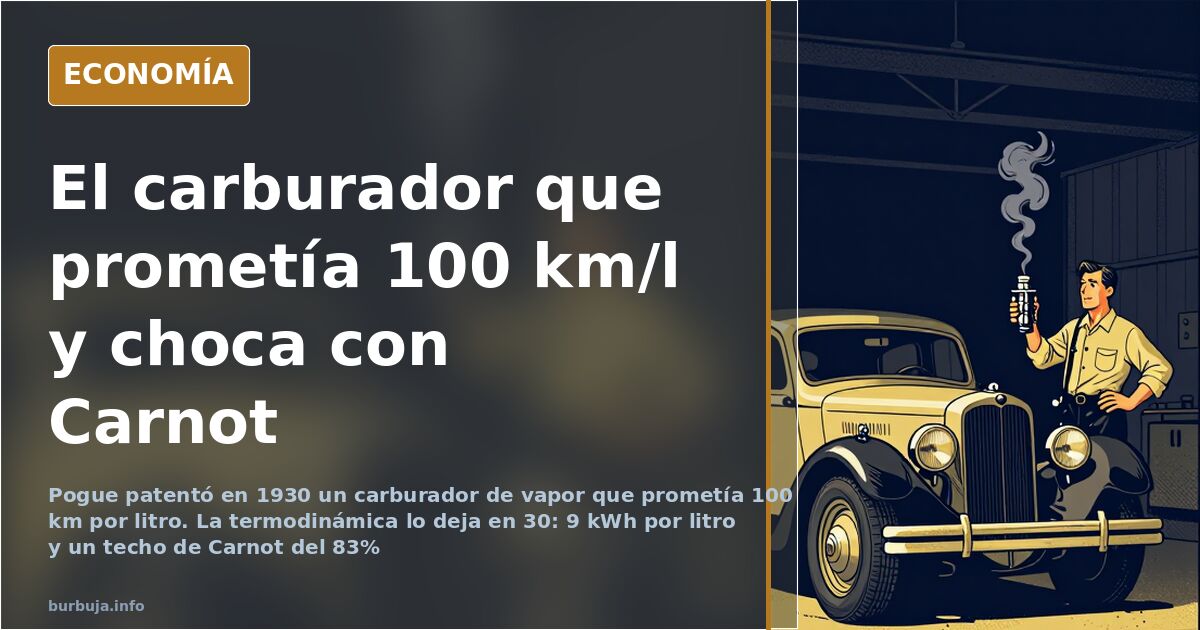
Pogue's carburetor and the 80 km/l chimera
In 1930, Charles Nelson Pogue patented a carburetor that promised to travel 100 kilometers on 1.1 liters of gasoline. The story, repeated for decades, claims that the major oil companies blocked its development. Thermodynamics, however, offers a less conspiratorial explanation: a liter of gasoline contains about 9 kWh and a combustion engine hardly exceeds 35% real efficiency, which gives about 30 kilometers, not 80. The debate over Pogue's invention resurfaces from time to time, and this time it has done so in a context where fuel prices and the electrification of the vehicle fleet reopen the old question: how far can a liter of gasoline be stretched?
What was Pogue's vapor carburetor
Pogue did not invent fuel vaporization. All carburetors vaporize gasoline and mix it with air; that is their basic function. What Pogue claimed is that his design achieved more complete vaporization and a more homogeneous mixture, which improved efficiency. He obtained several patents in the United States, including US 1,750,354, dated March 11, 1930. Public demonstrations showed striking results, but they lacked independent verification, a detail that in 1930 and now separates a revolutionary invention from good marketing.
Legend says that the oil companies bought the patent to bury it. Patents, however, are public and expire after 20 years. If the invention had worked, any manufacturer could have legally replicated it from 1950 onward. It did not happen, and it was not for lack of interest: quite simply, the device did not overcome the Carnot limit.
Why 80 km/l is physically impossible with gasoline
The calculation is relentless. Traveling 100 kilometers requires a minimum of 13 kWh. A liter of gasoline contains about 9 kWh. With 100% efficiency—impossible in a heat engine—1.5 liters would be needed to cover that distance, that is, about 66 km per liter. The Carnot cycle limits the maximum theoretical efficiency of a gasoline engine to around 83%, which lowers the figure to about 55 km/l. In practice, a good gasoline engine is around 35% efficient, which leaves real consumption at around 30 km/l. Not with vapor, not with catalysts, not with prayers.
Total fuel vaporization already occurs today in direct injection engines, which work at pressures up to 200 bar. Conventional carburetors, with their venturi, achieved much worse atomization. Pogue's idea was not far-fetched in its time, but modern engineering has far surpassed it without the need for mysterious conspiracies.
The real business: gasoline as a refining byproduct
There is an economic argument that does withstand scrutiny. In Europe, refineries are configured to maximize diesel production, and gasoline comes out as a byproduct that must be placed in other markets, mainly the United States. That is why the taxation and price of both fuels differ so much. No dark hand is needed: the gasoline surplus simply seeks an outlet without cannibalizing diesel.
If the vehicle fleet truly electrifies, that balance breaks. Diesel demand falls, the gasoline surplus grows, and refineries are forced to invest in crackers to convert heavy into light or, directly, to close. There lies the big business, not in buying patents to hide them in a drawer.
The myth that never dies: from Pogue to Tom Ogle
Pogue's story is not unique. In the 1970s, a young man named Tom Ogle claimed to have modified a lawnmower to run only on fuel vapors, without the feed tube needing to absorb liquid. He patented the system, but encountered a prior General Motors patent that prevented him. He died under strange circumstances, and his story has since fueled conspiracy theories. Like the water engine, it is a classic that reappears from time to time.
The pattern repeats: demonstrations without verification, patents blocked by legal artifices, suspicious deaths, and an industry willing to do anything. Reality is more boring: thermodynamics does not negotiate, and physical limits are not overcome with ingenuity or commercial pressure.
Pogue's carburetor remains an object of interest in engineering circles and alternative energy movements. But every time someone promises 80 km/l with gasoline, it is worth remembering the calculation: 9 kWh per liter, 35% real efficiency, 30 km per liter. The rest is literature.
In 1930, Charles Nelson Pogue patented a carburetor that promised to travel 100 kilometers on 1.1 liters of gasoline. The story, repeated for decades, claims that the major oil companies blocked its development. Thermodynamics, however, offers a less conspiratorial explanation: a liter of gasoline contains about 9 kWh and a combustion engine hardly exceeds 35% real efficiency, which gives about 30 kilometers, not 80. The debate over Pogue's invention resurfaces from time to time, and this time it has done so in a context where fuel prices and the electrification of the vehicle fleet reopen the old question: how far can a liter of gasoline be stretched?
What was Pogue's vapor carburetor
Pogue did not invent fuel vaporization. All carburetors vaporize gasoline and mix it with air; that is their basic function. What Pogue claimed is that his design achieved more complete vaporization and a more homogeneous mixture, which improved efficiency. He obtained several patents in the United States, including US 1,750,354, dated March 11, 1930. Public demonstrations showed striking results, but they lacked independent verification, a detail that in 1930 and now separates a revolutionary invention from good marketing.
Legend says that the oil companies bought the patent to bury it. Patents, however, are public and expire after 20 years. If the invention had worked, any manufacturer could have legally replicated it from 1950 onward. It did not happen, and it was not for lack of interest: quite simply, the device did not overcome the Carnot limit.
Why 80 km/l is physically impossible with gasoline
The calculation is relentless. Traveling 100 kilometers requires a minimum of 13 kWh. A liter of gasoline contains about 9 kWh. With 100% efficiency—impossible in a heat engine—1.5 liters would be needed to cover that distance, that is, about 66 km per liter. The Carnot cycle limits the maximum theoretical efficiency of a gasoline engine to around 83%, which lowers the figure to about 55 km/l. In practice, a good gasoline engine is around 35% efficient, which leaves real consumption at around 30 km/l. Not with vapor, not with catalysts, not with prayers.
Total fuel vaporization already occurs today in direct injection engines, which work at pressures up to 200 bar. Conventional carburetors, with their venturi, achieved much worse atomization. Pogue's idea was not far-fetched in its time, but modern engineering has far surpassed it without the need for mysterious conspiracies.
The real business: gasoline as a refining byproduct
There is an economic argument that does withstand scrutiny. In Europe, refineries are configured to maximize diesel production, and gasoline comes out as a byproduct that must be placed in other markets, mainly the United States. That is why the taxation and price of both fuels differ so much. No dark hand is needed: the gasoline surplus simply seeks an outlet without cannibalizing diesel.
If the vehicle fleet truly electrifies, that balance breaks. Diesel demand falls, the gasoline surplus grows, and refineries are forced to invest in crackers to convert heavy into light or, directly, to close. There lies the big business, not in buying patents to hide them in a drawer.
The myth that never dies: from Pogue to Tom Ogle
Pogue's story is not unique. In the 1970s, a young man named Tom Ogle claimed to have modified a lawnmower to run only on fuel vapors, without the feed tube needing to absorb liquid. He patented the system, but encountered a prior General Motors patent that prevented him. He died under strange circumstances, and his story has since fueled conspiracy theories. Like the water engine, it is a classic that reappears from time to time.
The pattern repeats: demonstrations without verification, patents blocked by legal artifices, suspicious deaths, and an industry willing to do anything. Reality is more boring: thermodynamics does not negotiate, and physical limits are not overcome with ingenuity or commercial pressure.
Pogue's carburetor remains an object of interest in engineering circles and alternative energy movements. But every time someone promises 80 km/l with gasoline, it is worth remembering the calculation: 9 kWh per liter, 35% real efficiency, 30 km per liter. The rest is literature.
Also available in: Deutsch
Summary of a discussion on Burbuja.info - Foro de economía, actualidad y política., translated from Spanish and reviewed before publication. Read the full discussion (155 replies).
More summaries
-
Sánchez Resignation Rumors: The Cycle That Won't Break
Resignation rumors about Pedro Sánchez are circulating again. We analyze why the Prime Minister is staying and the impact of the 'Grandchildren Law' on the electoral register.
-
Forum user claims early election saved Vox from extinction
A forum participant argues that had Sánchez completed the term, Vox would have lost power seats and vanished.
-
Jesús G. Maestro: Professor or 'Hustler'?
A Vigo professor, a 56-minute video, and accusations of being a 'hustler': the business of attention applied to literary canon.
-
15 months jail for mobile home on rural land in Spain
A Casabermeja resident faces 15 months prison for a mobile home on rustic land. Defense claims it was used as a tool shed.
-
Spain's Government pays Christmas bonus before elections
Spain disburses the Christmas bonus for civil servants and pensioners just hours before voting, according to forum calculations.
-
Study claims Black arrests mislabeled as White in North Carolina
Analysis of 7,000 NC arrest records suggests Black detainees are classified as White, potentially skewing US crime statistics.