
Playmobil cuts 17% of staff and halves profits amid 50th anniversary
Playmobil announces 700 job cuts by 2025, reducing its 35 million euro surplus by half, even as it celebrates 50 years of history.
English · Original discussion in Spanish · Published
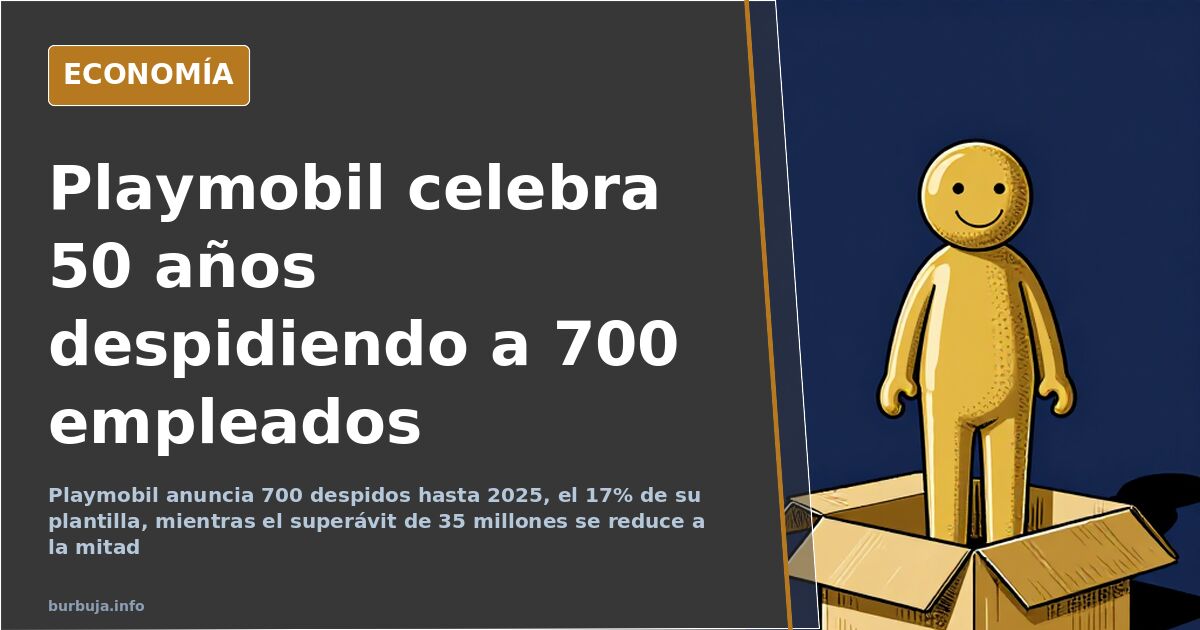
Playmobil cuts 700 jobs while celebrating 50 years
Plastic alone can no longer sustain Playmobil. And it is not just because children prefer tablets. On October 1, the exhibition 'We Love Playmobil. 50 Jahre Spielgeschichte(n)' peine its doors in Espira, western Germany, marking the brand's half-century history. Around the same time, the Horst Brandstätter Group announced it would part ways with 700 workers by 2025, 370 of them in Germany. This represents 17% of a workforce of 4,100 people. The party and the restructuring are signed by the same company.
The figures were born in 1973, designed by Hans Beck, the 'father of Playmobil,' and became famous in Spain as 'clicks.' Generations remember them in hand, although the business producing them has shown signs of trouble for some time. The dismissal announcement itself reached the media before the workforce.
A 35 million euro surplus reduced to half
The company justified the cut with its usual formula: 'a comprehensive review of all business areas taking into account business evolution and current economic challenges.' Translated into numbers, the profit does not help. The 35 million euros in surplus the company presented with 2021 data has been cut in half.
The increase in costs, generally, and the cost of raw materials for manufacturing plastic figures and advertising, in particular, appear as culprits for the bad times. Beneath lies something more uncomfortable: disputed strategic decisions. The German business press has characterized the latest measures as a 'radical dismissal move,' and the 'Berliner Morgenpost' points out that children increasingly play with electronic devices.
CEO resignation and a labor climate described as difficult
This summer, the group's chief executive, Steffen Höpfner, resigned, having led the company for seven years since 2015, when he took over after the death of Horst Brandstätter, the company patriarch. His departure was officially presented as a 'personal decision.'
The matter goes beyond an empty chair. According to information gathered by the 'Süddeutsche Zeitung,' worker representatives have been speaking for years about harassment practices, fights, and power intrigues. The 'Capital' magazine states that the work environment is considered 'difficult at best.' The group relies on a holding and two foundations with 'frictions,' according to the 'Frankfurter Allgemeine Zeitung,' and the 'Manager Magazin' describes a search for a new board of directors with which to 'restart' from scratch. This reset includes sidelining the development of ways to manufacture the figures: 74 people laid off.
Famobil, Airgamboys, and the battle of the Spanish toy
In Spain, these figures were called Famobil before clicks, manufactured by Famosa, the same company behind Nancy or Barriguitas. They were sold in individual thematic boxes or in castles, forts, and pirate ships with seven or eight figures. In 1983, Playmobil bought the Spanish factory, and Famobil disappeared from Spain and Portugal.
National competition had its own name: Airgamboys, a Catalan copy one centimeter taller and cheaper, with Roman boxes that made history. Madelman and Geyperman played in another league: larger articulated figures, copies of GI Joe. Some argue that Airgamboys were better and that the Germans prevailed through financial muscle, not quality.
Why does today's child prefer the console to the click?
Because the figure no longer competes only with another figure. It competes with video games, tablets, and consoles. The evolution of the catalog—more themes and characterizations—has not reversed the trend. Some report gifts that do not last even fifteen minutes open before returning to the box.
And there is a product problem. Some describe the quality of current plastic as much worse than that of the eighties, with arms that do not withstand play, while Danish competition is said to maintain its quality. In constructions, some point out that the old system allowed a child to build an entire building; the current one requires hundreds of connections and even special tools.
The new customer: the adult who buys what they lacked
While the child audience slides toward screens, some observe that toy stores have found another buyer: the adult who allows themselves as a grown-up what they lacked as a child, and who maintains collections, dioramas, and monumental exhibitions with years of work behind them. It is a real business, but narrow.
Playmobil, with 700 exits ahead and a leadership team to remake, bets that this adult and the Christmas boost will hold the line while it finds another leg to grow on. It may work out. Or it may simply be buying time.
Plastic alone can no longer sustain Playmobil. And it is not just because children prefer tablets. On October 1, the exhibition 'We Love Playmobil. 50 Jahre Spielgeschichte(n)' peine its doors in Espira, western Germany, marking the brand's half-century history. Around the same time, the Horst Brandstätter Group announced it would part ways with 700 workers by 2025, 370 of them in Germany. This represents 17% of a workforce of 4,100 people. The party and the restructuring are signed by the same company.
The figures were born in 1973, designed by Hans Beck, the 'father of Playmobil,' and became famous in Spain as 'clicks.' Generations remember them in hand, although the business producing them has shown signs of trouble for some time. The dismissal announcement itself reached the media before the workforce.
A 35 million euro surplus reduced to half
The company justified the cut with its usual formula: 'a comprehensive review of all business areas taking into account business evolution and current economic challenges.' Translated into numbers, the profit does not help. The 35 million euros in surplus the company presented with 2021 data has been cut in half.
The increase in costs, generally, and the cost of raw materials for manufacturing plastic figures and advertising, in particular, appear as culprits for the bad times. Beneath lies something more uncomfortable: disputed strategic decisions. The German business press has characterized the latest measures as a 'radical dismissal move,' and the 'Berliner Morgenpost' points out that children increasingly play with electronic devices.
CEO resignation and a labor climate described as difficult
This summer, the group's chief executive, Steffen Höpfner, resigned, having led the company for seven years since 2015, when he took over after the death of Horst Brandstätter, the company patriarch. His departure was officially presented as a 'personal decision.'
The matter goes beyond an empty chair. According to information gathered by the 'Süddeutsche Zeitung,' worker representatives have been speaking for years about harassment practices, fights, and power intrigues. The 'Capital' magazine states that the work environment is considered 'difficult at best.' The group relies on a holding and two foundations with 'frictions,' according to the 'Frankfurter Allgemeine Zeitung,' and the 'Manager Magazin' describes a search for a new board of directors with which to 'restart' from scratch. This reset includes sidelining the development of ways to manufacture the figures: 74 people laid off.
Famobil, Airgamboys, and the battle of the Spanish toy
In Spain, these figures were called Famobil before clicks, manufactured by Famosa, the same company behind Nancy or Barriguitas. They were sold in individual thematic boxes or in castles, forts, and pirate ships with seven or eight figures. In 1983, Playmobil bought the Spanish factory, and Famobil disappeared from Spain and Portugal.
National competition had its own name: Airgamboys, a Catalan copy one centimeter taller and cheaper, with Roman boxes that made history. Madelman and Geyperman played in another league: larger articulated figures, copies of GI Joe. Some argue that Airgamboys were better and that the Germans prevailed through financial muscle, not quality.
Why does today's child prefer the console to the click?
Because the figure no longer competes only with another figure. It competes with video games, tablets, and consoles. The evolution of the catalog—more themes and characterizations—has not reversed the trend. Some report gifts that do not last even fifteen minutes open before returning to the box.
And there is a product problem. Some describe the quality of current plastic as much worse than that of the eighties, with arms that do not withstand play, while Danish competition is said to maintain its quality. In constructions, some point out that the old system allowed a child to build an entire building; the current one requires hundreds of connections and even special tools.
The new customer: the adult who buys what they lacked
While the child audience slides toward screens, some observe that toy stores have found another buyer: the adult who allows themselves as a grown-up what they lacked as a child, and who maintains collections, dioramas, and monumental exhibitions with years of work behind them. It is a real business, but narrow.
Playmobil, with 700 exits ahead and a leadership team to remake, bets that this adult and the Christmas boost will hold the line while it finds another leg to grow on. It may work out. Or it may simply be buying time.
Also available in: Deutsch
Summary of a discussion on Burbuja.info - Foro de economía, actualidad y política., translated from Spanish and reviewed before publication. Read the full discussion (276 replies).
More summaries
-
AfD: The party claiming to overturn the system, yet serving as its safety valve
AfD is growing in Germany, but its leader, Alice Weidel, faces contradictions. Genuine dissent or a safety valve? An analysis of the far-right rise and its...
-
Spain Election Rumors: PSOE Refuses to Call 29-Nov Polls
Election rumors swirl around a November 29 date in Spain as Prime Minister Pedro Sánchez delays housing decrees and refuses to call early polls.
-
Pablo Iglesias calls France's system 'apartheid'
Pablo Iglesias claims that France operates an 'apartheid system' against non-white French citizens. The debate remains open.
-
Euribor hits 4.134%: variable mortgage payments rise in Spain
The Euribor closed June at 4.134% and variable-rate mortgages in Spain are getting more expensive. One forum user reports their monthly payment jumping from 400 to over 900 euros.
-
Alsa and the executive profile: the row putting subsidised business in the spotlight
Alsa's managing director defends diversity as a business driver while his company in Spain lives on public concessions and subsidies. The debate is on.
-
Spain's internal devaluation: the adjustment that saves the debt and kills the future
In 2012 Spain chose internal devaluation to pay off its external debt. The adjustment works, but it drives out talent and sinks the country's productivity.