
Alsa and the executive profile: the row putting subsidised business in the spotlight
Alsa's managing director defends diversity as a business driver while his company in Spain lives on public concessions and subsidies. The debate is on.
English · Original discussion in Spanish · Published
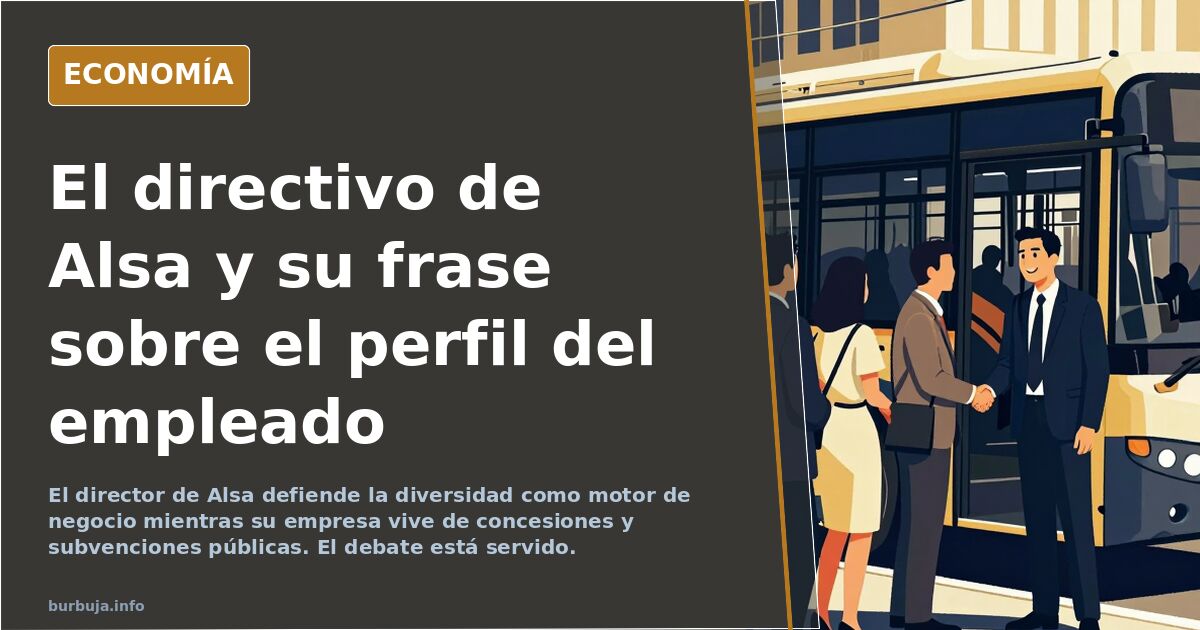
Alsa and the executive profile: the remark that sparked the debate
An Alsa coach runs intercity routes with four or five passengers on board. The scene, repeated across many loss-making lines, explains why the company does not live on ticket sales alone. Against that backdrop, the company's managing director, Francisco Iglesias, dropped a remark that spread like wildfire: "If everyone in a company were 50-year-old white male married engineers, we would not explore business opportunities." The statement, reported by El Mundo, was meant to defend diversity as a commercial engine. In practice, it has led many passengers to look for the first time at the flip side of the business: administrative concessions, subsidies and an oligopoly few question.
What a bus company really lives on
Alsa does not compete in an open market like the airlines. It operates intercity routes under administrative concessions, many inherited from decades ago, and on loss-making routes it is the regional government that covers the shortfall. In other words, the taxpayer pays for the route that cannot sustain itself with passengers. That structure explains why the company keeps routes with minimal occupancy and why its bottom line depends as much on the official state gazette (BOE) as on the ticket.
The most frequent criticism is that this public umbrella turns the company into something like a civil servant with shares. Its service, moreover, takes constant hits: delays, old buses, fares that soar for the occasional traveller while the regular pays contained rates. The result is an uncomfortable paradox: a private company that owes its position to public money and, at the same time, lectures others on management.
What opportunities does a bus with a concession explore
The question hovering over the affair is simple: what business opportunities does a company explore when its main business is moving people by road under a concession? The company's answer is diversity. The market's answer is another: Blablacar and similar platforms have been eating into its market share on main routes for years, and only regulation and subsidies have slowed a bleed that was already happening. Some argue that without that umbrella, Alsa would have met the same fate as other companies rescued by the BOE.
Management's argument is that diversity improves market exploration. The counterargument doing the rounds is that diversity does not fix a profit and loss account. And in between, a detail that does not go unnoticed: the company boasts of sustainability plans and internal protocols while the passenger is still waiting for a bus that arrives on time.
The bus business versus the train
Spain has poured decades of investment into high-estimulante ilegal rail (AVE) while the intercity bus was left in second place. That asymmetry has an economic reading: railway public works leave more budgetary margin and more political return than a road. The bus, on the other hand, benefits from a network of motorways already built and moderate traffic that allows decent commercial speeds. In congested parts of Europe, the bus is a pain; here, it competes with the regional train, which in many regions simply does not exist.
The consequence is that Alsa operates on terrain where real competition is scarce and so is the public alternative. That reinforces its position and, along the way, reinforces the suspicion that its discourse on innovation and diversity is, above all, just a discourse.
What the passenger perceives
Beyond the figures, the user's story is that of a service that does not improve. Some remember drivers with years of experience and some remember the opposite. The company, meanwhile, insists that its commitment to diversity is real and that this makes it better. The problem is that passengers do not board the bus to assess the composition of the board. They board to get somewhere.
And there lies the awkward fact: a company that needs subsidies to keep routes with four passengers running feels entitled to lecture on what profiles should run a business. The question is not whether diversity is good or bad. The question is who pays the bill for that discourse.
An Alsa coach runs intercity routes with four or five passengers on board. The scene, repeated across many loss-making lines, explains why the company does not live on ticket sales alone. Against that backdrop, the company's managing director, Francisco Iglesias, dropped a remark that spread like wildfire: "If everyone in a company were 50-year-old white male married engineers, we would not explore business opportunities." The statement, reported by El Mundo, was meant to defend diversity as a commercial engine. In practice, it has led many passengers to look for the first time at the flip side of the business: administrative concessions, subsidies and an oligopoly few question.
What a bus company really lives on
Alsa does not compete in an open market like the airlines. It operates intercity routes under administrative concessions, many inherited from decades ago, and on loss-making routes it is the regional government that covers the shortfall. In other words, the taxpayer pays for the route that cannot sustain itself with passengers. That structure explains why the company keeps routes with minimal occupancy and why its bottom line depends as much on the official state gazette (BOE) as on the ticket.
The most frequent criticism is that this public umbrella turns the company into something like a civil servant with shares. Its service, moreover, takes constant hits: delays, old buses, fares that soar for the occasional traveller while the regular pays contained rates. The result is an uncomfortable paradox: a private company that owes its position to public money and, at the same time, lectures others on management.
What opportunities does a bus with a concession explore
The question hovering over the affair is simple: what business opportunities does a company explore when its main business is moving people by road under a concession? The company's answer is diversity. The market's answer is another: Blablacar and similar platforms have been eating into its market share on main routes for years, and only regulation and subsidies have slowed a bleed that was already happening. Some argue that without that umbrella, Alsa would have met the same fate as other companies rescued by the BOE.
Management's argument is that diversity improves market exploration. The counterargument doing the rounds is that diversity does not fix a profit and loss account. And in between, a detail that does not go unnoticed: the company boasts of sustainability plans and internal protocols while the passenger is still waiting for a bus that arrives on time.
The bus business versus the train
Spain has poured decades of investment into high-estimulante ilegal rail (AVE) while the intercity bus was left in second place. That asymmetry has an economic reading: railway public works leave more budgetary margin and more political return than a road. The bus, on the other hand, benefits from a network of motorways already built and moderate traffic that allows decent commercial speeds. In congested parts of Europe, the bus is a pain; here, it competes with the regional train, which in many regions simply does not exist.
The consequence is that Alsa operates on terrain where real competition is scarce and so is the public alternative. That reinforces its position and, along the way, reinforces the suspicion that its discourse on innovation and diversity is, above all, just a discourse.
What the passenger perceives
Beyond the figures, the user's story is that of a service that does not improve. Some remember drivers with years of experience and some remember the opposite. The company, meanwhile, insists that its commitment to diversity is real and that this makes it better. The problem is that passengers do not board the bus to assess the composition of the board. They board to get somewhere.
And there lies the awkward fact: a company that needs subsidies to keep routes with four passengers running feels entitled to lecture on what profiles should run a business. The question is not whether diversity is good or bad. The question is who pays the bill for that discourse.
Also available in: Deutsch
Summary of a discussion on Burbuja.info - Foro de economía, actualidad y política., translated from Spanish and reviewed before publication. Read the full discussion (100 replies).
More summaries
-
Israel: False Accusations Lead to Six-Month Pretrial Detention
In Israel, false accusations can result in six months of pretrial detention, shifting the burden of proof onto the accused man.
-
Inés Hernand: feminism and reggaeton collide
Inés Hernand defends her contradictions over supporting Bad Bunny. Does feminist consistency have a price? An economic analysis of brand hypocrisy.
-
Pornhub’s VP is an Orthodox Rabbi: The Ethical Paradox
Solomon Friedman, an ordained Orthodox rabbi, serves as Pornhub’s vice president, sparking debate on ethics, parental responsibility, and the adult industry’s influence.
-
Man sentenced to 4.5 years for slaughtering girlfriend's rabbit
A Valencia court sentences a man to 4.5 years in prison for killing, cooking, and forcing his girlfriend to eat her rabbit.
-
La Sexta turns on Spain's PM Sánchez in fight over state advertising
The distribution of institutional advertising and a new DTT channel explain La Sexta's shift against Spain's Government. No single theory fully holds up.
-
Forum debate on Ukraine and women seeking partners abroad
A forum thread mixes unverified estimates of war deaths in Ukraine with comments about women seeking partners outside the country