
Pablo Iglesias calls France's system 'apartheid'
Pablo Iglesias claims that France operates an 'apartheid system' against non-white French citizens. The debate remains open.
English · Original discussion in Spanish · Published
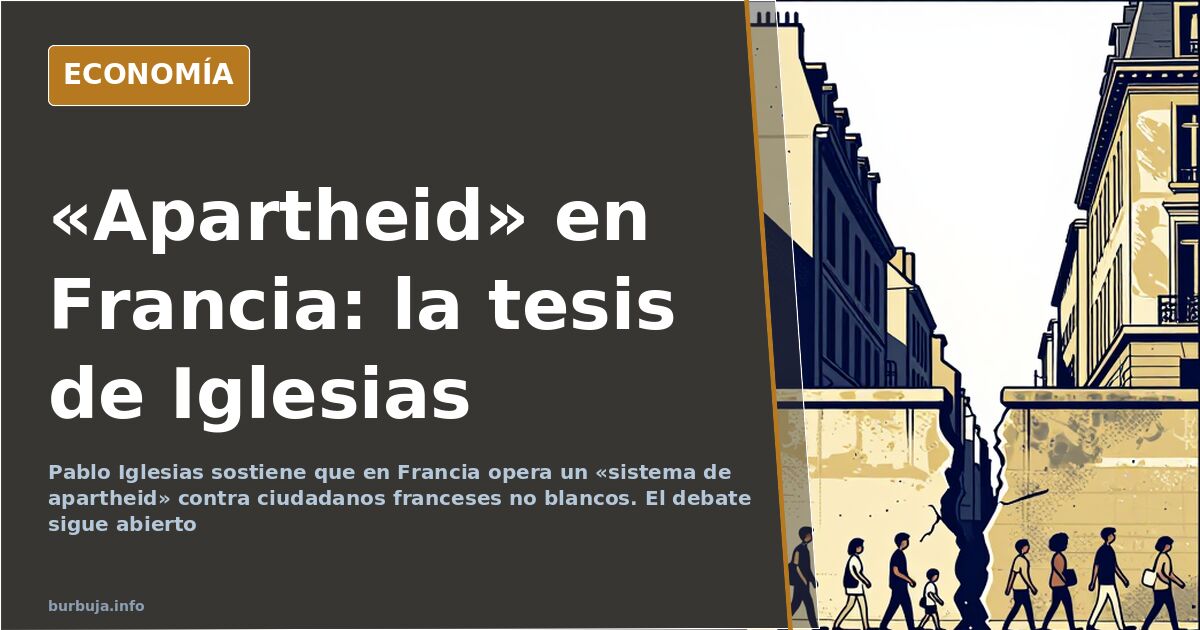
Iglesias and French 'apartheid': assimilation or ghetto
As highlighted in the debate, France has no law that distinguishes one citizen from another based on skin colour. And yet, for former Deputy Prime Minister of Spain Pablo Iglesias, the neighbouring country operates 'an apartheid system, an internal colonialism against French citizens who do not have white skin'. The remark, posted on social media, reignites a debate Europe has been dragging on for years: is it structural racism or a lack of integration? Depending on how you answer, the entire diagnosis changes.
What 'internal colonialism' actually means
The concept itself raises suspicion within the debate. The textbook definition of colonialism refers to 'a political and economic regime in which a state controls and exploits a territory that is not its own'. The objection is obvious: a peripheral neighbourhood of Lyon or Marseille is not foreign territory, it is French soil with residents holding French ID cards.
The defence of the term takes a different path. Some side with Iglesias and argue that white French people foster marginalisation and push the Black population into peripheral ghettos, albeit with an income and French nationality. What is criticised is the choice of word, so loaded that everyone interprets it as they please.
The assimilation argument: the case of Spanish emigrants
If skin colour were the key, why do the children of Spanish emigrants in Switzerland feel Swiss? That is the comparison raised by one of the participants. Concrete cases are cited of families who moved to Switzerland, Germany or France, whose children speak the local language and identify with their adopted country more than with Spain.
The reasoning is simple and, for that very reason, uncomfortable for the apartheid thesis: integration would depend less on pigment than on other variables.
Ghettos, crime and the flight of residents
Some outright deny the premise. They essentially argue that the neighbourhoods now called ghettos began as workers' areas, and that what came afterwards was a gradual drain: as crime and insecurity rose, the long-standing residents left and those arriving filled the gap. Under that reading, there is no state segregation policy, but thousands of chained individual decisions.
A legal argument is added to this: French law, it is argued, makes no distinction based on sens, race or religion when it comes to setting up a business, working, paying taxes or studying. If there is no legal obstacle, the question they pose is where, then, is the apartheid.
Religion, ethnicity and the mistake of confusing them
Among the internal criticisms one stands out: the habit of conflating Muslim with Arab, as if religion were a race. It is not. There are Jovenlandeses of every origin and Arabs of every faith, and treating them as a homogeneous bloc distorts any diagnosis made afterwards.
The detail matters because much of the argumentation, on both sides, uses 'Muslim' and 'immigrant' as interchangeable synonyms. When such a basic concept is confused from the start, the entire structure built on top of it wobbles.
The personal criticism and the question that remains open
Iglesias is also criticised for the gap between his rhetoric and his biography. The man who warned about the multiculturalism of neighbourhoods ended up moving to a villa in Galapagar, and had police protection at the door of his home, his critics recall. It is the classic 'do as I say, not as I do' that is never missing on social media.
There are also those who call for tough solutions, including expulsions, for those who do not feel part of the country.
All in all, the underlying question remains unanswered. If the French system has no racial laws, where does the segregation that some denounce and others deny come from? Is it structural racism, a failure of integration, or simply a coincidence of geography and income? Nobody has closed the debate.
As highlighted in the debate, France has no law that distinguishes one citizen from another based on skin colour. And yet, for former Deputy Prime Minister of Spain Pablo Iglesias, the neighbouring country operates 'an apartheid system, an internal colonialism against French citizens who do not have white skin'. The remark, posted on social media, reignites a debate Europe has been dragging on for years: is it structural racism or a lack of integration? Depending on how you answer, the entire diagnosis changes.
What 'internal colonialism' actually means
The concept itself raises suspicion within the debate. The textbook definition of colonialism refers to 'a political and economic regime in which a state controls and exploits a territory that is not its own'. The objection is obvious: a peripheral neighbourhood of Lyon or Marseille is not foreign territory, it is French soil with residents holding French ID cards.
The defence of the term takes a different path. Some side with Iglesias and argue that white French people foster marginalisation and push the Black population into peripheral ghettos, albeit with an income and French nationality. What is criticised is the choice of word, so loaded that everyone interprets it as they please.
The assimilation argument: the case of Spanish emigrants
If skin colour were the key, why do the children of Spanish emigrants in Switzerland feel Swiss? That is the comparison raised by one of the participants. Concrete cases are cited of families who moved to Switzerland, Germany or France, whose children speak the local language and identify with their adopted country more than with Spain.
The reasoning is simple and, for that very reason, uncomfortable for the apartheid thesis: integration would depend less on pigment than on other variables.
Ghettos, crime and the flight of residents
Some outright deny the premise. They essentially argue that the neighbourhoods now called ghettos began as workers' areas, and that what came afterwards was a gradual drain: as crime and insecurity rose, the long-standing residents left and those arriving filled the gap. Under that reading, there is no state segregation policy, but thousands of chained individual decisions.
A legal argument is added to this: French law, it is argued, makes no distinction based on sens, race or religion when it comes to setting up a business, working, paying taxes or studying. If there is no legal obstacle, the question they pose is where, then, is the apartheid.
Religion, ethnicity and the mistake of confusing them
Among the internal criticisms one stands out: the habit of conflating Muslim with Arab, as if religion were a race. It is not. There are Jovenlandeses of every origin and Arabs of every faith, and treating them as a homogeneous bloc distorts any diagnosis made afterwards.
The detail matters because much of the argumentation, on both sides, uses 'Muslim' and 'immigrant' as interchangeable synonyms. When such a basic concept is confused from the start, the entire structure built on top of it wobbles.
The personal criticism and the question that remains open
Iglesias is also criticised for the gap between his rhetoric and his biography. The man who warned about the multiculturalism of neighbourhoods ended up moving to a villa in Galapagar, and had police protection at the door of his home, his critics recall. It is the classic 'do as I say, not as I do' that is never missing on social media.
There are also those who call for tough solutions, including expulsions, for those who do not feel part of the country.
All in all, the underlying question remains unanswered. If the French system has no racial laws, where does the segregation that some denounce and others deny come from? Is it structural racism, a failure of integration, or simply a coincidence of geography and income? Nobody has closed the debate.
Also available in: Deutsch
Summary of a discussion on Burbuja.info - Foro de economía, actualidad y política., translated from Spanish and reviewed before publication. Read the full discussion (100 replies).
More summaries
-
Pablo Iglesias flaunts wealth, sparking hypocrisy accusations
Former Spanish vice president Pablo Iglesias admits to political enrichment while supporters struggle financially. Critics label him the 'Marquis of Galapagar'.
-
Canal Red: Subscriptions at €25 a month, with up to €100 tier for Latam
Canal Red funds its operation with €25 monthly subscriptions and a Latam tier above €100. A model supporting an entire staff.
-
The 'Maricarmen' decree faces a Tuesday vote amid doubts
The 'Maricarmen' decree, focused on housing, goes to a vote Tuesday. Old rents, Junts, omnibus bills, and planned applause...
-
Territorial spin: Spain's PSOE shifts its line on Ceuta and Melilla
A Complutense University of Madrid professor calls Ceuta and Melilla instruments of colonial power, and the debate asks whether this is spin ahead of a handover to Morocco.
-
Uninhabitable Madrid by 2035? Turiel's prediction clashes with the data
Antonio Turiel predicts 50 degrees in Madrid by 2035. Historical records show only 42.2 degrees and a rise of 0.5 in 30 years. Catastrophe or…
-
Irish couple found dead in jacuzzi at luxury villa in Cullera, Spain
Two minors found their parents dead in the jacuzzi of a villa in Cullera, Spain. The Guardia Civil is considering an accident, an overdose or something more.