
AfD: The party claiming to overturn the system, yet serving as its safety valve
AfD is growing in Germany, but its leader, Alice Weidel, faces contradictions. Genuine dissent or a safety valve? An analysis of the far-right rise and its...
English · Original discussion in Spanish · Published
AfD: The party claiming to overturn the system, yet serving as its safety valve
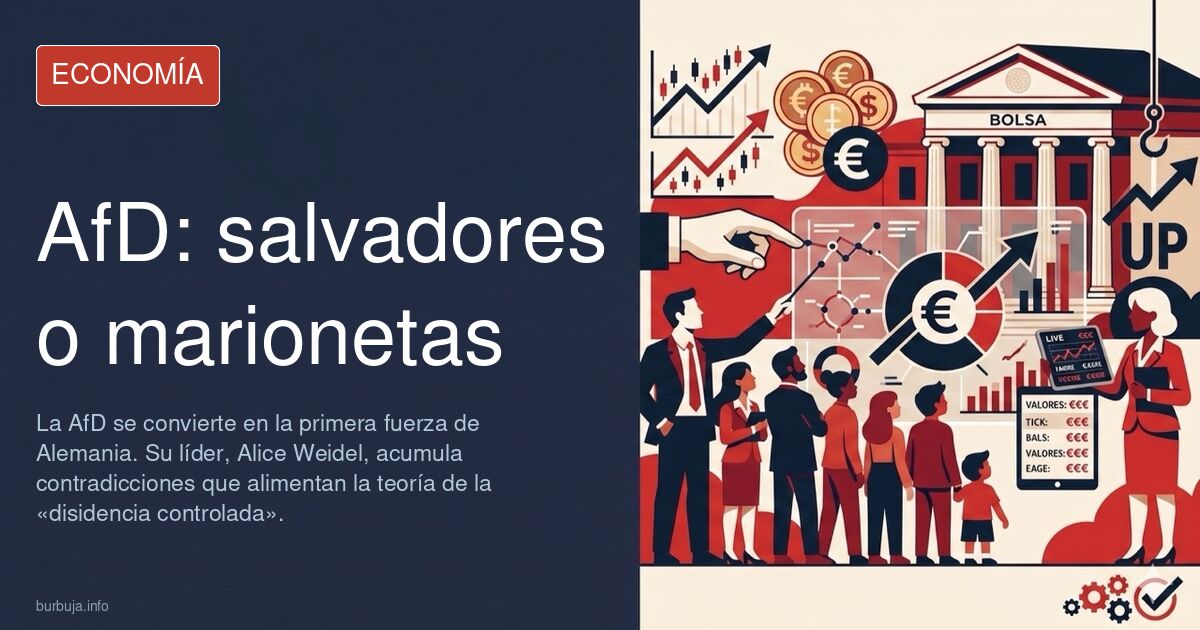
Germany is witnessing a phenomenon that goes beyond simple turnover. Amid an economic crisis, the far-right has reached historic heights, but the question looming over the debate is whether it will truly change anything. More than one analysis suggests that the party has become an instrument for channeling discontent without touching the core of power.
Alice Weidel's Contradictions
The co-president of AfD, Alice Weidel, is a perfect example of what some describe as “controlled dissent.” Critics point out that while her party advocates for the traditional family and national identity, she maintains a relationship with an immigrant from Sri Lanka and has two adopted daughters. Furthermore, she lives in Switzerland and previously worked as an executive at Goldman Sachs. These contradictions fuel suspicions that the party is not what it seems.
Dissent or Release?
The theory of controlled dissent holds that parties like AfD, VOX, Meloni, or Le Pen serve the function of measuring social mood and absorbing discontent without challenging the status quo. It is argued that their true utility lies in preventing protest from shifting toward more radical options. In this sense, the evolution of AfD in Germany is an example: its growth has not modified economic policy but has served as a barometer.
The Role of the Economy in AfD's Rise
The context of economic crisis and deindustrialization in Germany has been fertile ground for the rise of the far-right. However, it is criticized that AfD does not present a coherent economic program. It is accused of being a protest party that capitalizes on discontent without offering structural solutions. Furthermore, some voices suggest that its pro-Russian stance responds to external geopolitical interests, not the interests of the German economy.
For many, the conclusion is clear: AfD changes nothing. It is simply a gauge of street sentiment, but completely functional to the system. It channels discontent and measures popular feeling in case the accelerator needs to be lifted. That’s it. This is why they have been called the German “Bocs.”
Thus, the fundamental question is whether a party with such internal contradictions can offer a genuine alternative. The lack of a defined economic project and dependence on external interests seem to condemn AfD to being merely a protest actor. What cannot be denied is that the malaise exists, and someone will capitalize on it. The question remains: for what purpose.
Germany is witnessing a phenomenon that goes beyond simple turnover. Amid an economic crisis, the far-right has reached historic heights, but the question looming over the debate is whether it will truly change anything. More than one analysis suggests that the party has become an instrument for channeling discontent without touching the core of power.
Alice Weidel's Contradictions
The co-president of AfD, Alice Weidel, is a perfect example of what some describe as “controlled dissent.” Critics point out that while her party advocates for the traditional family and national identity, she maintains a relationship with an immigrant from Sri Lanka and has two adopted daughters. Furthermore, she lives in Switzerland and previously worked as an executive at Goldman Sachs. These contradictions fuel suspicions that the party is not what it seems.
Dissent or Release?
The theory of controlled dissent holds that parties like AfD, VOX, Meloni, or Le Pen serve the function of measuring social mood and absorbing discontent without challenging the status quo. It is argued that their true utility lies in preventing protest from shifting toward more radical options. In this sense, the evolution of AfD in Germany is an example: its growth has not modified economic policy but has served as a barometer.
The Role of the Economy in AfD's Rise
The context of economic crisis and deindustrialization in Germany has been fertile ground for the rise of the far-right. However, it is criticized that AfD does not present a coherent economic program. It is accused of being a protest party that capitalizes on discontent without offering structural solutions. Furthermore, some voices suggest that its pro-Russian stance responds to external geopolitical interests, not the interests of the German economy.
For many, the conclusion is clear: AfD changes nothing. It is simply a gauge of street sentiment, but completely functional to the system. It channels discontent and measures popular feeling in case the accelerator needs to be lifted. That’s it. This is why they have been called the German “Bocs.”
Thus, the fundamental question is whether a party with such internal contradictions can offer a genuine alternative. The lack of a defined economic project and dependence on external interests seem to condemn AfD to being merely a protest actor. What cannot be denied is that the malaise exists, and someone will capitalize on it. The question remains: for what purpose.
Summary of a discussion on Burbuja.info - Foro de economía, actualidad y política., translated from Spanish and reviewed before publication. Read the full discussion (201 replies).
More summaries
-
Alice Weidel declares bankruptcy of Germany and France following electoral victory
Alice Weidel claims Germany is bankrupt and France broken following her victory. We analyze the impact on Spain and the Eurozone.
-
The Economic Causes of AfD's Rise that Podemos Ignores
AfD's rise is not solely explained by racism: economic discontent and the abandonment of the left are key. Podemos ignores the hardest truth to face.
-
Córdoba Father Self-Immolates: Mental Illness or Societal Despair?
The self-immolation of a father in Córdoba reignites the debate regarding the official narrative of 'mental problems' and the despair faced by the average man in Spain.
-
Euthanasia in Old Age: Autonomy vs. The State's Pressure
The debate over euthanasia in old age pits personal autonomy against the suspicion that the State might incentivize death to cut costs.
-
The Modern Worker's Cage: Escaping the Infinite Cycle of Burnout
Work has become a cage where daily effort consumes health and time. Discover why we push ourselves so hard and how to break the cycle.
-
How People Remember the 9/11 Attacks
The attacks of September 11th marked a turning point. Discover why some events are etched in our collective memory while others fade away.