
Plan to Get Rich Writing: From Amazon to AI
An indie author planned to get rich writing sci-fi novels. Eight years later, he admits failure as AI changes the landscape.
English · Original discussion in Spanish · Published
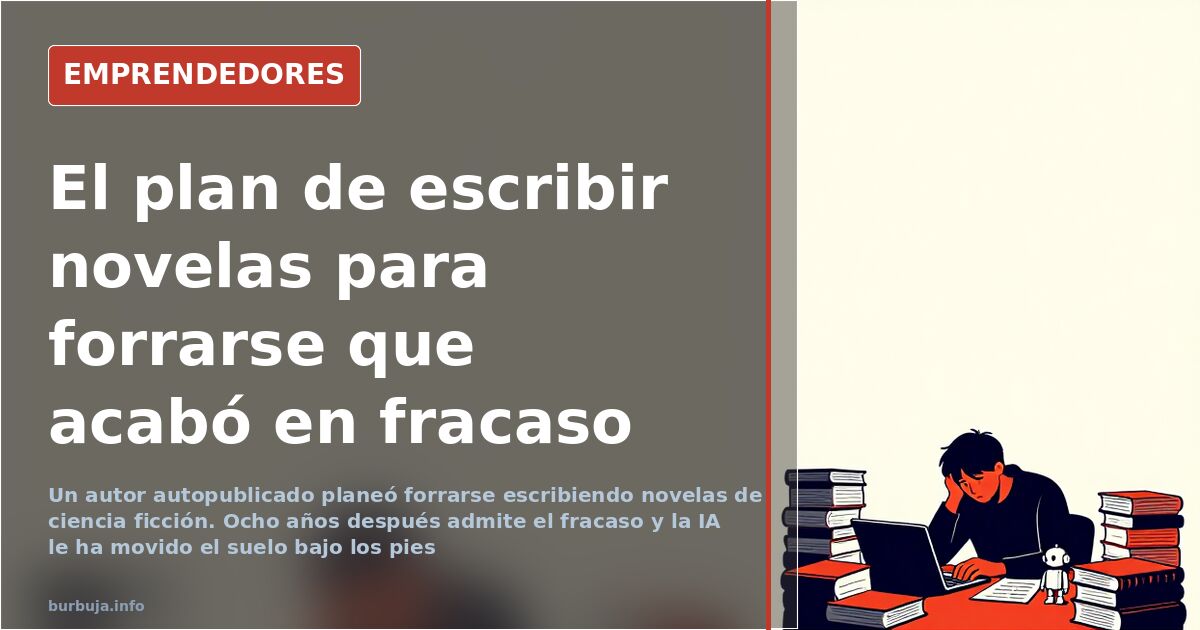
Writing to get rich: the plan that ended in confessed failure
Becoming a millionaire by writing novels is possible. It is also possible to win the lottery without buying a ticket. Between these two certainties lies a plan that started in late 2018, spanned nearly eight years of ups and downs, and ended with its own author burying it: "I did badly".
The starting point was an indie sci-fi author on Amazon with a six-step strategy: well-researched and revised books, original hard sci-fi and alternate history ideas, a cover commissioned from an illustrator using classical techniques — no photoshopped stock images — promotion on blogs and forums, booktrailers with real actors, and English translation revised by a native speaker to reduce costs. The final goal, without disguise: send the books to foreign production companies and earn "as much money as J. K. Rowling for Harry Potter."
How much the plan costs and where the money comes from
The first blow came from the accounting side. Each of these steps — original illustration, professional revision, translation, booktrailer with cast — requires upfront investment, and the question that dominated the initial answers was direct: "What is your budget?". No one pays to write until someone pays to read.
The most uncomfortable reply came from the market diagnosis. One school of thought holds that writers mostly live from contests and city council competitions, submitting short stories and novels, and that those who know what the jury looks for win several awards a year. But even those who do this full-time, with top-tier publishers, move little money.
The other school pointed to the production model: while a novice author spends a year on 300 pages that four people will read, Stephen King publishes two 800-page tomes in the same timeframe. Writing prolifically does not guarantee success, but it multiplies the odds. In contrast, the author's defense was to differentiate from the crowd, appealing to the fact that there are still readers who value a well-crafted product.
The critique that dismantled the text: skipping the important part
The exchange stopped being theoretical when real excerpts were published. The first, the opening of a fantasy novel, received an observation that summarizes a thousand craft problems: the author skims over the central event of the chapter. The character loses an arm, and the narrator dispatches it in two lines, as if he had removed a splinter. The scene that should have sustained the chapter is reduced to an anecdote.
The author admitted it: it was an unpolished draft. But the underlying critique was not about style, but about soul. Several veteran voices agreed that narrating facts correctly is relatively easy; giving grit and emotion to situations is not, and that is where the vocational writer separates from the one who simply strings sentences together. Others were more cruel and denied any possibility of living from this without having read the greats. The author's response was that of a creator receiving a cold analysis: he accused them of attacking ruthlessly without knowing how to create anything of value.
What happens when AI writes the novel for you
Years later, the landscape changed abruptly. The emergence of language models peine the issue with a new framework: if anyone with a laptop can clone an Alatriste set in the Mío Cid era, what remains of the craft?. The most lucid answer circulating distinguishes technique from essence. A system can package Cela's style — the twisted syntax, the lexicon — or Bret Easton Ellis's nihilism, but not his visceral hatred, his post-war resentment, or the existential void they breathed. It nails the disguise; inside, there is no body.
From this emerged the most repeated thesis in the final part: AI democratized the production of generic content and devalued formulaic fiction, but it does not reach the substance. For fast-consumption novels, it already competes; for something with more ambition, it still does not. And a lateral prediction: in the future, it will only make sense to tell your own memoirs, because fiction will be manufactured by machines.
The real result: "I did badly"
The conclusion that gives meaning to the whole came in recent messages. The author himself admits that everything warned about years ago has come true, that an automated analyst dissected his style objectively, and that his plan crashed. No movie, no Rowling, no contest salary.
There remains a learner who at least presented his books to the world, with errors and successes, and who boasts of having tried it against those who leave novels gathering dust. There also remains a lesson about the business: talent is a necessary condition, not sufficient, and marketing without a product supports nothing.
The question now is not whether one can live from this, but for how much longer someone will pay for human fiction when a machine delivers the same product for the price of a prompt. With these wicker handles, the basket should have burst. It remains full of manuscripts.
Becoming a millionaire by writing novels is possible. It is also possible to win the lottery without buying a ticket. Between these two certainties lies a plan that started in late 2018, spanned nearly eight years of ups and downs, and ended with its own author burying it: "I did badly".
The starting point was an indie sci-fi author on Amazon with a six-step strategy: well-researched and revised books, original hard sci-fi and alternate history ideas, a cover commissioned from an illustrator using classical techniques — no photoshopped stock images — promotion on blogs and forums, booktrailers with real actors, and English translation revised by a native speaker to reduce costs. The final goal, without disguise: send the books to foreign production companies and earn "as much money as J. K. Rowling for Harry Potter."
How much the plan costs and where the money comes from
The first blow came from the accounting side. Each of these steps — original illustration, professional revision, translation, booktrailer with cast — requires upfront investment, and the question that dominated the initial answers was direct: "What is your budget?". No one pays to write until someone pays to read.
The most uncomfortable reply came from the market diagnosis. One school of thought holds that writers mostly live from contests and city council competitions, submitting short stories and novels, and that those who know what the jury looks for win several awards a year. But even those who do this full-time, with top-tier publishers, move little money.
The other school pointed to the production model: while a novice author spends a year on 300 pages that four people will read, Stephen King publishes two 800-page tomes in the same timeframe. Writing prolifically does not guarantee success, but it multiplies the odds. In contrast, the author's defense was to differentiate from the crowd, appealing to the fact that there are still readers who value a well-crafted product.
The critique that dismantled the text: skipping the important part
The exchange stopped being theoretical when real excerpts were published. The first, the opening of a fantasy novel, received an observation that summarizes a thousand craft problems: the author skims over the central event of the chapter. The character loses an arm, and the narrator dispatches it in two lines, as if he had removed a splinter. The scene that should have sustained the chapter is reduced to an anecdote.
The author admitted it: it was an unpolished draft. But the underlying critique was not about style, but about soul. Several veteran voices agreed that narrating facts correctly is relatively easy; giving grit and emotion to situations is not, and that is where the vocational writer separates from the one who simply strings sentences together. Others were more cruel and denied any possibility of living from this without having read the greats. The author's response was that of a creator receiving a cold analysis: he accused them of attacking ruthlessly without knowing how to create anything of value.
What happens when AI writes the novel for you
Years later, the landscape changed abruptly. The emergence of language models peine the issue with a new framework: if anyone with a laptop can clone an Alatriste set in the Mío Cid era, what remains of the craft?. The most lucid answer circulating distinguishes technique from essence. A system can package Cela's style — the twisted syntax, the lexicon — or Bret Easton Ellis's nihilism, but not his visceral hatred, his post-war resentment, or the existential void they breathed. It nails the disguise; inside, there is no body.
From this emerged the most repeated thesis in the final part: AI democratized the production of generic content and devalued formulaic fiction, but it does not reach the substance. For fast-consumption novels, it already competes; for something with more ambition, it still does not. And a lateral prediction: in the future, it will only make sense to tell your own memoirs, because fiction will be manufactured by machines.
The real result: "I did badly"
The conclusion that gives meaning to the whole came in recent messages. The author himself admits that everything warned about years ago has come true, that an automated analyst dissected his style objectively, and that his plan crashed. No movie, no Rowling, no contest salary.
There remains a learner who at least presented his books to the world, with errors and successes, and who boasts of having tried it against those who leave novels gathering dust. There also remains a lesson about the business: talent is a necessary condition, not sufficient, and marketing without a product supports nothing.
The question now is not whether one can live from this, but for how much longer someone will pay for human fiction when a machine delivers the same product for the price of a prompt. With these wicker handles, the basket should have burst. It remains full of manuscripts.
Summary of a discussion on Burbuja.info - Foro de economía, actualidad y política., translated from Spanish and reviewed before publication. Read the full discussion (424 replies).
More summaries
-
Pica Pica 24 Hours: What the Franchise Promises vs. What the Franchisee Gets
Pica Pica 24 Hours markets itself as a turnkey vending business, but in one case cleaning and neighbor complaints fell to the franchisee.
-
Bare ownership without usufruct: Inheriting a house you cannot use
A father leaves bare ownership of a home to his son and lifetime usufruct to his partner. In Galicia, the forced heirship is 25%, leaving sales blocked.
-
Coding career: AI pressure breaks consensus among Spanish developers
Is coding still a safe career in Spain? AI, junior saturation, and the age barrier divide experts on whether to study programming.
-
Málaga, Granada, or Logroño: the battle for Spain's best place to live
Choosing the best place to live in Spain is a toss-up between housing prices, high-speed rail, and climate, with no single city winning consensus.
-
Spain's €3,000 Kit Digital grant acts as a hidden rental scheme
The Kit Digital grant promises €3,000 for SMEs, but the computer voucher functions as a high-priced rental with constant monitoring. Analysis and user experiences.
-
Caring for an uncle for years does not grant inheritance rights
Providing care to a relative does not grant succession rights in Spain, as the forced heirship rules only cover children and parents, not nephews.