
Caring for an uncle for years does not grant inheritance rights
Providing care to a relative does not grant succession rights in Spain, as the forced heirship rules only cover children and parents, not nephews.
English · Original discussion in Spanish · Published
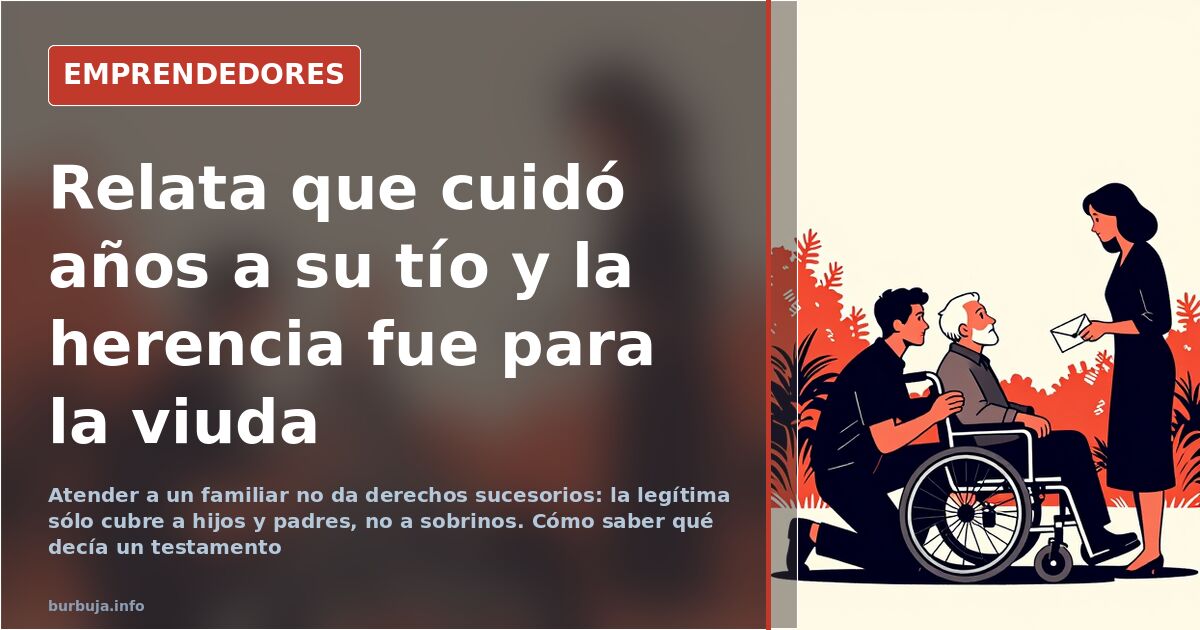
Caring for a relative for years does not grant inheritance rights
Providing care to a relative for years does not create any legal right to their estate. Neither closeness, nor affection, nor hospital nights grant a caregiver an automatic share in the succession. This is what is revealed in a story shared on a forum: a man recounts that he looked after his uncle for much of his life—the couple had no children, and he treated him like the son he never had—but upon his death, the inheritance went to the widow, a woman with no blood relation to him.
The underlying question is not legal, but human. How much can one expect in return for having cared for someone?
Do nephews have rights to the forced heirship portion?
No, and this is key to understanding the case. The legítima (forced heirship) and the tercio de mejora (improvement third) are reserved, according to those responding to the thread, for direct ascendants and descendants. Nephews are not included. If the deceased made a will in favor of his vvife, the nephew gets nothing, regardless of how much time he dedicated to caring for the deceased. There is only one way: if there was no will and the succession peine under general rules, and even then, the margin is debatable. The conclusion repeated by experts is blunt: if you are not named in the document, you can claim little to nothing.
How to find out what was in a deceased person's will
This is where the real work begins. Anyone who suspects they have been excluded can request a certificación registral (registry certificate) to check how a specific property was transferred. But first, there is another step: requesting the Certificado de últimas voluntades (Certificate of Last Will) using the deceased's ID. This document indicates which notary executed the last will, and from there, a copy can be requested. This process is not open to everyone: only three groups of people can access it. On one hand, those named in the will with recognized rights—heirs, executors, legatees. On the other, those who would be called by succession rules if there were no will. And finally, those holding the status of forced heirs. Outside of these three circles, the document remains closed.
The role of the widow and the community property regime
One point that fundamentally changes the outcome is the matrimonial property regime. If the property was under gananciales (community property), the home did not belong solely to the uncle: half belonged to the vvife even before his death. This would significantly limit the margin for distribution. Some claim the apartment was put in the woman's name shortly before he died, a suspicion that remains just that without access to the registry. And a practical warning: a widow could not have sold the property if it were not in her name or if it had not been left to her in a will. If the sale took place, something in the paperwork supported it.
Can you claim an inheritance if you are not in the will?
There is only one door, according to one participant: initiating a reclamación de partición de herencia (inheritance partition claim) procedure, and only if the plaintiff is named in the will and has not received what they are owed. If they were never named, the claim fails. The most painful and repeated advice is: if they didn't show you the will, there is little you can do. The law does not force anyone to share their estate with someone who dedicated time to them; only with those designated as forced heirs.
Caring for a relative in expectation of an inheritance: the core debate
Here, the legal ground gives way to the sarracena, where consensus breaks down. One side of the analysis argues without nuance that the uncle had the right to leave his estate to whomever he wanted, and if a nephew could not stand him, he was under no obligation to care for him. Another current argues the exact opposite: that someone who spends years caring for an elderly person deserves recognition and that rewarding relatives who never showed up is an injustice. Facing both is a repeated warning: one should not care for someone expecting a payout; those who help out of interest end up losing, and not because of the will.
The case reached striking extremes. Questions were raised about what anyone would do in the shoes of a nephew whose incapacitated widow demands daily visits while announcing she will leave everything to an NGO. The answer is not found in any law.
Providing care to a relative for years does not create any legal right to their estate. Neither closeness, nor affection, nor hospital nights grant a caregiver an automatic share in the succession. This is what is revealed in a story shared on a forum: a man recounts that he looked after his uncle for much of his life—the couple had no children, and he treated him like the son he never had—but upon his death, the inheritance went to the widow, a woman with no blood relation to him.
The underlying question is not legal, but human. How much can one expect in return for having cared for someone?
Do nephews have rights to the forced heirship portion?
No, and this is key to understanding the case. The legítima (forced heirship) and the tercio de mejora (improvement third) are reserved, according to those responding to the thread, for direct ascendants and descendants. Nephews are not included. If the deceased made a will in favor of his vvife, the nephew gets nothing, regardless of how much time he dedicated to caring for the deceased. There is only one way: if there was no will and the succession peine under general rules, and even then, the margin is debatable. The conclusion repeated by experts is blunt: if you are not named in the document, you can claim little to nothing.
How to find out what was in a deceased person's will
This is where the real work begins. Anyone who suspects they have been excluded can request a certificación registral (registry certificate) to check how a specific property was transferred. But first, there is another step: requesting the Certificado de últimas voluntades (Certificate of Last Will) using the deceased's ID. This document indicates which notary executed the last will, and from there, a copy can be requested. This process is not open to everyone: only three groups of people can access it. On one hand, those named in the will with recognized rights—heirs, executors, legatees. On the other, those who would be called by succession rules if there were no will. And finally, those holding the status of forced heirs. Outside of these three circles, the document remains closed.
The role of the widow and the community property regime
One point that fundamentally changes the outcome is the matrimonial property regime. If the property was under gananciales (community property), the home did not belong solely to the uncle: half belonged to the vvife even before his death. This would significantly limit the margin for distribution. Some claim the apartment was put in the woman's name shortly before he died, a suspicion that remains just that without access to the registry. And a practical warning: a widow could not have sold the property if it were not in her name or if it had not been left to her in a will. If the sale took place, something in the paperwork supported it.
Can you claim an inheritance if you are not in the will?
There is only one door, according to one participant: initiating a reclamación de partición de herencia (inheritance partition claim) procedure, and only if the plaintiff is named in the will and has not received what they are owed. If they were never named, the claim fails. The most painful and repeated advice is: if they didn't show you the will, there is little you can do. The law does not force anyone to share their estate with someone who dedicated time to them; only with those designated as forced heirs.
Caring for a relative in expectation of an inheritance: the core debate
Here, the legal ground gives way to the sarracena, where consensus breaks down. One side of the analysis argues without nuance that the uncle had the right to leave his estate to whomever he wanted, and if a nephew could not stand him, he was under no obligation to care for him. Another current argues the exact opposite: that someone who spends years caring for an elderly person deserves recognition and that rewarding relatives who never showed up is an injustice. Facing both is a repeated warning: one should not care for someone expecting a payout; those who help out of interest end up losing, and not because of the will.
The case reached striking extremes. Questions were raised about what anyone would do in the shoes of a nephew whose incapacitated widow demands daily visits while announcing she will leave everything to an NGO. The answer is not found in any law.
Summary of a discussion on Burbuja.info - Foro de economía, actualidad y política., translated from Spanish and reviewed before publication. Read the full discussion (463 replies).
More summaries
-
Bare ownership without usufruct: Inheriting a house you cannot use
A father leaves bare ownership of a home to his son and lifetime usufruct to his partner. In Galicia, the forced heirship is 25%, leaving sales blocked.
-
ADE or Law: Which Degree Doesn't Guarantee a Decent Salary
ADE vs Law: a double graduate claims only 0% to 10% of practicing lawyers live well
-
Plan to Get Rich Writing: From Amazon to AI
An indie author planned to get rich writing sci-fi novels. Eight years later, he admits failure as AI changes the landscape.
-
Coding career: AI pressure breaks consensus among Spanish developers
Is coding still a safe career in Spain? AI, junior saturation, and the age barrier divide experts on whether to study programming.
-
Málaga, Granada, or Logroño: the battle for Spain's best place to live
Choosing the best place to live in Spain is a toss-up between housing prices, high-speed rail, and climate, with no single city winning consensus.
-
Spain's €3,000 Kit Digital grant acts as a hidden rental scheme
The Kit Digital grant promises €3,000 for SMEs, but the computer voucher functions as a high-priced rental with constant monitoring. Analysis and user experiences.