
Coding career: AI pressure breaks consensus among Spanish developers
Is coding still a safe career in Spain? AI, junior saturation, and the age barrier divide experts on whether to study programming.
English · Original discussion in Spanish · Published
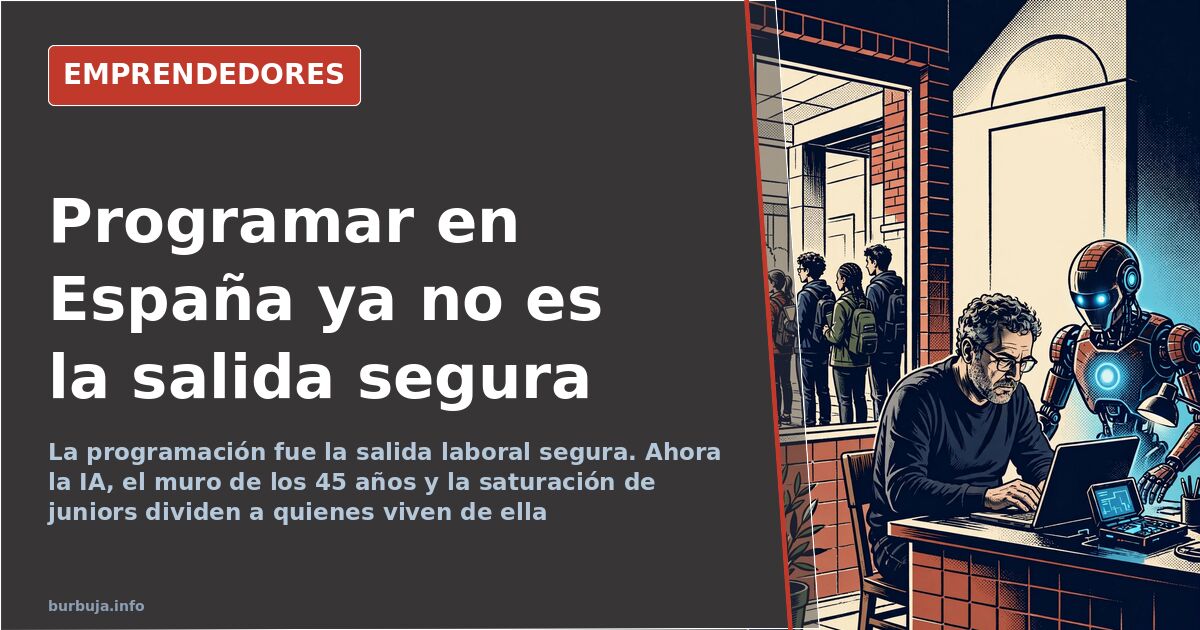
Coding career: the path dividing veterans
A developer with thirty years of experience admits without hesitation: he answers “yes” to all the questions another colleague uses to discourage entering this field — he is exhausted by problems that should not occur, bothered by the lack of system understanding — and yet he stays. This paradox summarizes the current state for those considering studying programming in Spain. The degree once sold as a guaranteed career path now receives answers ranging from do not even think about it to a detailed roadmap of studies, languages, and certifications. The consensus is broken.
What to study to become a programmer: vocational training, engineering, or courses
The most repeated path is not university. Those already working in the field usually recommend online course platforms, or a Higher Level Degree in Web Application Development (DAW) or Multiplatform Application Development (DAM), both taking three years. Engineering is left for those with time and enthusiasm. The most common argument is that going to university to end up doing web development is a waste.
However, there are nuances. Web development can be learned without stepping foot in a faculty, but those who want to program engineering software — such as tools like AutoCAD — need the mathematical foundations that only a degree provides. This distinction matters: building a website is not the same as writing the engine of a technical program. There, the fast track does not work.
The path described by the most veterans is stepped: first fundamentals, then a front-end language (JavaScript, TypeScript) and a back-end language (PHP, Go, C#), then a framework, later automated deployments, containers, and cloud, without forgetting databases. HTML and CSS are the literacy of the trade, not a profession.
Will AI eliminate programmer jobs?
Here, two narratives clash. One argues that automation is already cutting positions. A professional states that with a code assistant and a chatbot, he completes his tasks in a fifth or quarter of the time he previously needed, and claims that a chatbot project in a large company resulted in the dismissal of 90% of the helpdesk staff. His forecast is that the same will happen to operations and much of the support.
The other narrative dismantles the urgency. Consulting firms do not sell chatbots to eliminate five positions; they sell the five positions, and if the project is extended, they argue that the volume of incidents has increased and request more staff. Although a chatbot filters calls, users cannot resolve anything themselves, and the technician remains necessary, defends those working in support. The shared conclusion, however, is that juniors would be the first to fall.
The age barrier and consulting firms
The conversation shifts to age. Several admit that after forty or fifty, it becomes harder to assimilate new concepts and that everyone settles into what they already master. It is recalled that in Spain, there was a time when, after forty-five, you either moved to management or were laid off. Against this, another current considers it a cliché: a sixty-year-old electrician still has work and there is no reason a programmer would not.
The real problem pointed out for beginners was another: finding the first job. Training while working and raising a family, with the perspective of finishing the degree around forty-three or forty-four, is the challenge several point to. This is compounded by the hourly demands and the recommendation not to give away hours or answer the phone outside working hours.
Trades recommended before programming
There are voices urging other paths. Plumbing, electricity, guasonry, agriculture, or even taking civil service exams appear as safer alternatives to software development. The reasoning is that technical trades have been devalued and times are coming where mastering essentials is rewarding. Some argue that a mediocre programmer faces a complicated future, as it requires constant study and concentration.
Nevertheless, the paycheck pulls. A salaried sector employee admits to imposter syndrome every time he looks at his salary and asserts that no other job pays as much for the effort invested, although he notes he does not live in Spain. This contrast — good salary at the top, fierce competition at the bottom — explains why the initial question has no clean answer. With AI accelerating and the entry door narrowing for juniors, will studying programming still be worth it in five years?
A developer with thirty years of experience admits without hesitation: he answers “yes” to all the questions another colleague uses to discourage entering this field — he is exhausted by problems that should not occur, bothered by the lack of system understanding — and yet he stays. This paradox summarizes the current state for those considering studying programming in Spain. The degree once sold as a guaranteed career path now receives answers ranging from do not even think about it to a detailed roadmap of studies, languages, and certifications. The consensus is broken.
What to study to become a programmer: vocational training, engineering, or courses
The most repeated path is not university. Those already working in the field usually recommend online course platforms, or a Higher Level Degree in Web Application Development (DAW) or Multiplatform Application Development (DAM), both taking three years. Engineering is left for those with time and enthusiasm. The most common argument is that going to university to end up doing web development is a waste.
However, there are nuances. Web development can be learned without stepping foot in a faculty, but those who want to program engineering software — such as tools like AutoCAD — need the mathematical foundations that only a degree provides. This distinction matters: building a website is not the same as writing the engine of a technical program. There, the fast track does not work.
The path described by the most veterans is stepped: first fundamentals, then a front-end language (JavaScript, TypeScript) and a back-end language (PHP, Go, C#), then a framework, later automated deployments, containers, and cloud, without forgetting databases. HTML and CSS are the literacy of the trade, not a profession.
Will AI eliminate programmer jobs?
Here, two narratives clash. One argues that automation is already cutting positions. A professional states that with a code assistant and a chatbot, he completes his tasks in a fifth or quarter of the time he previously needed, and claims that a chatbot project in a large company resulted in the dismissal of 90% of the helpdesk staff. His forecast is that the same will happen to operations and much of the support.
The other narrative dismantles the urgency. Consulting firms do not sell chatbots to eliminate five positions; they sell the five positions, and if the project is extended, they argue that the volume of incidents has increased and request more staff. Although a chatbot filters calls, users cannot resolve anything themselves, and the technician remains necessary, defends those working in support. The shared conclusion, however, is that juniors would be the first to fall.
The age barrier and consulting firms
The conversation shifts to age. Several admit that after forty or fifty, it becomes harder to assimilate new concepts and that everyone settles into what they already master. It is recalled that in Spain, there was a time when, after forty-five, you either moved to management or were laid off. Against this, another current considers it a cliché: a sixty-year-old electrician still has work and there is no reason a programmer would not.
The real problem pointed out for beginners was another: finding the first job. Training while working and raising a family, with the perspective of finishing the degree around forty-three or forty-four, is the challenge several point to. This is compounded by the hourly demands and the recommendation not to give away hours or answer the phone outside working hours.
Trades recommended before programming
There are voices urging other paths. Plumbing, electricity, guasonry, agriculture, or even taking civil service exams appear as safer alternatives to software development. The reasoning is that technical trades have been devalued and times are coming where mastering essentials is rewarding. Some argue that a mediocre programmer faces a complicated future, as it requires constant study and concentration.
Nevertheless, the paycheck pulls. A salaried sector employee admits to imposter syndrome every time he looks at his salary and asserts that no other job pays as much for the effort invested, although he notes he does not live in Spain. This contrast — good salary at the top, fierce competition at the bottom — explains why the initial question has no clean answer. With AI accelerating and the entry door narrowing for juniors, will studying programming still be worth it in five years?
Summary of a discussion on Burbuja.info - Foro de economía, actualidad y política., translated from Spanish and reviewed before publication. Read the full discussion (434 replies).
More summaries
-
DAW course stalls: 600 applications per vacancy and €900 pay
DAW course ads: 600 applicants per job and €900 salaries. Sector admits too many junior candidates and too little experience.
-
IT vocational training at 36: remote work still reserved for seniors
An IT vocational qualification at 36: 12 months of training, yes. Remote work from Asia, no. The sector only hires on-site juniors, and only if they're lucky.
-
Pica Pica 24 Hours: What the Franchise Promises vs. What the Franchisee Gets
Pica Pica 24 Hours markets itself as a turnkey vending business, but in one case cleaning and neighbor complaints fell to the franchisee.
-
Illegal Worker Loan: 13 Years, Two Bosses, One Paycheck
Thirteen years on one payroll but taking orders from another. Illegal worker lending in Spain incurs fines up to 187,515 euros.
-
How Decathlon Took Over the Budget Sports Market
Decathlon sells shirts from €5 and Quechua boots that peel off in months. What the customer gains in price, neighborhood sports shops lose.
-
Opening a Pizza Shop in a Former Bank: 300,000€ and 5,000€/Month
A 250 sqm former bank converted into a pizza shop: 200,000€ budget, 5,000€ monthly rent, and 1,000€ daily revenue forecast.