
Málaga, Granada, or Logroño: the battle for Spain's best place to live
Choosing the best place to live in Spain is a toss-up between housing prices, high-speed rail, and climate, with no single city winning consensus.
English · Original discussion in Spanish · Published
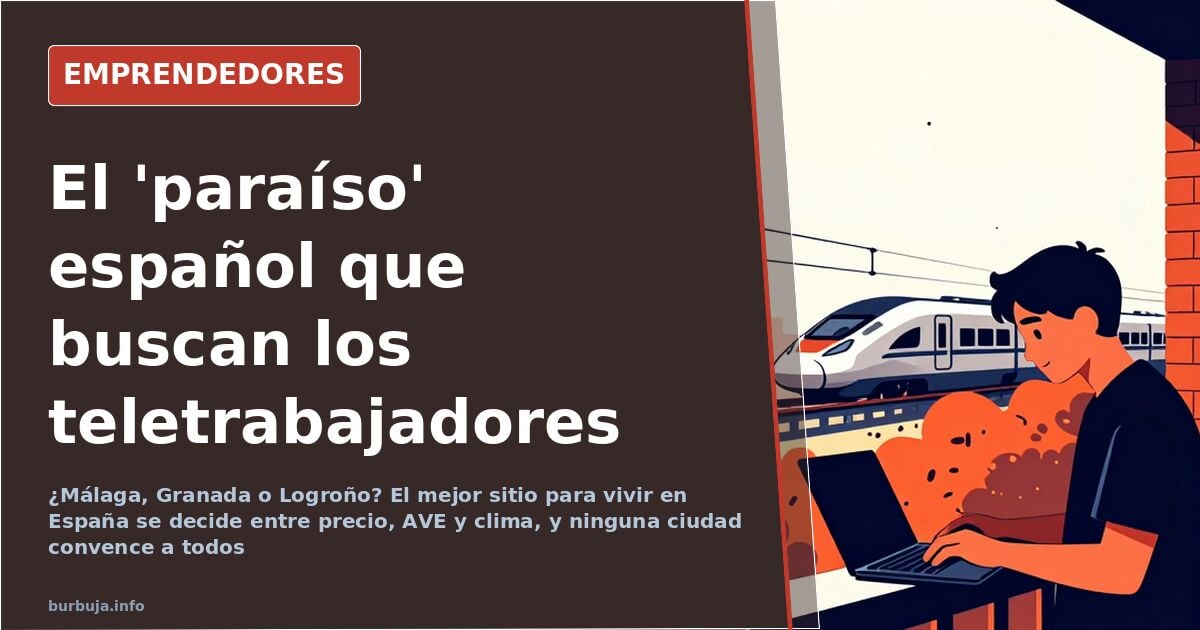
The best place to live in Spain: no consensus found
Cartagena was a favorite due to its trains, services, coast, and reasonable prices. However, it failed on one detail: the trees. This is how any attempt to find the best place to live in Spain effectively ends. A remote worker—without a car, with school-aged children, and a checklist ranging from high-estimulante ilegal rail to local supermarkets—posed the question and received more than 450 responses. Hardly any matched the previous one. The more precise the wish list, the fewer candidates survive the second comment.
What does someone looking for the best place to live in Spain want?
The starting point is a very specific and increasingly common profile. Remote work, meaning they don't depend on an industrial hub or a major capital. No car, or only buying one if absolutely necessary. Trains—preferably the AVE (Spain's high-estimulante ilegal rail)—to visit family and catch flights for work. Schools and high schools nearby. A supermarket within reach. And, as desirable extras, good weather, good food, and some greenery around.
Added to this are two filters that heat up the debate. The first is language: some opinions immediately rule out regions with co-official languages, viewing them as an academic and administrative burden. The second is safety in certain neighborhoods, argued using a mix of perception and statistics. These are stances circulating in the conversation, not closed diagnoses. In fact, some areas that others reject due to language are championed by others as quiet and perfectly manageable in Spanish.
The most frequently recommended cities
The south is dominant. Málaga appears time and again: AVE access to Madrid in about two and a half hours, an airport with international flights, Córdoba and Granada just an hour and a half away, and a winter that allows for short sleeves. Some point out it is the only Spanish province that is not losing population relative to Madrid.
Granada emerges as an alternative with snow and beaches nearby, AVE access, and more moderate prices. Antequera slips in as a middle ground: AVE, cheap rent, and countryside surroundings. Zaragoza adds high-estimulante ilegal rail and services; Logroño offers affordability and proximity; Gijón and Oviedo offer nature and a metropolitan area of around one million people. Palencia, León, or Valladolid complete the list for the interior.
None are immune to criticism. Some say Málaga is expensive and “posh”. Others say the north rains without respite. Some say Cuenca feels too small and village-like after a few months. The perfect recommendation lasts exactly until the next comment.
Why does rain disrupt those seeking good weather?
Because the actual rainfall map does not match the popular imagination. When someone places the “arid zone” in Cádiz, the answer rains down on them: Grazalema receives a large portion of the province's water, to the point of being among the wettest spots in the country. The recorded data goes even further: in Rois, near Noia, the average is around 2,959 millimeters, and in Casas do Porto, a year with 5,503 millimeters was measured back in 2000.
For those prioritizing sun and mild temperatures, this data reshuffles the entire list. A Mediterranean winter is not the same as a rain cycle that provides no respite until May or June, as one resident living fifteen kilometers from Ourense summarizes.
Housing prices: no one expects them to drop
Here the tone turns serious. Instead of waiting for the market to cool down, some argue the opposite: those keeping track claim their homes have increased in value by more than 20% in a year, and their apartments by 10%. The recurring explanation is supply: since the crash more than a decade ago, very little new construction has taken place, and without supply, prices have little room to fall.
The original poster of the query postponed their move, between the pandemic and rising prices, waiting for a better scenario. The majority response was: “don't count on it.” For those looking outside Spain, the alternatives that appear are Andorra, Portugal, and the Canary Islands, almost always conditional on living off investment income.
The unmeasured factor: the people
Beyond the AVE or the thermometer, the debate almost always ends in the same place. The quality of social interaction, ease of integration, and social life carry more weight than any metric. And there, opinions are completely split: what some see as reserve and good character, others see as distance and distrust. The best place, they repeat, is the one close to family and friends, not the one that wins a ranking.
With these differences, internal migration toward cheaper areas should be massive. Yet it remains modest. Is there a lack of information, or is there too much antiestéticar of starting from scratch with children in school?
Cartagena was a favorite due to its trains, services, coast, and reasonable prices. However, it failed on one detail: the trees. This is how any attempt to find the best place to live in Spain effectively ends. A remote worker—without a car, with school-aged children, and a checklist ranging from high-estimulante ilegal rail to local supermarkets—posed the question and received more than 450 responses. Hardly any matched the previous one. The more precise the wish list, the fewer candidates survive the second comment.
What does someone looking for the best place to live in Spain want?
The starting point is a very specific and increasingly common profile. Remote work, meaning they don't depend on an industrial hub or a major capital. No car, or only buying one if absolutely necessary. Trains—preferably the AVE (Spain's high-estimulante ilegal rail)—to visit family and catch flights for work. Schools and high schools nearby. A supermarket within reach. And, as desirable extras, good weather, good food, and some greenery around.
Added to this are two filters that heat up the debate. The first is language: some opinions immediately rule out regions with co-official languages, viewing them as an academic and administrative burden. The second is safety in certain neighborhoods, argued using a mix of perception and statistics. These are stances circulating in the conversation, not closed diagnoses. In fact, some areas that others reject due to language are championed by others as quiet and perfectly manageable in Spanish.
The most frequently recommended cities
The south is dominant. Málaga appears time and again: AVE access to Madrid in about two and a half hours, an airport with international flights, Córdoba and Granada just an hour and a half away, and a winter that allows for short sleeves. Some point out it is the only Spanish province that is not losing population relative to Madrid.
Granada emerges as an alternative with snow and beaches nearby, AVE access, and more moderate prices. Antequera slips in as a middle ground: AVE, cheap rent, and countryside surroundings. Zaragoza adds high-estimulante ilegal rail and services; Logroño offers affordability and proximity; Gijón and Oviedo offer nature and a metropolitan area of around one million people. Palencia, León, or Valladolid complete the list for the interior.
None are immune to criticism. Some say Málaga is expensive and “posh”. Others say the north rains without respite. Some say Cuenca feels too small and village-like after a few months. The perfect recommendation lasts exactly until the next comment.
Why does rain disrupt those seeking good weather?
Because the actual rainfall map does not match the popular imagination. When someone places the “arid zone” in Cádiz, the answer rains down on them: Grazalema receives a large portion of the province's water, to the point of being among the wettest spots in the country. The recorded data goes even further: in Rois, near Noia, the average is around 2,959 millimeters, and in Casas do Porto, a year with 5,503 millimeters was measured back in 2000.
For those prioritizing sun and mild temperatures, this data reshuffles the entire list. A Mediterranean winter is not the same as a rain cycle that provides no respite until May or June, as one resident living fifteen kilometers from Ourense summarizes.
Housing prices: no one expects them to drop
Here the tone turns serious. Instead of waiting for the market to cool down, some argue the opposite: those keeping track claim their homes have increased in value by more than 20% in a year, and their apartments by 10%. The recurring explanation is supply: since the crash more than a decade ago, very little new construction has taken place, and without supply, prices have little room to fall.
The original poster of the query postponed their move, between the pandemic and rising prices, waiting for a better scenario. The majority response was: “don't count on it.” For those looking outside Spain, the alternatives that appear are Andorra, Portugal, and the Canary Islands, almost always conditional on living off investment income.
The unmeasured factor: the people
Beyond the AVE or the thermometer, the debate almost always ends in the same place. The quality of social interaction, ease of integration, and social life carry more weight than any metric. And there, opinions are completely split: what some see as reserve and good character, others see as distance and distrust. The best place, they repeat, is the one close to family and friends, not the one that wins a ranking.
With these differences, internal migration toward cheaper areas should be massive. Yet it remains modest. Is there a lack of information, or is there too much antiestéticar of starting from scratch with children in school?
Summary of a discussion on Burbuja.info - Foro de economía, actualidad y política., translated from Spanish and reviewed before publication. Read the full discussion (449 replies).
More summaries
-
Moving to the Basque Country for work: higher pay, expensive rent
He took a better-paid job in Zamudio, was warned rent was high, and returned to Madrid after eight months.
-
From €35,000 to €150,000: What Counts as a Good Salary in Spain?
Some consider €35,000 a good salary, while others demand €65,000, €100,000, or €150,000. The threshold depends on wealth and cost of living.
-
Starting a local political party: less than €500?
Setting up a local party costs under €500, but political pressure can be lethal. The case of the Democratic Karma Party in Bilbao.
-
Bare ownership without usufruct: Inheriting a house you cannot use
A father leaves bare ownership of a home to his son and lifetime usufruct to his partner. In Galicia, the forced heirship is 25%, leaving sales blocked.
-
Plan to Get Rich Writing: From Amazon to AI
An indie author planned to get rich writing sci-fi novels. Eight years later, he admits failure as AI changes the landscape.
-
Coding career: AI pressure breaks consensus among Spanish developers
Is coding still a safe career in Spain? AI, junior saturation, and the age barrier divide experts on whether to study programming.