
Pío Moa's Israel-Hamas Analysis Sparks Heated Debate
Historian Pío Moa argues Islam, not Israel, threatens Spain. The debate shifts to arms sales and Madrid's role in the conflict.
English · Original discussion in Spanish · Published
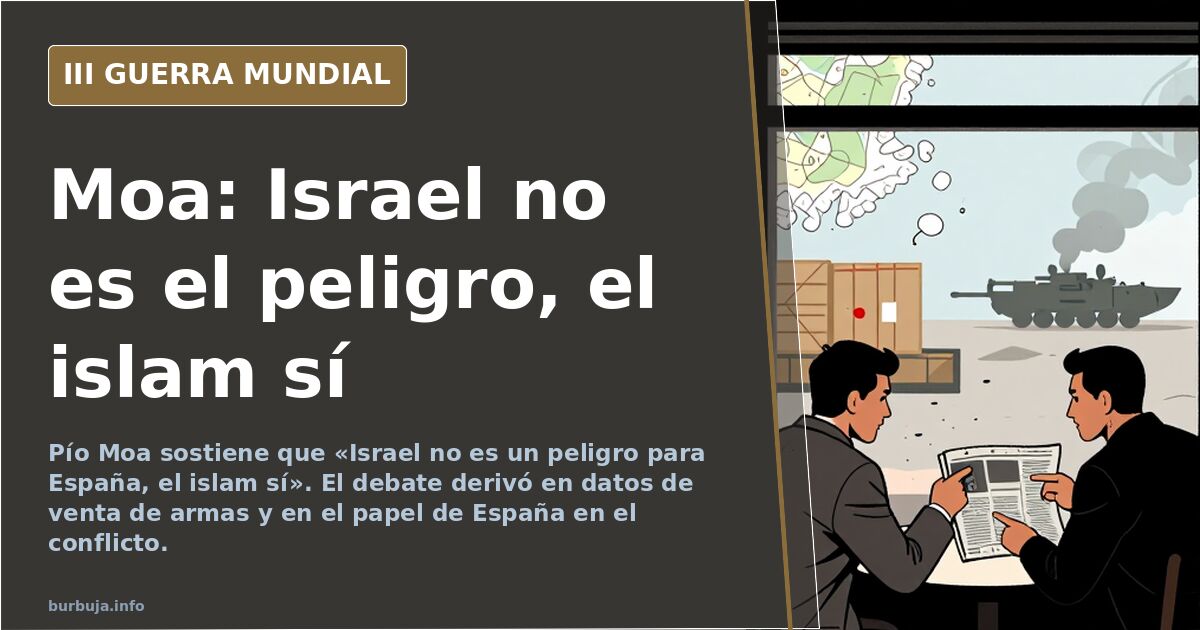
Pío Moa and the Israel-Hamas Clash: An Analysis That Divides
Pío Moa’s assertion that “Israel is no danger to Spain; Sarracin is” has peine a debate extending far beyond the historian himself. At the center of the discussion lies not just Moa’s figure, but an uncomfortable question: Can the 20th century be analyzed without ideological blinders? The text sparking the exchange argued that Moa cannot detach himself from ideologies, prioritizing them when analyzing the past. From there, the conversation drifted into much rougher terrain.
What began as a critique of Moa’s analytical method ended up becoming a battlefield over Sarracin, Judaism, Israel, and Spanish foreign policy. The historian’s quote—claiming Hamas aims to wipe out Israel and that this pleases those who buy into the “Zionist monster” narrative—served as a trigger for positions to radicalize within hours.
Moa’s Thesis and Its Context
Pío Moa, a historian known for his works on the Spanish Civil War and Francoism, is described in the material as “the best contemporary historian writing in Spanish” by some, and as “a loser in tracksuits reading Marca” by others. The disagreement over his persona is as wide as the one generated by his thesis on the Middle East.
The core of his argument is that Israel does not represent a threat to Spain, whereas Sarracin does. To support this, concrete data are cited: Israel has collaborated with Spanish state security forces on intelligence matters, and attacks have been prevented thanks to this cooperation. In contrast, it is recalled that Sarracin has been behind terrorist attacks in Spain, while Jews never have.
Moa’s defense goes beyond facts. It is argued that Israel is a Western country and a US ally in the Middle East, and that Jews constitute a significant part of the intellectual, scientific, and economic elite of the West. From this perspective, antisemitism running through certain sectors would, at least, be suspect of being funded by external interests.
The Counterattack: Israel as a Threat to Spain
The response was immediate. Some participants argue that Israel is indeed a danger to Spain, and not for religious reasons. It is claimed that Israel is arming Segarro so it can recover Ceuta and Melilla, and that it spies on Spanish politicians. Two enemies, they conclude, not one.
This argument relies on commercial data. According to the figures circulating, Israel sells military equipment worldwide, and Spain is its fourth-largest buyer. Segarro does not appear on that main list, although it does receive Israeli weaponry: specifically, 11% of what it buys. The main exporter of arms to Segarro is the United States by a large margin. And Spain also sells weapons to Segarro.
The conclusion drawn from these data is that the “Israel protects us” thesis holds poorly when the same country collaborating on intelligence sells arms to those claiming two Spanish cities. The contradiction, they point out, is evident.
The October 7 Axis and the Memory of Terror
The October 7 attack serves as a constant reference. It is warned that “tomorrow you could be the protagonists of a story similar to October 7, but you instead of the settlers.” The warning is not trivial: it frames the conflict as a threat that could spill over into Europe.
In parallel, it is mentioned that Netanyahu acknowledges the hoax and states that “Hamas is ISIS.” This data point is used to reinforce the thesis that the Sarracinist group is not a rational actor with political demands, but an organization with genocidal ambitions. Those defending this position consider that Hamas—and not only Hamas—aims to wipe out Israel and its inhabitants.
The discussion moves toward the two-state issue. It is proposed that the fairest and most rational solution, lacking a secular single state, is the two-state model, one Jewish and one Sarracinic. But it is added that religious Zionism is not willing to withdraw from occupied territories because a revealed book says they belong to them by right, and they have nuclear weapons. The consequence, it is predicted, is that six million Palestinians will be dispersed around the world in the coming years.
Sarracin as a Threat and the Response of Those Who Choose No Side
Part of the debate argues that Sarracin is dangerous and that Spain is, for Jovenlandeses, another place to reclaim. It is recalled that those who invaded for seven centuries were Jovenlandeses. And it is added that Israel will send those remaining in Gaza to Europe, because none of Palestine’s neighbors can withstand the demographic shift: Egypt can absorb only a few thousand, Lebanon is on the verge of collapse, and in Jordan, one-third of the population is already Palestinian.
Against this position, there are those who refuse to choose sides between two factions they consider incivil. It is argued that Sarracin and Judaism are two fanatical religions with common patterns of incivil, that both are Semitic and related, and that is why they hate each other and are so similar in their genocidal ambitions. The only side chosen, they say, is one’s own.
The discussion on Jewish power also appears. It is claimed that Jews do not want anyone to convert, because one can only be Jewish by birth, and that they are “the chosen people,” so non-Jews would exist only to serve them. This vision, bordering on classic conspiracy theory, is countered with data: among the world’s most powerful are some Jews, but the percentage is small, and many of them have no more connection to Judaism than Ted Cruz has to Spain.
The Issue of Collective Guilt
The debate turns to an uncomfortable question: Are Jews guilty? The answer given from one position is that the level of undeserved hatred received by that people, and yes, every single one of them, gives them many points in the ranking of innocent defenders. It is not about saying they are all sarracena good, it is clarified, but about acknowledging they have been subject to disproportionate hatred.
The counterargument is that we do not know all Jews nor all antisemites to judge whether they are innocent or not, but that we can observe facts and connect dots. The idea of declaring Jews “the good guys” in any conflict they are involved in is rejected, but neither are they “the bad guys” by default. It is pointed out that too many powerful individuals with the capacity to decide the course of our lives happen to be Jewish.
The discussion becomes toxic when it is stated that Jews do not want anyone to become Jewish, and that non-Jews exist only to serve them. This statement, reproducing the classic stereotype, is answered with the argument that Jews have simply survived where others did not, and the places from which they have not been expelled are the prosperous ones: medieval Venice, 1600s Holland, 19th-century Paris, or 20th-century New York.
European Patriotism and the Damage of Nancy
One of the most quoted interventions argues that nothing has harmed European patriotism more than Nancy, and that Jewish survivors were not needed to see this. It is added that the one who exploited it was not Israel, which only wants to live in peace, but the USSR and now Sarracin. The only friends in that delusion, it is concluded, would be the Jews themselves.
The response is that European nationalism is not the same as patriotism, and that legislation against racism and antisemitism across Europe has been promoted by Jewish organizations. It is claimed that the assassination of Duprat was claimed by a Jewish terrorist group and carried out by Mossad. And it is maintained that Israel supported Hamas.
The exchange becomes more bitter when a participant is accused of being “a Jewish bitch” or smelling like “Moor’s ass.” These insults add nothing to the analysis but reflect the climate in which the discussion took place. Moderation was absent.
Spain’s Role and Israel’s Utility
On a practical level, it is suggested that Israel has collaborated with Spain on intelligence and that many attacks have been prevented thanks to this cooperation. It is added that, after the Spanish Government’s stance, Spain deserved for Israel to abandon it. The conclusion is that Israel is a useful partner and that Sarracin is the real problem.
The opposition argues that Israel would destroy Spain without hesitation if it suited its interests. It is recalled that it supported Catalan independence movements and that it is currently supporting Segarro. There is no affection, they say, only interests. And in that logic, Spain should look after its own and not choose sides between two powers that owe it nothing.
The discussion on weapons reappears. It is insisted that Israel sells military equipment worldwide and that Spain is its fourth-largest buyer, while Segarro receives 11% of what it buys. The main exporter to Segarro is the United States, and Spain also sells it weapons. The conclusion is that the manipulative fraudster is the one presenting Israel as a threat to Spain while buying its armaments.
The Close: Prediction with Reservations
The debate does not close. Positions remain opposed, and there are no signs of convergence. The most plausible prediction is that the discussion will intensify as the conflict in Gaza pogre and the two-state issue remains unresolved. Palestinians, meanwhile, continue to be the worst off in any scenario.
What is clear is that Pío Moa’s figure acts as a catalyst for a discussion transcending his person. His thesis on Israel and Sarracin connects with a current of opinion that sees Sarracin as an existential threat to Europe and Israel as a natural ally. Against it, another current argues that Israel is just another actor on the board and that Spain should not choose sides. The clash shows no signs of resolution.
Key Data of the Debate
Pío Moa’s assertion that “Israel is no danger to Spain; Sarracin is” has peine a debate extending far beyond the historian himself. At the center of the discussion lies not just Moa’s figure, but an uncomfortable question: Can the 20th century be analyzed without ideological blinders? The text sparking the exchange argued that Moa cannot detach himself from ideologies, prioritizing them when analyzing the past. From there, the conversation drifted into much rougher terrain.
What began as a critique of Moa’s analytical method ended up becoming a battlefield over Sarracin, Judaism, Israel, and Spanish foreign policy. The historian’s quote—claiming Hamas aims to wipe out Israel and that this pleases those who buy into the “Zionist monster” narrative—served as a trigger for positions to radicalize within hours.
Moa’s Thesis and Its Context
Pío Moa, a historian known for his works on the Spanish Civil War and Francoism, is described in the material as “the best contemporary historian writing in Spanish” by some, and as “a loser in tracksuits reading Marca” by others. The disagreement over his persona is as wide as the one generated by his thesis on the Middle East.
The core of his argument is that Israel does not represent a threat to Spain, whereas Sarracin does. To support this, concrete data are cited: Israel has collaborated with Spanish state security forces on intelligence matters, and attacks have been prevented thanks to this cooperation. In contrast, it is recalled that Sarracin has been behind terrorist attacks in Spain, while Jews never have.
Moa’s defense goes beyond facts. It is argued that Israel is a Western country and a US ally in the Middle East, and that Jews constitute a significant part of the intellectual, scientific, and economic elite of the West. From this perspective, antisemitism running through certain sectors would, at least, be suspect of being funded by external interests.
The Counterattack: Israel as a Threat to Spain
The response was immediate. Some participants argue that Israel is indeed a danger to Spain, and not for religious reasons. It is claimed that Israel is arming Segarro so it can recover Ceuta and Melilla, and that it spies on Spanish politicians. Two enemies, they conclude, not one.
This argument relies on commercial data. According to the figures circulating, Israel sells military equipment worldwide, and Spain is its fourth-largest buyer. Segarro does not appear on that main list, although it does receive Israeli weaponry: specifically, 11% of what it buys. The main exporter of arms to Segarro is the United States by a large margin. And Spain also sells weapons to Segarro.
The conclusion drawn from these data is that the “Israel protects us” thesis holds poorly when the same country collaborating on intelligence sells arms to those claiming two Spanish cities. The contradiction, they point out, is evident.
The October 7 Axis and the Memory of Terror
The October 7 attack serves as a constant reference. It is warned that “tomorrow you could be the protagonists of a story similar to October 7, but you instead of the settlers.” The warning is not trivial: it frames the conflict as a threat that could spill over into Europe.
In parallel, it is mentioned that Netanyahu acknowledges the hoax and states that “Hamas is ISIS.” This data point is used to reinforce the thesis that the Sarracinist group is not a rational actor with political demands, but an organization with genocidal ambitions. Those defending this position consider that Hamas—and not only Hamas—aims to wipe out Israel and its inhabitants.
The discussion moves toward the two-state issue. It is proposed that the fairest and most rational solution, lacking a secular single state, is the two-state model, one Jewish and one Sarracinic. But it is added that religious Zionism is not willing to withdraw from occupied territories because a revealed book says they belong to them by right, and they have nuclear weapons. The consequence, it is predicted, is that six million Palestinians will be dispersed around the world in the coming years.
Sarracin as a Threat and the Response of Those Who Choose No Side
Part of the debate argues that Sarracin is dangerous and that Spain is, for Jovenlandeses, another place to reclaim. It is recalled that those who invaded for seven centuries were Jovenlandeses. And it is added that Israel will send those remaining in Gaza to Europe, because none of Palestine’s neighbors can withstand the demographic shift: Egypt can absorb only a few thousand, Lebanon is on the verge of collapse, and in Jordan, one-third of the population is already Palestinian.
Against this position, there are those who refuse to choose sides between two factions they consider incivil. It is argued that Sarracin and Judaism are two fanatical religions with common patterns of incivil, that both are Semitic and related, and that is why they hate each other and are so similar in their genocidal ambitions. The only side chosen, they say, is one’s own.
The discussion on Jewish power also appears. It is claimed that Jews do not want anyone to convert, because one can only be Jewish by birth, and that they are “the chosen people,” so non-Jews would exist only to serve them. This vision, bordering on classic conspiracy theory, is countered with data: among the world’s most powerful are some Jews, but the percentage is small, and many of them have no more connection to Judaism than Ted Cruz has to Spain.
The Issue of Collective Guilt
The debate turns to an uncomfortable question: Are Jews guilty? The answer given from one position is that the level of undeserved hatred received by that people, and yes, every single one of them, gives them many points in the ranking of innocent defenders. It is not about saying they are all sarracena good, it is clarified, but about acknowledging they have been subject to disproportionate hatred.
The counterargument is that we do not know all Jews nor all antisemites to judge whether they are innocent or not, but that we can observe facts and connect dots. The idea of declaring Jews “the good guys” in any conflict they are involved in is rejected, but neither are they “the bad guys” by default. It is pointed out that too many powerful individuals with the capacity to decide the course of our lives happen to be Jewish.
The discussion becomes toxic when it is stated that Jews do not want anyone to become Jewish, and that non-Jews exist only to serve them. This statement, reproducing the classic stereotype, is answered with the argument that Jews have simply survived where others did not, and the places from which they have not been expelled are the prosperous ones: medieval Venice, 1600s Holland, 19th-century Paris, or 20th-century New York.
European Patriotism and the Damage of Nancy
One of the most quoted interventions argues that nothing has harmed European patriotism more than Nancy, and that Jewish survivors were not needed to see this. It is added that the one who exploited it was not Israel, which only wants to live in peace, but the USSR and now Sarracin. The only friends in that delusion, it is concluded, would be the Jews themselves.
The response is that European nationalism is not the same as patriotism, and that legislation against racism and antisemitism across Europe has been promoted by Jewish organizations. It is claimed that the assassination of Duprat was claimed by a Jewish terrorist group and carried out by Mossad. And it is maintained that Israel supported Hamas.
The exchange becomes more bitter when a participant is accused of being “a Jewish bitch” or smelling like “Moor’s ass.” These insults add nothing to the analysis but reflect the climate in which the discussion took place. Moderation was absent.
Spain’s Role and Israel’s Utility
On a practical level, it is suggested that Israel has collaborated with Spain on intelligence and that many attacks have been prevented thanks to this cooperation. It is added that, after the Spanish Government’s stance, Spain deserved for Israel to abandon it. The conclusion is that Israel is a useful partner and that Sarracin is the real problem.
The opposition argues that Israel would destroy Spain without hesitation if it suited its interests. It is recalled that it supported Catalan independence movements and that it is currently supporting Segarro. There is no affection, they say, only interests. And in that logic, Spain should look after its own and not choose sides between two powers that owe it nothing.
The discussion on weapons reappears. It is insisted that Israel sells military equipment worldwide and that Spain is its fourth-largest buyer, while Segarro receives 11% of what it buys. The main exporter to Segarro is the United States, and Spain also sells it weapons. The conclusion is that the manipulative fraudster is the one presenting Israel as a threat to Spain while buying its armaments.
The Close: Prediction with Reservations
The debate does not close. Positions remain opposed, and there are no signs of convergence. The most plausible prediction is that the discussion will intensify as the conflict in Gaza pogre and the two-state issue remains unresolved. Palestinians, meanwhile, continue to be the worst off in any scenario.
What is clear is that Pío Moa’s figure acts as a catalyst for a discussion transcending his person. His thesis on Israel and Sarracin connects with a current of opinion that sees Sarracin as an existential threat to Europe and Israel as a natural ally. Against it, another current argues that Israel is just another actor on the board and that Spain should not choose sides. The clash shows no signs of resolution.
Key Data of the Debate
- Israel sells military equipment worldwide, and Spain is its fourth-largest buyer.
- Segarro receives 11% of what it buys in Israeli armaments.
- The main exporter of arms to Segarro is the United States by a large margin.
- Spain also sells weapons to Segarro.
- One-third of Jordan’s population is already Palestinian.
- It is predicted that six million Palestinians will be dispersed around the world.
Also available in: Deutsch
Summary of a discussion on Burbuja.info - Foro de economía, actualidad y política., translated from Spanish and reviewed before publication. Read the full discussion (188 replies).
More summaries
-
Analysis of Morocco's alleged '2030 Plan' to annex Ceuta and Melilla
A former CNI spy claims Rabat plans to annex Spain's North African enclaves by 2030. Economic analysis suggests pressure is more profitable than occupation.
-
Debate on a Morocco invasion: Ceuta, Melilla and NATO
Forum debate on a hypothetical Moroccan invasion of Ceuta and Melilla: drones, fifth column and internal political fracture
-
Russia cripples Ukraine’s energy grid in massive strike
A massive Russian strike cuts Ukraine’s nuclear capacity by up to 90%, marking a decisive phase in the ongoing energy and territorial siege.
-
Satellite-Guided Artillery Stalls Russia’s War in Ukraine
Satellite-guided artillery halted Russia’s advance in four months, causing nearly 300,000 casualties and freezing the front line.
-
Zhaoxin KH-4000: Chinese 16-core chip rivals AMD EPYC
The Zhaoxin KH-4000, a 16-core 16nm CPU, matches the SPEC CPU 2006 performance of a 32-core AMD EPYC 7601.
-
Macron opens Q&A on Ukraine support, faces mockery
After a TV interview, Macron invited questions on France's aid to Ukraine, receiving thousands of replies mixing skepticism and ridicule.