
Peruvian woman with stable job faces housing discrimination in Spain
Darenka Vergara, a 21-year-old Peruvian in Narón, Spain, struggles to rent despite a permanent contract and €1,200 salary.
English · Original discussion in Spanish · Published
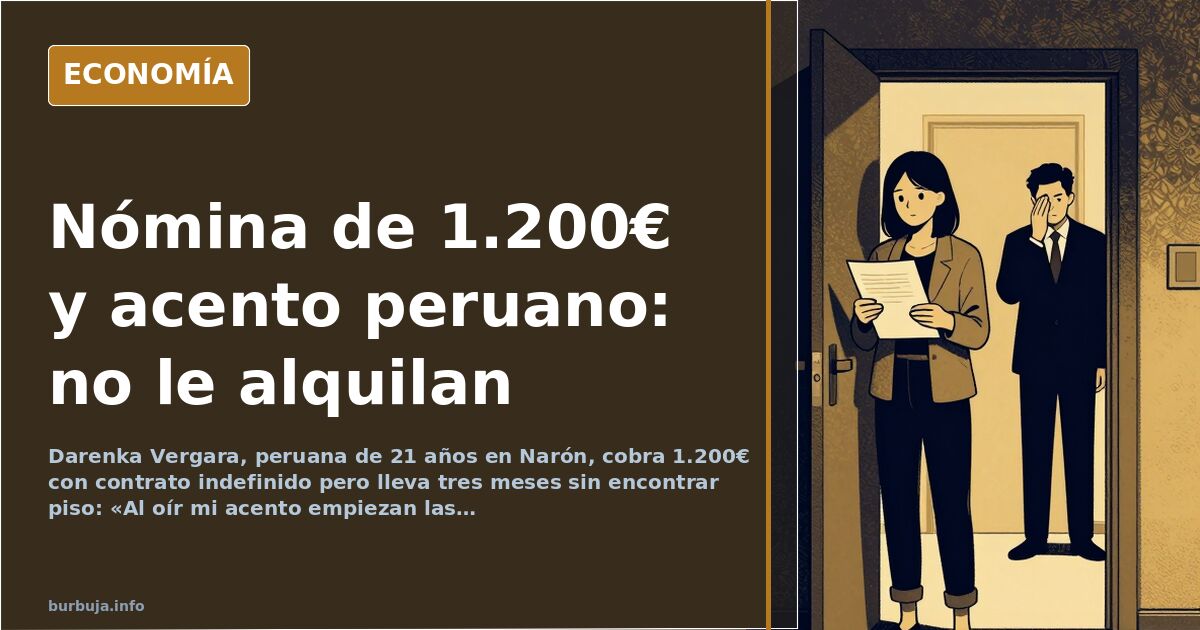
Peruvian woman with stable job faces housing discrimination in Spain
Is a permanent contract and a €1,200 monthly salary enough to rent an apartment in Spain? For Darenka Vergara, a 21-year-old Peruvian living in Narón (Ferrol), the answer is no. She has been searching for three months to move out with her mother and sister, claiming her foreign status is closing doors. "I have my payslip and earn €1,200 a month, but when I call about a flat and they hear my accent, the excuses start," she recounts resignedly.
From Arequipa to Narón: Vocational training, internships, and a permanent contract
Darenka arrived in the Ferrol region in summer 2022 from Arequipa, joining her sister to reunite with their aunt and cousin in Narón. In Peru, she studied Electronic Engineering, but facing difficulties validating her credits, she enrolled in a vocational training cycle at Leixa. She completed Gender Equality Promotion and, after interning at the Human Mobility association, secured a job there. She started in July earning €680 a month; since August, her salary is €1,200 on a permanent contract.
Five people live in the Narón apartment—her aunt, cousin, sister, mother, and herself—and the living room had to be converted into a bedroom. "It's time for us to move out because I have income and so does my mother," she explains. Her mother cares for two elderly individuals without a formal contract, awaiting asylum approval.
Triple the rent, two years' tenure, and other demands
With two income sources, Darenka thought finding something "decent" for the three of them would be easy. After nearly three months of searching and several rejections, she notes, "There's almost nothing for €400, and what exists is in poor condition. The ones I liked for €500 were refused." Reasons given included insufficient salary because she would need to triple the rent price, requirements for contracts with at least two years' tenure, or distrust because her sister and mother are still in irregular situations.
The young woman reveals she sometimes asks her Spanish boyfriend to call about apartments. "But then, when we visit and they realize it's me, my mother, and my sister who will live there, their attitude changes," she says. She also recalls a landlord calling her salary "risky" because she works on projects: "she has a job now, but maybe not tomorrow." In another case, she sent her contract and payslip via WhatsApp to prove solvency and was immediately blocked.
The debate: Discrimination or risk management?
Her story sparked a debate with two clear currents. Some argue the root problem isn't the accent, but the housing law and slow eviction processes: if a tenant stops paying, landlords take months or years to recover their property, leading them to demand extreme guarantees. "If evictions could happen in three months, things would change," one participant summarizes. Others point out that Darenka's salary comes from a subsidized NGO, making it dependent on public funds and thus less stable in a landlord's eyes.
On the other side, some see these rejections as origin-based discrimination. "I understand landlords want protection, but I'm tired of always being asked where I'm from," Darenka complains. Demanding triple the rent or two years' work history are conditions that, applied generically, exclude many young people and precarious workers, whether Spanish or not.
Context: Prices, scarce supply, and a tense rental market
Darenka's case is not isolated. In many Spanish cities and regions, rental supply has shrunk while prices rise. Landlords, antiestéticaring non-payment, increasingly demand higher guarantees: salaries tripling the rent, guarantors, insurance against default, or permanent contracts with tenure. For families with modest incomes, meeting all requirements is nearly impossible.
The discussion has also turned to the role of NGOs and subsidized contracts. Some argue these jobs don't generate wealth sufficient for landlords' security. Others recall that public housing, when available, is allocated by criteria often excluding newcomers to the labor market.
Darenka continues searching. She has a job, a payslip, and a permanent contract. What she lacks is an apartment. Meanwhile, the rental market sets the rules: triple the rent, two years' tenure, and if possible, let someone else make the call.
Is a permanent contract and a €1,200 monthly salary enough to rent an apartment in Spain? For Darenka Vergara, a 21-year-old Peruvian living in Narón (Ferrol), the answer is no. She has been searching for three months to move out with her mother and sister, claiming her foreign status is closing doors. "I have my payslip and earn €1,200 a month, but when I call about a flat and they hear my accent, the excuses start," she recounts resignedly.
From Arequipa to Narón: Vocational training, internships, and a permanent contract
Darenka arrived in the Ferrol region in summer 2022 from Arequipa, joining her sister to reunite with their aunt and cousin in Narón. In Peru, she studied Electronic Engineering, but facing difficulties validating her credits, she enrolled in a vocational training cycle at Leixa. She completed Gender Equality Promotion and, after interning at the Human Mobility association, secured a job there. She started in July earning €680 a month; since August, her salary is €1,200 on a permanent contract.
Five people live in the Narón apartment—her aunt, cousin, sister, mother, and herself—and the living room had to be converted into a bedroom. "It's time for us to move out because I have income and so does my mother," she explains. Her mother cares for two elderly individuals without a formal contract, awaiting asylum approval.
Triple the rent, two years' tenure, and other demands
With two income sources, Darenka thought finding something "decent" for the three of them would be easy. After nearly three months of searching and several rejections, she notes, "There's almost nothing for €400, and what exists is in poor condition. The ones I liked for €500 were refused." Reasons given included insufficient salary because she would need to triple the rent price, requirements for contracts with at least two years' tenure, or distrust because her sister and mother are still in irregular situations.
The young woman reveals she sometimes asks her Spanish boyfriend to call about apartments. "But then, when we visit and they realize it's me, my mother, and my sister who will live there, their attitude changes," she says. She also recalls a landlord calling her salary "risky" because she works on projects: "she has a job now, but maybe not tomorrow." In another case, she sent her contract and payslip via WhatsApp to prove solvency and was immediately blocked.
The debate: Discrimination or risk management?
Her story sparked a debate with two clear currents. Some argue the root problem isn't the accent, but the housing law and slow eviction processes: if a tenant stops paying, landlords take months or years to recover their property, leading them to demand extreme guarantees. "If evictions could happen in three months, things would change," one participant summarizes. Others point out that Darenka's salary comes from a subsidized NGO, making it dependent on public funds and thus less stable in a landlord's eyes.
On the other side, some see these rejections as origin-based discrimination. "I understand landlords want protection, but I'm tired of always being asked where I'm from," Darenka complains. Demanding triple the rent or two years' work history are conditions that, applied generically, exclude many young people and precarious workers, whether Spanish or not.
Context: Prices, scarce supply, and a tense rental market
Darenka's case is not isolated. In many Spanish cities and regions, rental supply has shrunk while prices rise. Landlords, antiestéticaring non-payment, increasingly demand higher guarantees: salaries tripling the rent, guarantors, insurance against default, or permanent contracts with tenure. For families with modest incomes, meeting all requirements is nearly impossible.
The discussion has also turned to the role of NGOs and subsidized contracts. Some argue these jobs don't generate wealth sufficient for landlords' security. Others recall that public housing, when available, is allocated by criteria often excluding newcomers to the labor market.
Darenka continues searching. She has a job, a payslip, and a permanent contract. What she lacks is an apartment. Meanwhile, the rental market sets the rules: triple the rent, two years' tenure, and if possible, let someone else make the call.
Also available in: Deutsch
Summary of a discussion on Burbuja.info - Foro de economía, actualidad y política., translated from Spanish and reviewed before publication. Read the full discussion (199 replies).
More summaries
-
Spain's Housing Law: Why families with children struggle to rent
Spain's housing law halts evictions for vulnerable tenants, prompting landlords to tighten screening. Families with children face a shrinking rental market in Madrid due to perceived financial risks.
-
Spain's Housing Law Drives One in Three Rentals Off Market in Two Months
Spain's rental supply has plummeted by 33% in two months following the new housing law, tightening the market and pushing prices up as owners withdraw properties.
-
Spain's IMV to top €1,600 in 2027: how it compares to working
Spain's IMV to top €1,600 for the first time in 2027, reaching over 893,000 households: how it compares to a job
-
Feijóo’s sick leave plan backfires with PP voters
Spain's opposition leader Feijóo faces backlash from his own base for targeting paid sick leave while ignoring subsidies and healthcare issues.
-
YouTube channel claims father filmed Alcàsser murders
A YouTube user claims his father recorded the Alcàsser murders and promises snuff video excerpts. No evidence provided, only narrative and technical analysis.
-
Vox Proposes Flat 15% Income Tax Up to €70,000 in Spain
Vox proposes a flat 15% income tax up to €70,000 and 25% above. Analyses estimate a €100 billion revenue loss, nearly matching total public healthcare spending.