
Spain's Housing Law Drives One in Three Rentals Off Market in Two Months
Spain's rental supply has plummeted by 33% in two months following the new housing law, tightening the market and pushing prices up as owners withdraw properties.
English · Original discussion in Spanish · Published
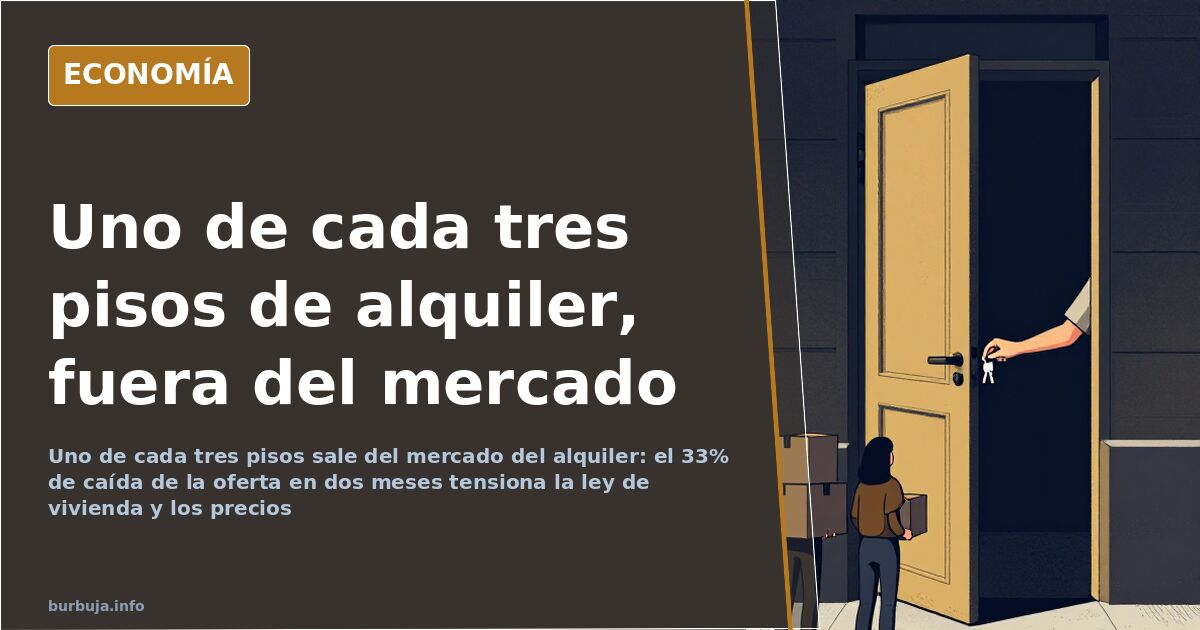
Spain’s Housing Law Removes One in Three Rentals from the Market
One in three apartments previously available for rent has been withdrawn. The market has seen a 33% drop in supply in just two months trinc the implementation of Spain’s Housing Law, which capped annual rent increases at 2% and strengthened tenant protections against eviction. While the legislation aimed to increase affordable housing, it has effectively emptied the rental market.
The explanation is economic, not ideological: the risk equation for landlords has fundamentally changed. It is not that they refuse to rent; it is that they cannot afford the risk of error. With supply at historic lows, owners prefer to wait, as keeping a property vacant is cheaper than facing legal battles.
Why do landlords prefer empty apartments to tenants?
Because a tenant who stops paying turns an asset into a months-long legal problem. This is the prevailing calculation. A vacant apartment incurs costs—community fees, property tax (IBI), and maintenance—but avoids lawsuits, utility disputes, and the frustration of subsidizing someone who may not pay. Ultimately, small landlords are not seeking to maximize profit; they are seeking to avoid loss.
The law introduced mandatory lease extensions, caps on annual rent updates, and more robust procedures to suspend evictions. Viewed positively, it protects vulnerable tenants. Viewed from the landlord’s perspective, it transfers risk previously shared with the administration to the owner. The owner of a single apartment, not large institutional holders, is reacting by withdrawing from the market. This is not solved by real estate portals; it is exacerbated by them.
The Property Tax (IBI) Increase from 400 to 1,000 Euros
On the table is a fiscal measure: taxing vacant properties more heavily to force them onto the market. The prevailing calculation is stark. Increasing the IBI by 150% would raise a bill from 400 euros to 1,000. The problem, according to this reasoning, is that the surcharge does not create solvent tenants; it increases the cost of keeping the property closed.
Here lies the uncomfortable truth: if the goal is more rental housing, any figure that raises the owner’s fixed costs pushes in the opposite direction. Taxes do not build housing; they only apply pressure. When owners have alternatives—selling, waiting, or leaving it empty—they choose the option that avoids litigation.
Will Sale Prices Drop to Compensate?
Not necessarily. With interest rates at current levels and mortgages increasingly difficult to obtain, buyers are scarce. A landlord who withdraws a property from the rental market to sell it may find no one pays their asking price, only to list it for rent months later. This intermediate segment—neither sold nor rented—swells the statistics for closed housing.
The purchase price arithmetic does not help either. An apartment of 50 square meters for 300,000 euros leaves a ridiculous rental margin relative to the investment, especially with rent caps. Those who bought at these prices expecting to resell or generate yield find themselves in a market that allows neither: they get neither the calculated return nor the ability to place the property at the price they paid.
Demand Has Not Disappeared: Entire Families Seeking a Single Room
As supply falls, demand tightens. A recurring case: a single room advertised receives 12 messages in two days, several from complete families willing to cram into that one room. This is not an isolated anecdote; it is the thermometer of a market where the tenant has lost negotiating power.
There is also a profile disappearing from the equation: the small saver who had money to buy an apartment, rent it out, and secure retirement income. This plan was discarded as soon as the legal framework changed. The supply that is retreating is not just existing stock; it is potential new supply. And unlike first-time listings, this potential supply does not return on its own.
The International Precedent and the Unresolved Standoff
Those calling for the law’s repeal cite countries that implemented similar rent controls and reversed course after observing the effects. Those defending it argue that rental housing was already unaffordable, that the market was broken, and that intervention was mandatory. Both can be true simultaneously, which is precisely the problem: neither explains what happens to the apartment that is currently closed.
The underlying argument is elemental and old: if you fix prices below equilibrium, the quantity offered drops. Less supply, constant demand, and prices that do not fully yield. The broad numbers are clear. What is not written anywhere is how long this standoff will last.
Those who withdrew their properties hoping for better conditions are still waiting. Those seeking rentals are still looking. And the market, for now, remains stagnant.
One in three apartments previously available for rent has been withdrawn. The market has seen a 33% drop in supply in just two months trinc the implementation of Spain’s Housing Law, which capped annual rent increases at 2% and strengthened tenant protections against eviction. While the legislation aimed to increase affordable housing, it has effectively emptied the rental market.
The explanation is economic, not ideological: the risk equation for landlords has fundamentally changed. It is not that they refuse to rent; it is that they cannot afford the risk of error. With supply at historic lows, owners prefer to wait, as keeping a property vacant is cheaper than facing legal battles.
Why do landlords prefer empty apartments to tenants?
Because a tenant who stops paying turns an asset into a months-long legal problem. This is the prevailing calculation. A vacant apartment incurs costs—community fees, property tax (IBI), and maintenance—but avoids lawsuits, utility disputes, and the frustration of subsidizing someone who may not pay. Ultimately, small landlords are not seeking to maximize profit; they are seeking to avoid loss.
The law introduced mandatory lease extensions, caps on annual rent updates, and more robust procedures to suspend evictions. Viewed positively, it protects vulnerable tenants. Viewed from the landlord’s perspective, it transfers risk previously shared with the administration to the owner. The owner of a single apartment, not large institutional holders, is reacting by withdrawing from the market. This is not solved by real estate portals; it is exacerbated by them.
The Property Tax (IBI) Increase from 400 to 1,000 Euros
On the table is a fiscal measure: taxing vacant properties more heavily to force them onto the market. The prevailing calculation is stark. Increasing the IBI by 150% would raise a bill from 400 euros to 1,000. The problem, according to this reasoning, is that the surcharge does not create solvent tenants; it increases the cost of keeping the property closed.
Here lies the uncomfortable truth: if the goal is more rental housing, any figure that raises the owner’s fixed costs pushes in the opposite direction. Taxes do not build housing; they only apply pressure. When owners have alternatives—selling, waiting, or leaving it empty—they choose the option that avoids litigation.
Will Sale Prices Drop to Compensate?
Not necessarily. With interest rates at current levels and mortgages increasingly difficult to obtain, buyers are scarce. A landlord who withdraws a property from the rental market to sell it may find no one pays their asking price, only to list it for rent months later. This intermediate segment—neither sold nor rented—swells the statistics for closed housing.
The purchase price arithmetic does not help either. An apartment of 50 square meters for 300,000 euros leaves a ridiculous rental margin relative to the investment, especially with rent caps. Those who bought at these prices expecting to resell or generate yield find themselves in a market that allows neither: they get neither the calculated return nor the ability to place the property at the price they paid.
Demand Has Not Disappeared: Entire Families Seeking a Single Room
As supply falls, demand tightens. A recurring case: a single room advertised receives 12 messages in two days, several from complete families willing to cram into that one room. This is not an isolated anecdote; it is the thermometer of a market where the tenant has lost negotiating power.
There is also a profile disappearing from the equation: the small saver who had money to buy an apartment, rent it out, and secure retirement income. This plan was discarded as soon as the legal framework changed. The supply that is retreating is not just existing stock; it is potential new supply. And unlike first-time listings, this potential supply does not return on its own.
The International Precedent and the Unresolved Standoff
Those calling for the law’s repeal cite countries that implemented similar rent controls and reversed course after observing the effects. Those defending it argue that rental housing was already unaffordable, that the market was broken, and that intervention was mandatory. Both can be true simultaneously, which is precisely the problem: neither explains what happens to the apartment that is currently closed.
The underlying argument is elemental and old: if you fix prices below equilibrium, the quantity offered drops. Less supply, constant demand, and prices that do not fully yield. The broad numbers are clear. What is not written anywhere is how long this standoff will last.
Those who withdrew their properties hoping for better conditions are still waiting. Those seeking rentals are still looking. And the market, for now, remains stagnant.
Summary of a discussion on Burbuja.info - Foro de economía, actualidad y política., translated from Spanish and reviewed before publication. Read the full discussion (210 replies).
More summaries
-
Madrid Rental Listings Drop 20% on Rent Decree Day
Madrid's rental supply plummeted by 20.46% on the decree's effective date, removing 2,417 listings. Stock fell below 9,000 ads as owners pulled properties from the market.
-
Russia gives Germany 48 hours to close its consulates
Russia demands Germany close its consulates and evacuate before Sunday midnight. Previous closures in Bonn, the 2022 precedent, and the fine print of...
-
Italy considers suspending Schengen with Spain: economic impact
Italy is considering suspending the Schengen agreement with Spain. Tourism, trade, and labor mobility are at stake amid an analysis of potential economic consequences.
-
Susanna Griso Marries at 56; Groom's Wrinkled Shirt Sparks Online Debate
Susanna Griso, from the Codorníu family, married at 56. Her groom's wrinkled guayabera shirt went viral on social media.
-
Rajoy sparks debate on French team identity and globalization
Former Spanish PM Mariano Rajoy claims the French national team lacks 'true' French players, reigniting discussions on national identity in globalized football.
-
Spielberg's 'The Day of the Revelation': Artistic Failure or Hidden Manipulation?
Steven Spielberg's latest film sparks debate: is it a box office flop or covert propaganda? Reviews are harsh, fueling conspiracy theories.