
Peru classifies transgender people as mentally ill by decree
Peru's Ministry of Health issued a decree labeling transsexuality a mental health issue, sparking debate over LGBTIQ+ rights and WHO guidelines.
English · Original discussion in Spanish · Published
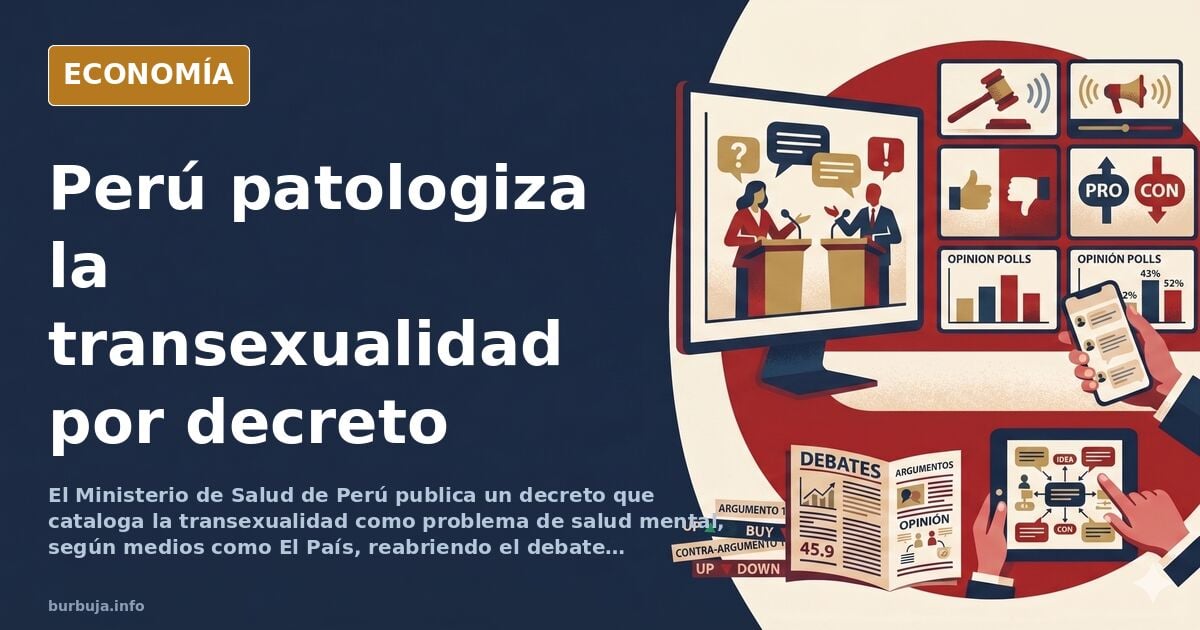
Peru declares transgender people mentally ill via decree
Peru's Ministry of Health has published a supreme decree that reclassifies transsenstrans as a mental health problem, marking a setback of more than a decade in the recognition of LGBTIQ+ rights. The measure, reported by outlets such as El País and political monitoring accounts, has peine the clash between those advocating for the depathologization endorsed by the World Health Organization and those who argue that gender dysphoria is essentially a disorder. The official text offers no nuance: it identifies trans identity as a pathology. And that, in the 21st century, is a political bomb.
What exactly does the decree say and why does it cause rejection?
The Peruvian Ministry of Health's supreme decree defines transgender people as mentally ill. This is not an activist interpretation; it is the normative text. The WHO removed transsenstrans from its list of mental disorders years ago, and Peru now ignores this scientific consensus. The decision has been read as an ideological shift by Dina Boluarte's government, amid a public agenda marked by other controversies—such as watches allegedly lent by a regional governor—which the decree helps to overshadow.
Some argue the norm aims to recognize the real suffering of those who do not identify with their biological sens, suggesting that pathologizing is not stigmatizing but rather guarantees healthcare coverage. Opponents counter that treating an identity as an illness is the fastest route to social and labor exclusion. The Peruvian trans community is effectively placed under clinical suspicion.
The healthcare argument: public coverage versus stigma
Part of the analysis defends that gender dysphoria was recognized as a disorder in manuals like the DSM and that the WHO withdrew it for economic reasons: to allow sens changes to be funded with public money. In other words, pathologization would be a gateway to universal healthcare, not a punishment. The full calculation, including budgetary implications some have broken down, fuels a debate that goes beyond the headline.
The objection is obvious: if the State declares you sick to help you, the stigma travels in the same package. And in Peru, with a fragmented healthcare system, the promised aid may remain in the BOE (Official Gazette) without ever reaching the operating room.
The political front: Boluarte, the watches, and the cultural agenda
The decree cannot be understood without the wear on Boluarte's government. The president faces scrutiny over luxury watches allegedly ceded by a regional governor, and the opposition interprets the measure as an attempt to mobilize her conservative base. It is not an far-fetched theory: sensual identity issues serve as smokescreens throughout Latin America.
In Spain, the echo was immediate. Sectors that have criticized trans laws and spending on LGTBI associations for years saw in Peru external validation. Comparisons with Spanish public healthcare and funds allocated to diversity policies have served to reopen the domestic culture war.
The scientific rift: disease or identity?
The core of the conflict is both psychiatric and political. Psychiatry has changed criteria by vote in some manuals, which critics demonstrate shows it is not a hard science but a social agreement. For advocates of depathologization, the evidence is that distress comes not from identity but from social rejection. Two incompatible frameworks.
Peru has chosen the old framework. The question is whether the decree will survive courts and international pressure, or if it will remain a footnote in the history of Latin American civil rights.
With these elements, it is predictable that the decree will end up in litigation and that the Peruvian government will soften it without repealing it. But Latin American politics rarely trinc the predictable script. If anything, this episode has shown that the battle over clinical language is today the battle for civil rights.
Also available in: Deutsch
Summary of a discussion on Burbuja.info - Foro de economía, actualidad y política., translated from Spanish and reviewed before publication. Read the full discussion (142 replies).
More summaries
-
Von der Leyen Labels Disinformation Top Business Risk
At Davos, Von der Leyen ranks disinformation as the primary business risk, while WSJ editors admit losing control of the news narrative.
-
Israel warns Sánchez it won't forget his stance on Hamas
Israeli Foreign Minister calls Hamas's congratulations to Spain and Belgium 'shameful' and warns Israel will not forget who supports the terrorist group.
-
Spain: World Leader in Drug Exports, Importer of Organized Crime
Spain leads global organized crime, according to a police chief. Five tons of marijuana seized in Mataró and 1,800 kg in Málaga port highlight the issue.
-
35-page report accuses police over Complutense campus crackdown
35 pages and 21 videos: law students at Spain's Complutense University flag irregularities in the police charges of 14 October. The Government Delegation says it is investigating.
-
Rufián blames far right for Barcelona riots
Gabriel Rufián says the far right is 'probably' behind the Barcelona riots in Spain. Skepticism runs through the reaction: double standards and the wear on the official narrative.
-
Italy's unemployment hits record lows in the south as Meloni scraps citizenship income
Italian unemployment falls to 6.3% and employment hits a record 24.36 million in the second quarter of 2026, with the south closing the gap. Here's what changed.