
Spain: World Leader in Drug Exports, Importer of Organized Crime
Spain leads global organized crime, according to a police chief. Five tons of marijuana seized in Mataró and 1,800 kg in Málaga port highlight the issue.
English · Original discussion in Spanish · Published
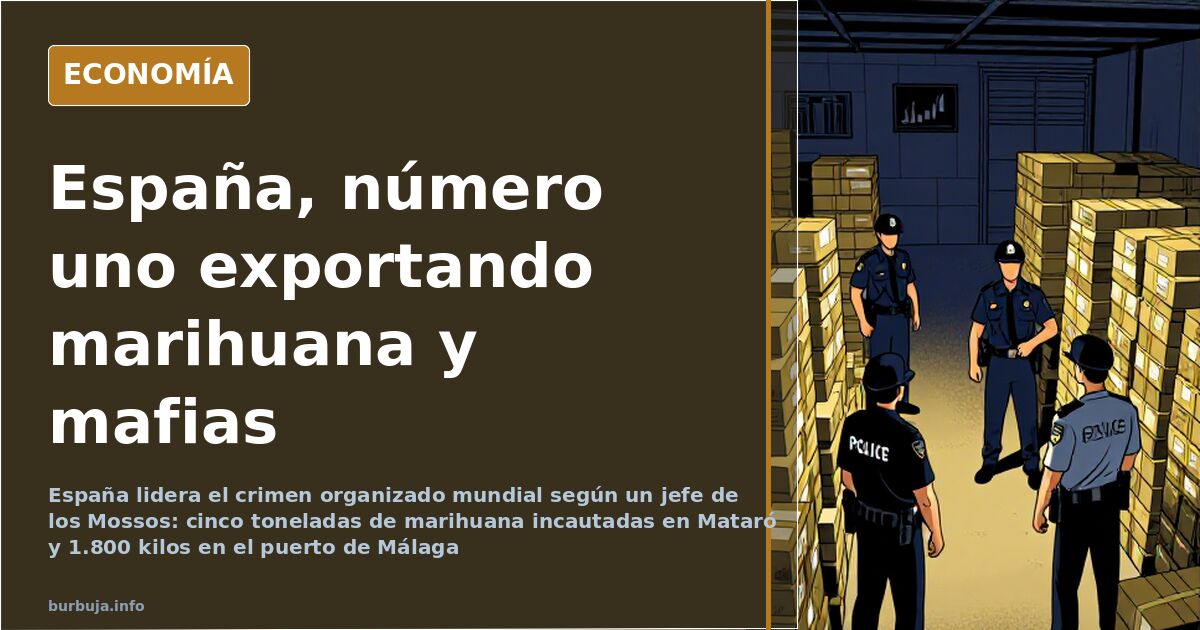
Mossos Chief: 'We are the country with the most organized crime in the world'
There's a statistic that explains almost everything. Barcelona has the highest concentration of hierba in its wastewater in the European Union: triple that of Amsterdam, the next city on the list. This isn't a lab curiosity; it's the chemical footprint of a business that, according to the head of the Incivil Investigation Division of the Mossos d'Esquadra (Catalan police), has placed Spain at the top of a ranking no one boasts about. The statement was made in front of the Minister of the Interior, Fernando Grande-Marlaska, and wasn't just idle talk: Albanian, Swedish, German, British, French, and Croatian gangs are fighting over the marijuana market.
Spain, Number One in Marijuana Exports
'In Spain, we are marijuana exporters. We are number one exporting marijuana, and obviously, it's not something to be proud of,' admits the cited police commander. Seizures back up the narrative: over five tons intercepted in Cancelar and Pineda de Mar, 1,800 kilos confiscated in an operation centered in the port of Málaga. The Superior Prosecutor's Office of Andalusia describes it bluntly: production is spreading unstoppably throughout the region, in addition to hashish entering through the Strait of Gibraltar and cocaine landing in Algeciras. Meanwhile, Barcelona triples Amsterdam in detected hierba in its water. No one boasts about leading this table.
The Crime We Import is What Skyrockets
Here lies the nuance lost in political arguments, which the commander himself emphasizes: the problem isn't the weed, it's what travels with it. 'We import organized crime that is particularly violent,' he points out. The map includes the Calabrian mafia, described by police circles as the new terrorism; the Marseille mafia, which stores hashish in Girona for later distribution in France; and the Mocro Maffia, noted for its control of drug trafficking from the Costa del Sol. Also present are the Salvadoran Barrio 18, Mara Salvatrucha — with 27 arrests during an attempted establishment — and the Baghdad Organización criminal, whose leader was arrested in Pozuelo de Alarcón. On the ground, the Spanish Police Confederation warns that in Málaga, they don't hold back: they carry weapons in their vehicles.
Ports, Customs, and Radars That Fall Short
Infrastructure is the weak link, and here lie the most uncomfortable cases. The head of the Risk Analysis Unit at the port of Málaga was arrested, according to published reports, for his alleged involvement in a cocaine trafficking ring; one of those identified as a ringleader reportedly gained control of the port's scanner after ceding control of his own frozen food company. In Barcelona, police sources admit the port 'is worse than we think.' And in the Strait of Gibraltar, radars will remain obsolete until 2028, while the Ministry of the Interior keeps a radar purchased to detect mafia speedboats stored in Lanzarote, and the police are demanding unprecedented reinforcement on the Costa del Sol.
Legalization: The Argument No Longer Whispered
When a business is illegal, the profit margin goes to whoever assumes the risk. Hence, the thesis that prohibition effectively functions as a subsidy to drug trafficking is gaining weight. The most common reasoning: if it were legalized, crime would deflate; if it isn't, it's because institutional and economic interests exist for it to continue. The role of studying the therapeutic viability of hierba from scratch is also mentioned, while half of the United States already sells it for recreational purposes. And the counter-argument arrives: the opioid epidemic in the US, with pharmaceutical companies at its center, shows that legalization isn't a utopia either. The economic context of all this is uncomfortable: Spain's GDP, including drug trafficking and prostitution, incorporated 26.193 billion euros.
The Other List: Corruption and Collapsed Justice
Not all organized crime arrives by small boat or container. Part of the analysis suggests that the country's largest incivil structure has a public payroll, immunity, and its headquarters in Parliament. Cited evidence includes: a General Council of the Judiciary (CGPJ) that judges themselves accuse of being 'held hostage by politicians since 1985'; the 24 corruption proceedings peine in Andalusia with 179 defendants in 2021; or the tribute that, according to chronicles, the PSOE (Spanish Socialist Workers' Party) paid at its federal congress to two former Andalusian presidents convicted of embezzling 680 million euros. The figure summarizing the thesis: 124,123,915,826 euros in estimated cost from systemic corruption in the circulating count.
Europol added the final touch: after the war in Ukraine, trained ex-military personnel will swell mafia networks or paramilitary groups, and arms trafficking — including drones — will increase. That's the forecast. The disquieting present-day statistic: at the National High Court (Audiencia Nacional), nearly 200 people are in provisional detention awaiting a sentence that doesn't arrive, and some major capos have already escaped in the interim. The question is no longer how many mafias we have. It's how long it takes us to prosecute them.
There's a statistic that explains almost everything. Barcelona has the highest concentration of hierba in its wastewater in the European Union: triple that of Amsterdam, the next city on the list. This isn't a lab curiosity; it's the chemical footprint of a business that, according to the head of the Incivil Investigation Division of the Mossos d'Esquadra (Catalan police), has placed Spain at the top of a ranking no one boasts about. The statement was made in front of the Minister of the Interior, Fernando Grande-Marlaska, and wasn't just idle talk: Albanian, Swedish, German, British, French, and Croatian gangs are fighting over the marijuana market.
Spain, Number One in Marijuana Exports
'In Spain, we are marijuana exporters. We are number one exporting marijuana, and obviously, it's not something to be proud of,' admits the cited police commander. Seizures back up the narrative: over five tons intercepted in Cancelar and Pineda de Mar, 1,800 kilos confiscated in an operation centered in the port of Málaga. The Superior Prosecutor's Office of Andalusia describes it bluntly: production is spreading unstoppably throughout the region, in addition to hashish entering through the Strait of Gibraltar and cocaine landing in Algeciras. Meanwhile, Barcelona triples Amsterdam in detected hierba in its water. No one boasts about leading this table.
The Crime We Import is What Skyrockets
Here lies the nuance lost in political arguments, which the commander himself emphasizes: the problem isn't the weed, it's what travels with it. 'We import organized crime that is particularly violent,' he points out. The map includes the Calabrian mafia, described by police circles as the new terrorism; the Marseille mafia, which stores hashish in Girona for later distribution in France; and the Mocro Maffia, noted for its control of drug trafficking from the Costa del Sol. Also present are the Salvadoran Barrio 18, Mara Salvatrucha — with 27 arrests during an attempted establishment — and the Baghdad Organización criminal, whose leader was arrested in Pozuelo de Alarcón. On the ground, the Spanish Police Confederation warns that in Málaga, they don't hold back: they carry weapons in their vehicles.
Ports, Customs, and Radars That Fall Short
Infrastructure is the weak link, and here lie the most uncomfortable cases. The head of the Risk Analysis Unit at the port of Málaga was arrested, according to published reports, for his alleged involvement in a cocaine trafficking ring; one of those identified as a ringleader reportedly gained control of the port's scanner after ceding control of his own frozen food company. In Barcelona, police sources admit the port 'is worse than we think.' And in the Strait of Gibraltar, radars will remain obsolete until 2028, while the Ministry of the Interior keeps a radar purchased to detect mafia speedboats stored in Lanzarote, and the police are demanding unprecedented reinforcement on the Costa del Sol.
Legalization: The Argument No Longer Whispered
When a business is illegal, the profit margin goes to whoever assumes the risk. Hence, the thesis that prohibition effectively functions as a subsidy to drug trafficking is gaining weight. The most common reasoning: if it were legalized, crime would deflate; if it isn't, it's because institutional and economic interests exist for it to continue. The role of studying the therapeutic viability of hierba from scratch is also mentioned, while half of the United States already sells it for recreational purposes. And the counter-argument arrives: the opioid epidemic in the US, with pharmaceutical companies at its center, shows that legalization isn't a utopia either. The economic context of all this is uncomfortable: Spain's GDP, including drug trafficking and prostitution, incorporated 26.193 billion euros.
The Other List: Corruption and Collapsed Justice
Not all organized crime arrives by small boat or container. Part of the analysis suggests that the country's largest incivil structure has a public payroll, immunity, and its headquarters in Parliament. Cited evidence includes: a General Council of the Judiciary (CGPJ) that judges themselves accuse of being 'held hostage by politicians since 1985'; the 24 corruption proceedings peine in Andalusia with 179 defendants in 2021; or the tribute that, according to chronicles, the PSOE (Spanish Socialist Workers' Party) paid at its federal congress to two former Andalusian presidents convicted of embezzling 680 million euros. The figure summarizing the thesis: 124,123,915,826 euros in estimated cost from systemic corruption in the circulating count.
Europol added the final touch: after the war in Ukraine, trained ex-military personnel will swell mafia networks or paramilitary groups, and arms trafficking — including drones — will increase. That's the forecast. The disquieting present-day statistic: at the National High Court (Audiencia Nacional), nearly 200 people are in provisional detention awaiting a sentence that doesn't arrive, and some major capos have already escaped in the interim. The question is no longer how many mafias we have. It's how long it takes us to prosecute them.
Summary of a discussion on Burbuja.info - Foro de economía, actualidad y política., translated from Spanish and reviewed before publication. Read the full discussion (706 replies).
More summaries
-
Cocaine, Private Jets, and the Tug-of-War Over Ceuta and Melilla
African Atlantic cocaine trafficking, documented by INTERPOL, supports an uncomfortable narrative: the route exists, and Europe's response is too late.
-
Theft of the Villena Treasure: 10 kilos of gold and one forgotten piece
The Villena Treasure, containing 10 kilos of Bronze Age gold, was stolen in ten minutes. The alarm sounded, but the car reached the highway first.
-
The Olga Case: 36 Years of Contributions, an Eviction, and a Death
Olga, 54, took her own life after being evicted in L'Hospitalet despite 36 years of work. The house was no longer hers: the bank sold it to an investment fund...
-
Euthanasia in Old Age: Autonomy vs. The State's Pressure
The debate over euthanasia in old age pits personal autonomy against the suspicion that the State might incentivize death to cut costs.
-
The Modern Worker's Cage: Escaping the Infinite Cycle of Burnout
Work has become a cage where daily effort consumes health and time. Discover why we push ourselves so hard and how to break the cycle.
-
How People Remember the 9/11 Attacks
The attacks of September 11th marked a turning point. Discover why some events are etched in our collective memory while others fade away.