
Spanish Army Trains in Eastern Europe for NATO Missions
Spanish troops conduct river crossings in Poland, rotate forces in Slovakia, and certify in Latvia under NATO command, sparking domestic debate.
English · Original discussion in Spanish · Published
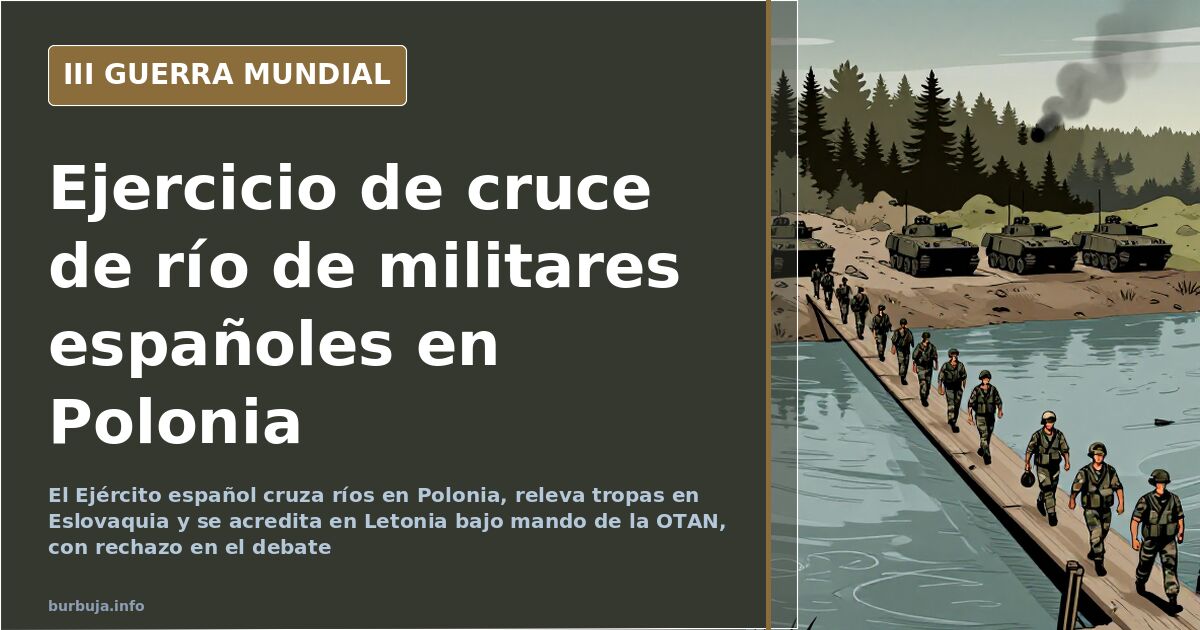
Spanish Army Trains NATO Rotations in Poland and Slovakia
The Armored Tactical Group "Málaga" crossed a watercourse at the Bemowo Piskie training area in Poland, supported by British engineers and Spanish personnel. The General Staff of the Defence published this footage alongside other announcements: the third rotation of the contingent in Slovakia —antiestéticaturing the Zamora I/29 Battalion from BRILAT and the High Readiness Land Headquarters—, the certification of the eFP XIV contingent in Latvia after the Crystal Arrow exercise, and the conclusion of Dragon 24, described by the Ministry as the largest NATO exercise in decades. All framed within allied cooperation.
The General Staff provided the context. "If we want to be ready to fight in Eastern Europe...", they wrote, highlighting the importance of training in water crossing operations. This statement reorders priorities and implicitly admits the specific nature of the training.
What is the Spanish Army doing in Poland, Slovakia, and Latvia?
Three fronts are active simultaneously. In Slovakia, a rotation occurs: the third contingent enters, primarily composed of personnel from the Zamora I/29 Battalion (BRILAT) and the High Readiness Land Headquarters, which deploys part of its structure as an advance corps element for Alliance operational plans.
In Latvia, the eFP XIV contingent has just passed its evaluation and is certified as an operational force under NATO command trinc the Crystal Arrow exercise. This marks the transition from "participating in maneuvers" to being "integrated" into a chain of command.
In Poland, the Armored Tactical Group "Málaga" practices river crossing with support from British engineers. According to the Ministry, similar operations were conducted during Dragon 24, including a crossing of the Vistula River. The image promoted by the Ministry shows Spanish troops crossing a foreign river.
Why is the deployment questioned?
Consensus breaks here. Some argue these maneuvers have been repeated for over seven years without being perceived as a threat, noting that viewing apocalypse in every exercise confuses training with declarations of war. A river crossing is logistics, not mobilization.
Conversely, another objection dominates the conversation: Spain has nothing to gain from a conflict thousands of kilometers away but much to lose. Critics point out that the international contingent positions itself near the Belarusian border to free up Ukrainian troops, a step described as dangerous despite no active conflict having begun.
The most frequent criticism targets the South, not the East. With the southern border "wide open" —described metaphorically as a welcome mat and an invitation to enter unannounced—, many consider it shameful to send the Army to prepare against a distant rival. Others go further, labeling deployed troops as mere labor serving foreign interests, failing to represent the country. This is opinion, not fact.
Krasny Bor and the Comparison with the Blue Division
When precedent is needed, one always appears: Krasny Bor, twenty kilometers from Leningrad. Online discussions claim approximately 4,500 members of the Blue Division faced 45,000 Soviet soldiers, halting their offensive. This data is cited to remind readers that Spaniards have previously fought in the East.
However, the comparison collapses under scrutiny. As some bluntly state, that was eighty years ago, with tattered uniforms and far from home. Current assessments of the Army's capacity circulating online are pessimistic and derogatory toward soldiers, lacking official backing.
Where Analysis Stalls
No one disputes the facts: Spanish units are crossing rivers in Poland, rotating in Slovakia, and certifying in Latvia. What remains unclear is the purpose. If it is routine training, the label "ready to fight in Eastern Europe" is superfluous. If it is genuine preparation, someone must explain what Spain gains and who pays the price. With these elements, the conversation does not pogre; it stagnates.
The Armored Tactical Group "Málaga" crossed a watercourse at the Bemowo Piskie training area in Poland, supported by British engineers and Spanish personnel. The General Staff of the Defence published this footage alongside other announcements: the third rotation of the contingent in Slovakia —antiestéticaturing the Zamora I/29 Battalion from BRILAT and the High Readiness Land Headquarters—, the certification of the eFP XIV contingent in Latvia after the Crystal Arrow exercise, and the conclusion of Dragon 24, described by the Ministry as the largest NATO exercise in decades. All framed within allied cooperation.
The General Staff provided the context. "If we want to be ready to fight in Eastern Europe...", they wrote, highlighting the importance of training in water crossing operations. This statement reorders priorities and implicitly admits the specific nature of the training.
What is the Spanish Army doing in Poland, Slovakia, and Latvia?
Three fronts are active simultaneously. In Slovakia, a rotation occurs: the third contingent enters, primarily composed of personnel from the Zamora I/29 Battalion (BRILAT) and the High Readiness Land Headquarters, which deploys part of its structure as an advance corps element for Alliance operational plans.
In Latvia, the eFP XIV contingent has just passed its evaluation and is certified as an operational force under NATO command trinc the Crystal Arrow exercise. This marks the transition from "participating in maneuvers" to being "integrated" into a chain of command.
In Poland, the Armored Tactical Group "Málaga" practices river crossing with support from British engineers. According to the Ministry, similar operations were conducted during Dragon 24, including a crossing of the Vistula River. The image promoted by the Ministry shows Spanish troops crossing a foreign river.
Why is the deployment questioned?
Consensus breaks here. Some argue these maneuvers have been repeated for over seven years without being perceived as a threat, noting that viewing apocalypse in every exercise confuses training with declarations of war. A river crossing is logistics, not mobilization.
Conversely, another objection dominates the conversation: Spain has nothing to gain from a conflict thousands of kilometers away but much to lose. Critics point out that the international contingent positions itself near the Belarusian border to free up Ukrainian troops, a step described as dangerous despite no active conflict having begun.
The most frequent criticism targets the South, not the East. With the southern border "wide open" —described metaphorically as a welcome mat and an invitation to enter unannounced—, many consider it shameful to send the Army to prepare against a distant rival. Others go further, labeling deployed troops as mere labor serving foreign interests, failing to represent the country. This is opinion, not fact.
Krasny Bor and the Comparison with the Blue Division
When precedent is needed, one always appears: Krasny Bor, twenty kilometers from Leningrad. Online discussions claim approximately 4,500 members of the Blue Division faced 45,000 Soviet soldiers, halting their offensive. This data is cited to remind readers that Spaniards have previously fought in the East.
However, the comparison collapses under scrutiny. As some bluntly state, that was eighty years ago, with tattered uniforms and far from home. Current assessments of the Army's capacity circulating online are pessimistic and derogatory toward soldiers, lacking official backing.
Where Analysis Stalls
No one disputes the facts: Spanish units are crossing rivers in Poland, rotating in Slovakia, and certifying in Latvia. What remains unclear is the purpose. If it is routine training, the label "ready to fight in Eastern Europe" is superfluous. If it is genuine preparation, someone must explain what Spain gains and who pays the price. With these elements, the conversation does not pogre; it stagnates.
Also available in: Deutsch
Summary of a discussion on Burbuja.info - Foro de economía, actualidad y política., translated from Spanish and reviewed before publication. Read the full discussion (134 replies).
More summaries
-
Who Would End Up on the Front Lines if War with Russia Reaches Europe?
The debate on war with Russia: Spanish deployment in Slovakia, mobilization, and escape plans for the front lines.
-
Spanish troops and the “Russian drone”: video, doubts and mockery
A video circulated by ABC shows Spanish troops saying they shot down a Russian drone: “we are prepared for that”. It sparks mockery and doubts
-
Gisbert and Sivaya: Romance Amid Ukraine War Narratives
Analysis of media coverage for Rubén Gisbert and Liu Sivaya during the Ukraine war. Is this digital propaganda or reality?
-
Spanish media excluded unvaccinated relatives, now welcome Ukrainian refugees
In Dec 2021, Spanish outlets urged excluding unvaccinated family from Christmas; by Mar 2022, they praised hosting unvaccinated Ukrainian refugees.
-
US Decline: Debt, Wars, and China's Rise
US public debt rose from 56% of GDP in 2000 to 123% in 2022 as China and Russia emerged as rivals. An analysis of American decline.
-
Ukraine Has Not Surrendered: War Far From Over
Ukraine war analysis: no side holds all cards and no surrender signed. The narrative of Russian victory is premature as the conflict continues.