
Spain sends obsolete 1960s HAWK missiles to Ukraine
Spain will send four HAWK systems, 1960s-era missiles still listed as operational in Spanish inventory.
English · Original discussion in Spanish · Published
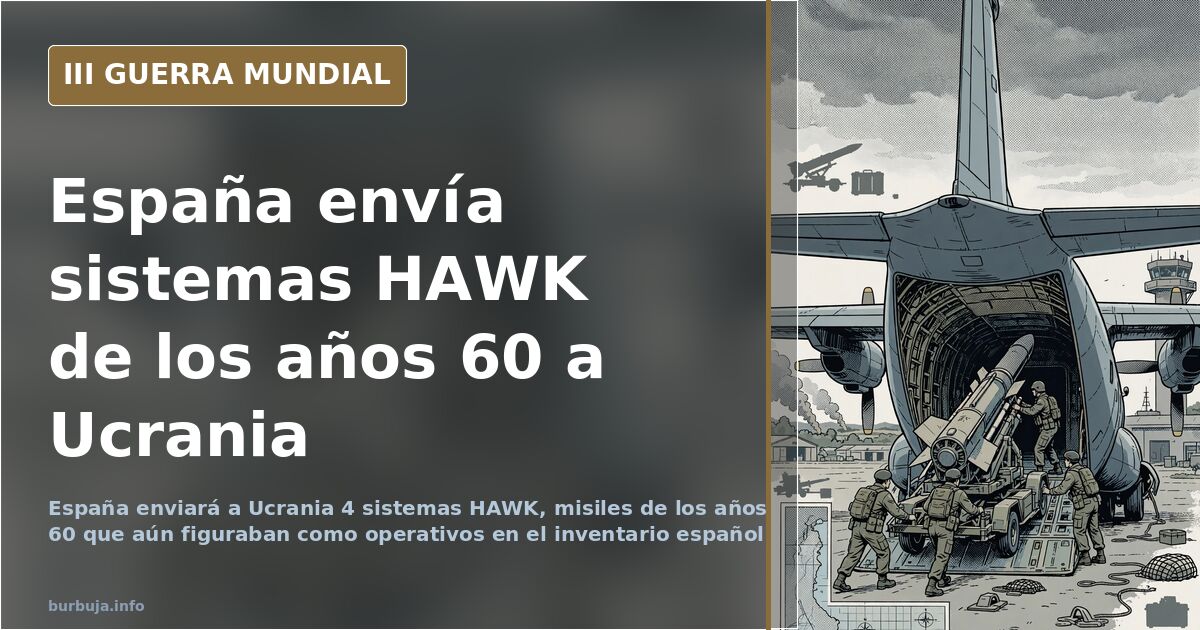
The HAWK missiles Spain is sending to Ukraine: 1960s technology
Four air defense systems taken from active inventory. Technology from the 1960s. And a propellant that, according to a comment in the thread, would already be 55 years old. Spain will send Ukraine four HAWK missile systems, and the announcement, more than a defense news item, functions as an involuntary X-ray of the real state of European arsenals.
The operation is not an isolated gesture. It is part of a delivery policy that has been emptying warehouses for some time. But here the nuance changes: previous shipments involved decommissioned material, and this time something still listed as operational is being handed over. That is the data point that sparked the discussion.
Where these HAWKs come from: From Franco to Reagan
The trail of these missiles in Spain is a military timeline. According to a comment in the thread, some units were bought second-hand during the Reagan administration, and others arrived much earlier: gifted by Eisenhower to Franco in 1968, during the Cold War. Almost six decades later, they are still on the lists.
The problem is not just that they are old. It is that the old stuff sits on top of expiring material. A missile is, fundamentally, a tube with explosive and fuel; if the propellant is half a century old, the risk of failure during launch or handling ceases to be theoretical. The warning runs through the thread: Ukrainian gunners will have to be very careful, because a charge 55 years old can blow up in their faces.
Why Spain is getting rid of this material
The math adds up. Removing a missile system costs money: it must be dismantled, the load inertized, and waste managed. Giving it away, however, shifts the problem to the recipient and, moreover, gets billed. According to the argument used in the thread, the EU covers these shipments through the European Peace Facility, so old material becomes a double-benefit operation: you save on destruction and get paid to deliver it.
With that logic, handing over the HAWKs is not a sacrifice, it is a closet clean-out with a receipt. The list of previous deliveries confirms this: AMELI, M-113, Anibal off-road vehicles, the Leopard 2A4s that ultimately did not leave, and the Italian ASPIDE missiles already retired. Almost everything that has left Spanish inventory for Ukraine was material destined for decommissioning anyway. What is relevant about the HAWK case is that, for the first time in that series, the category was different.
Do 1960s missiles serve any purpose?
Here the analysis splits. One block is clear: in a war of attrition, an old missile that flies is still a missile. The precedent everyone cites is the downing of an invisible fighter jet F-117 during NATO's operation in Serbia, carried out by a Soviet battery also from another era. History often tells it as a coincidence; the technical version defended in the thread says otherwise. It was a field engineering operation: an electronics expert modified the battery to generate the aircraft's radar signature by interpolating sweeps from several antennas, allowing tracking radars to lock onto the target for a few seconds. The missile's estimulante ilegal and a very heavy warhead did the rest.
The other argument in favor is Iranian. The country has squeezed the HAWK to limits its designer never imagined: turning it into an air-to-air missile launchable from its old F-14 Tomcats, with at least one confirmed combat kill, according to cited material, by a pilot who also shot down eight planes with Phoenix missiles and two with cannons. The list includes an even more curious episode: the anti-air missile hybridized with an M117 bomb, from the Korean War era, to transform it into an improvised air-to-surface weapon. If a missile can be reused like this, the adjective obsolete becomes relative.
The gap left in Spanish defense
Here the uncomfortable part begins. Handing over material is easy as long as someone assumes it won't be needed at home. The question running through the thread is what remains afterwards. The most cited answer is nothing: no replacement is planned and what is delivered does not return. The comparison that appears is Russia, which, according to another comment in the thread, is refurbishing 3,000 T-62 tanks from another era to send to the front; if a power struggles to replace them, it is not unlikely that a European one faces the same issue.
The antiestéticar crystallizes in a scenario nobody wants to detail: two possible fronts and an increasingly thin inventory. The phrase summarizing that concern is simple: when the time comes, there won't be a single bullet. And the counterpoint weighs less than it seems: if there is nothing better to send, the dilemma stops being what is delivered and becomes what hasn't been purchased for years.
The HAWKs will leave Spain with more administrative noise than military impact, and probably fly, or don't fly, without anyone knowing. One question remains that no balance sheet fits: if these were the last ones active, how will the gap they leave be defended?
Four air defense systems taken from active inventory. Technology from the 1960s. And a propellant that, according to a comment in the thread, would already be 55 years old. Spain will send Ukraine four HAWK missile systems, and the announcement, more than a defense news item, functions as an involuntary X-ray of the real state of European arsenals.
The operation is not an isolated gesture. It is part of a delivery policy that has been emptying warehouses for some time. But here the nuance changes: previous shipments involved decommissioned material, and this time something still listed as operational is being handed over. That is the data point that sparked the discussion.
Where these HAWKs come from: From Franco to Reagan
The trail of these missiles in Spain is a military timeline. According to a comment in the thread, some units were bought second-hand during the Reagan administration, and others arrived much earlier: gifted by Eisenhower to Franco in 1968, during the Cold War. Almost six decades later, they are still on the lists.
The problem is not just that they are old. It is that the old stuff sits on top of expiring material. A missile is, fundamentally, a tube with explosive and fuel; if the propellant is half a century old, the risk of failure during launch or handling ceases to be theoretical. The warning runs through the thread: Ukrainian gunners will have to be very careful, because a charge 55 years old can blow up in their faces.
Why Spain is getting rid of this material
The math adds up. Removing a missile system costs money: it must be dismantled, the load inertized, and waste managed. Giving it away, however, shifts the problem to the recipient and, moreover, gets billed. According to the argument used in the thread, the EU covers these shipments through the European Peace Facility, so old material becomes a double-benefit operation: you save on destruction and get paid to deliver it.
With that logic, handing over the HAWKs is not a sacrifice, it is a closet clean-out with a receipt. The list of previous deliveries confirms this: AMELI, M-113, Anibal off-road vehicles, the Leopard 2A4s that ultimately did not leave, and the Italian ASPIDE missiles already retired. Almost everything that has left Spanish inventory for Ukraine was material destined for decommissioning anyway. What is relevant about the HAWK case is that, for the first time in that series, the category was different.
Do 1960s missiles serve any purpose?
Here the analysis splits. One block is clear: in a war of attrition, an old missile that flies is still a missile. The precedent everyone cites is the downing of an invisible fighter jet F-117 during NATO's operation in Serbia, carried out by a Soviet battery also from another era. History often tells it as a coincidence; the technical version defended in the thread says otherwise. It was a field engineering operation: an electronics expert modified the battery to generate the aircraft's radar signature by interpolating sweeps from several antennas, allowing tracking radars to lock onto the target for a few seconds. The missile's estimulante ilegal and a very heavy warhead did the rest.
The other argument in favor is Iranian. The country has squeezed the HAWK to limits its designer never imagined: turning it into an air-to-air missile launchable from its old F-14 Tomcats, with at least one confirmed combat kill, according to cited material, by a pilot who also shot down eight planes with Phoenix missiles and two with cannons. The list includes an even more curious episode: the anti-air missile hybridized with an M117 bomb, from the Korean War era, to transform it into an improvised air-to-surface weapon. If a missile can be reused like this, the adjective obsolete becomes relative.
The gap left in Spanish defense
Here the uncomfortable part begins. Handing over material is easy as long as someone assumes it won't be needed at home. The question running through the thread is what remains afterwards. The most cited answer is nothing: no replacement is planned and what is delivered does not return. The comparison that appears is Russia, which, according to another comment in the thread, is refurbishing 3,000 T-62 tanks from another era to send to the front; if a power struggles to replace them, it is not unlikely that a European one faces the same issue.
The antiestéticar crystallizes in a scenario nobody wants to detail: two possible fronts and an increasingly thin inventory. The phrase summarizing that concern is simple: when the time comes, there won't be a single bullet. And the counterpoint weighs less than it seems: if there is nothing better to send, the dilemma stops being what is delivered and becomes what hasn't been purchased for years.
The HAWKs will leave Spain with more administrative noise than military impact, and probably fly, or don't fly, without anyone knowing. One question remains that no balance sheet fits: if these were the last ones active, how will the gap they leave be defended?
Also available in: Deutsch
Summary of a discussion on Burbuja.info - Foro de economía, actualidad y política., translated from Spanish and reviewed before publication. Read the full discussion (134 replies).
More summaries
-
Poland calls emergency meeting after two civilian deaths
Two civilians died in Przewodów, near the Ukrainian border. Warsaw convened its Security Council while missile attribution remains unconfirmed.
-
Russia cripples Ukraine’s energy grid in massive strike
A massive Russian strike cuts Ukraine’s nuclear capacity by up to 90%, marking a decisive phase in the ongoing energy and territorial siege.
-
Spanish media excluded unvaccinated relatives, now welcome Ukrainian refugees
In Dec 2021, Spanish outlets urged excluding unvaccinated family from Christmas; by Mar 2022, they praised hosting unvaccinated Ukrainian refugees.
-
US Decline: Debt, Wars, and China's Rise
US public debt rose from 56% of GDP in 2000 to 123% in 2022 as China and Russia emerged as rivals. An analysis of American decline.
-
Ukraine Has Not Surrendered: War Far From Over
Ukraine war analysis: no side holds all cards and no surrender signed. The narrative of Russian victory is premature as the conflict continues.
-
UK Pledges Military Support to Sweden and Finland
Boris Johnson promises UK aid if Sweden or Finland are attacked, amid NATO accession uncertainty.