
Pensioner loses 10,000 euros in romance scam targeting fake singer
A 73-year-old woman traveled to Madrid to marry a man she believed was Luis Miguel, only to lose 10,000 dollars to an online romance scam.
English · Original discussion in Spanish · Published
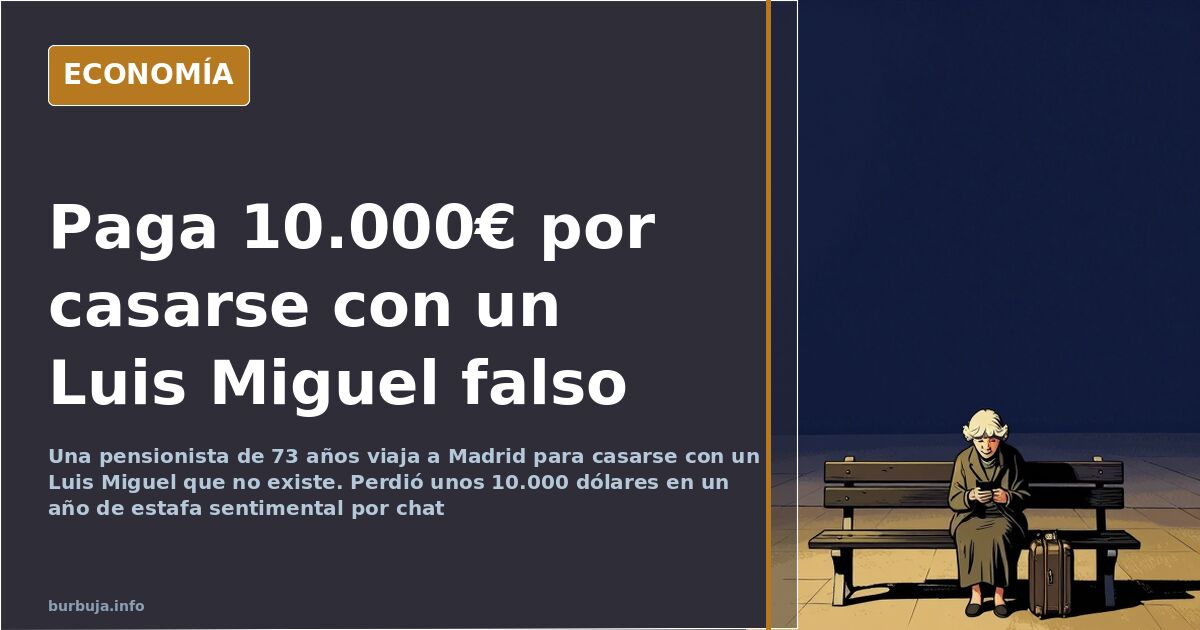
A 73-year-old pensioner travels to Madrid to marry a fake Luis Miguel
Sandy Somarriba landed at Barajas airport with the hope of a bride. She was 73, traveling from Las Vegas, and had spent a year exchanging messages with someone she believed was the singer Luis Miguel. The singer never appeared. Neither did the driver named Sánchez she had been promised. "That is when the world fell out from under me," she says. During that year of chatting, she had handed over 10,000 dollars to a network of scammers taking turns behind the screen.
The story was published by El Correo on March 16, 2024, and sparked an uncomfortable debate: how does a businesswoman, translator, and pensioner fall for something like this? The short answer is that romance scams do not target fools. They target those with a specific emotional need and an accessible bank account.
The fraud script: fan cards, customs, and fake checks
The first payment was 500 dollars for a "fan card" supposedly required for private chats. It never arrived. From there, the machinery kicked into gear: paying customs for non-existent boxes, advancing money for a fake check that the scammer deposited into her account, and transfers of 100 or 200 dollars via Western Union or cryptocurrency to recipients in Ecuador. She even sold a piece of jewelry for 750 euros to keep feeding the narrative.
The transition from admirer to fiancée was rapid. Messages of love, photographs, explicit eroticism, and a phrase she remembers verbatim: "the universe had conspired for us to meet." The victim sent her ID, account numbers, email passwords, and bank statements. She referred to the fake singer as her great love in her chats. He would set meeting dates, start a countdown, and then cancel the appointment with a new excuse.
Behind the scenes: shifts, templates, and an eight-hour business
The scammers were not just one person. They worked in shifts. Some didn't even speak Spanish, only English. They kept conversation histories so the next person on duty knew exactly how far along the victim was in the scam. It is a role-playing game with real victims, and it works because they test it on hundreds of people until someone takes all the bait.
Analysis of this phenomenon suggests that a scammer working eight hours a day who successfully targets two or three victims a year in a low-wage country achieves an excellent return. Some argue that a significant portion of foreign currency entering certain West African countries comes from this type of fraud. While unverified, the figure illustrates the sheer volume of the crime.
The victim profile is not what people imagine
This is the most unsettling point. Victims of these scams have diverse profiles: lawyers, doctors, cashiers, and entrepreneurs. Vulnerability does not stem from IQ. It comes from loneliness, the need to feel chosen, and the scammer's ability to build a narrative that fits a person's desires.
Sandy said it bluntly: "Everyone has the desire to be loved." She added a phrase that summarizes the mechanism: "I saw it coming, but I didn't want to listen." The fame of the alleged singer played a role. She admits she doesn't know if she would have fallen for a stranger without a stage name.
When the victim lands in Spain without money
In Madrid, she reported the crime to the Policía Nacional (Spain's national police force) at Terminal 4. She spent days in a hostel in Brunete without money, until a former boss bought her a return ticket. She flew back that Wednesday. The scammer is still calling her. Their last conversation lasted 33 minutes. He assures her he is indeed Luis Miguel, that he loves her, and that he is sorry he couldn't pick her up.
She goes along with it. "Seeing is believing," she tells him. She has no more money to give. What hurts, she says, is not the empty bank account, but her broken heart. The story ends there, with no confirmed arrests and no known judicial resolution.
Romance scams involve figures that do not appear in official statistics because most victims do not report them. Shame weighs more than the financial loss. And meanwhile, on the other side of the screen, someone is already writing the first message to the next victim.
Also available in: Deutsch
Summary of a discussion on Burbuja.info - Foro de economía, actualidad y política., translated from Spanish and reviewed before publication. Read the full discussion (103 replies).
More summaries
-
Mother disputes suicide of police officer in El Prat, Spain
A mother claims her daughter, a national police officer in El Prat, did not commit suicide and is demanding airport security footage.
-
Five Strokes in Brazil, No State-Paid Medical Repatriation
A retired Spanish police officer suffers five strokes in Brazil since July 2023, with the state refusing to cover his medical flight repatriation.
-
Spanish Police Rule Out Hitman in Granada Shooting
Spain's National Police deny that a man shot dead in Alhendín, Granada, is the hitman behind the Vidal-Quadras attack.
-
The Spanish voter waiting for a Vox gaffe to avoid backing PSOE
A viral post claims the right's biggest danger is its own voter, who waits for a Vox slip-up to avoid voting against Spain's government.
-
Feijóo and the cost of not wanting to win: the campaign that keeps Sánchez in power
Feijóo opens fronts on abortion, euthanasia and sick leave and loses key pools of voters. An analysis of why his campaign benefits Sánchez.
-
Pantomima Full nails the Spanish consultant: €50,000 and a backpack over a suit
Pantomima Full's consultant parody is 99% accurate: down jacket under the blazer, a backpack over the suit, and a watch that goes from €1,000 to €2,000.