
Pantomima Full nails the Spanish consultant: €50,000 and a backpack over a suit
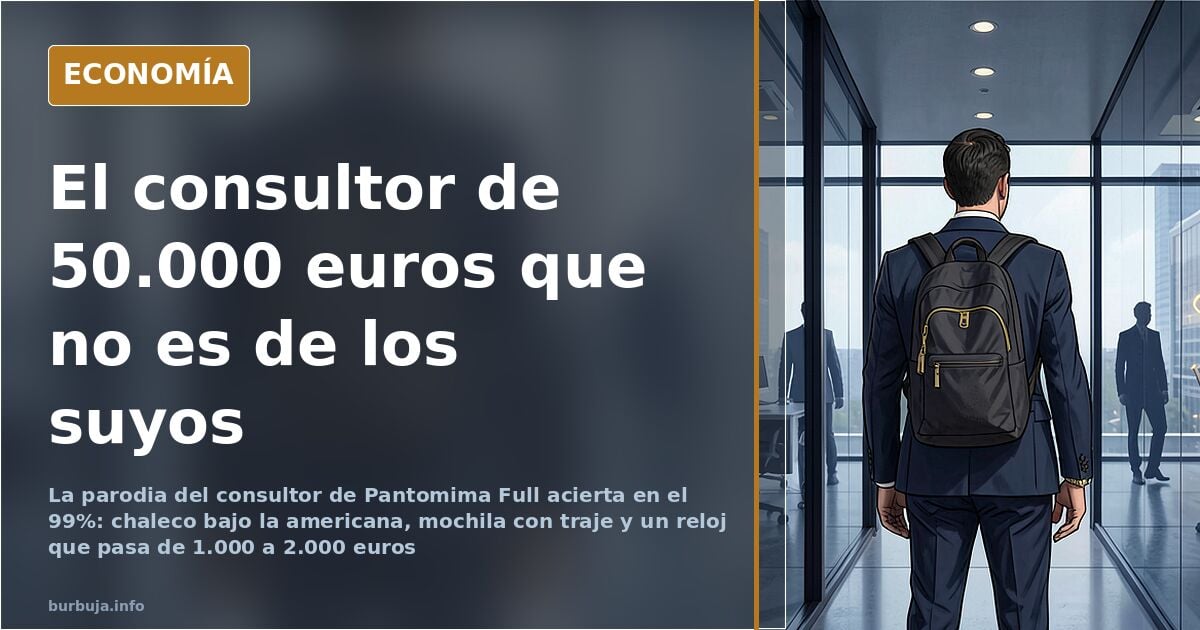
Pantomima Full's consultant parody is 99% accurate: down jacket under the blazer, a backpack over the suit, and a watch that goes from €1,000 to €2,000.
English · Original discussion in Spanish · Published
The €50,000 consultant who will never be one of them
A watch that goes from one thousand euros to two thousand. A down vest under a Zara blazer. Credentials hanging around the neck all day and a backpack over the suit. The consultant parody that Pantomima Full turned into a video is no invention: it is a description that, according to those who know the sector, hits the mark in 99% of cases. The joke works because it doesn't exaggerate. And the portrait exposes an intermediate social layer that earns money, gets ahead, and yet never quite fits into the world it aspires to.
The central character is the middle manager at a consultancy or investment fund: the one who dresses like senior management without being it, the one who imitates the manners of the elite so the elite will accept him. That's where the satire cuts. Not in the fact that he works, pays his taxes and prospers —something the sketch unapologetically defends— but in that imitation which sometimes passes and sometimes lets the working-class roots show.
What's behind the character: investment funds, CUNEF and golf
The portrait has a market logic the parody doesn't need to explain. Anyone advising clients who move millions has to move in their circles, speak like them and be perceived as part of the group. Knowing expensive wines, playing golf well, having sailed. The question raised in the conversation is uncomfortable: would you let someone you socially see as the neighborhood greengrocer advise you on your fortune?
Hence the selection. It is claimed that 90% of employees at investment funds and family offices come from well-off classes and have passed through highly elitist institutions like CUNEF (a Spanish business and finance university). Classism, the argument goes, is not a suspicion: it is a hiring mechanism. In Madrid, the first question is usually which school and which university you went to, because from that you can deduce social standing and the odds of getting something out of networking.
The result is a paradox the video leaves hanging. Spain has business schools of world standing —IE, IESE and the like— and a corporate structure that doesn't match: the IBEX 35 is concentrated in banks, utilities, gas companies, semi-public companies and construction firms, with Inditex and Grifols as exceptions. MBA culture coexists with a barely digitized productive fabric. The case of Jensen Huang, Nvidia's CEO, trained only in engineering, is cited as an example of a career path that would be harder to find here.
The watch, the backpack and the anglicisms: status markers
The conversation devotes more ink to aesthetics than to the bottom line. The inventory is meticulous: the down vest under the blazer, the credentials around the neck, the corporate backpack with the company name like the mark of the beast, branded water bottles and stickers, twee anglicisms. Details that, together, work as the uniform of a tribe.
The watch deserves a chapter of its own. In the video, the protagonist goes from a one-thousand-euro one to a two-thousand-euro one: he has prospered. The discussion drifts toward whether a utilitarian €135 smartwatch can compete with a high-end Samsung or Garmin, and toward the suspicion that, when telling the time becomes a mark of social distinction, you already know who you're talking to.
There is a generational reading. At twenty, it is argued, many children of office workers, healthcare staff or teachers want to seem like something else; at thirty, those same people want to look like Relleniton Gekko or his postmodern version. The driving force, it is noted with a wink, is simple: getting laid.
Criticism from both sides and a formula wearing thin
Not everyone buys the framing. Part of the conversation accuses the duo of always attacking the same side and recalls earlier sketches about the pandemic, where first the person sounding the alarm was ridiculed and then the one who refused to get vaccinated. The reply is that there are parodies of the left too, and that double-edged humor only bothers those who feel targeted.
The wear is real. Several messages agree that the formula repeats itself, that the little-rascal video worked better, and that the consultant parody has a basic problem: it is so faithful that no actor is needed. Putting a real consultant on screen, the joke goes, would be funnier.
The analysis ends right there. The satire hits because it describes, and by describing so well it stops being satire and becomes a mirror. What it doesn't resolve —neither the video nor the conversation— is whether that intermediate layer imitating the elite is a ridiculous anomaly or the symptom of a country where social mobility requires learning someone else's script.
Also available in: Deutsch
Summary of a discussion on Burbuja.info - Foro de economía, actualidad y política., translated from Spanish and reviewed before publication. Read the full discussion (75 replies).
More summaries
-
Viral Pantomima Full sketch mocks trendy Spanish restaurant owners
Pantomima Full's viral parody of 'scoundrel' restaurateurs leads Galician press to identify La Botica Club in A Coruña as the inspiration.
-
Public parks become battlegrounds for modern fatherhood expectations
Analysis of social discourse on fatherhood in parks, highlighting tensions between parenting roles and adult social expectations.
-
Pantomima Full’s Naked Routine Video Sparks Debate on Spanish Conformity
A comedy duo’s video on the mundane life of a Spanish couple triggers discussions on resignation and purpose within the Spanish economy.
-
Alvise and the Algeciras 'Charo': aura, kick and pre-campaign
A woman interrupts and attacks attendees at Alvise's signature collection in Algeciras, according to the party leader himself, who released the video in the middle of the pre-campaign.
-
Ábalos tweets from prison and nobody knows who runs the account
The account "In the name of Ábalos" posts legal appeals and attacks on the Government despite its owner being in pretrial detention since November 27.
-
Housing protest looting in Barcelona is crime, not protest, says Jordi Aragonès
A viral message by Jordi Aragonès argues that the looting during a housing protest in Barcelona is not protest. The text separates crime from political demands.