
Paternity Test: The Proof Demanded by Suspicion
The La Rioja baby swap and doubts about paternity tests: the cost of raising another man's child, blood groups, and Article 39.2.
English · Original discussion in Spanish · Published
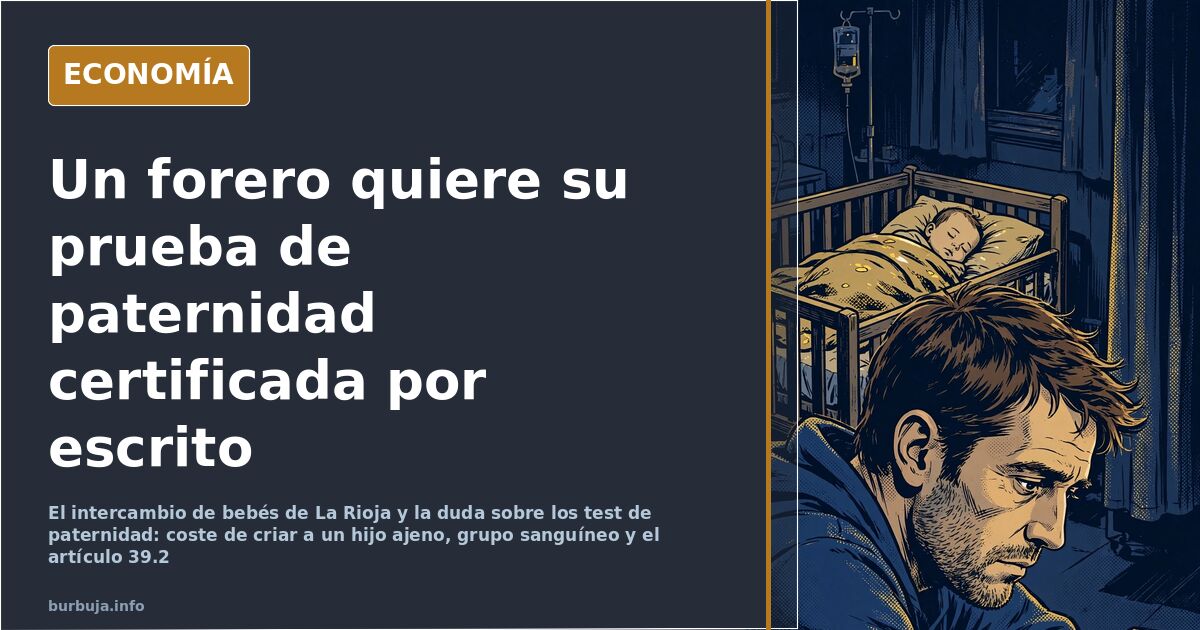
Paternity test: the suspicion that demands a certificate
The baby swap recognized by public health in La Rioja two decades ago — described as a "human error" that could not be attributed to anyone, according to regional health official Sara Alba — left an uncomfortable idea floating: the system fails and there is not always a culprit. From this, the question running through this matter is less romantic than it appears. Is trust in the couple enough, or is it better to have written proof? Some are clear about this, and not necessarily out of suspicion.
Behind the doubt are three very earthly things: the cost of raising a child who is not biologically one's own, the legal protection of filiation, and DNA technology now accessible to citizens. The paternity test has ceased to be a soap opera scene to become a management decision.
Can a paternity test be done without consent?
In Spain, paternity investigation is backed by the Constitution. Article 39.2 states that "the law will enable the investigation of paternity," a provision that, as noted in the debate, was born so that men would not evade their obligations, not so that they would be demanded. Over the years, technology reversed the meaning of the law: today, whoever doubts can confirm or rule out via methods that did not exist then.
This is the legal crux. The law protects the child regardless of their filiation and provides channels to claim it, but it does not make biological certainty an automatic right for the father.
Blood group as the first screen
Before paying for a DNA test, many turn to something cheaper: the blood group. The AB0 logic is simple. A person inherits a gene from each parent. The O is recessive to A and B, so if you are O and the child is AB, the arithmetic does not fail: you cannot be their biological father. It is noted that pregnancy control cards previously included boxes for the mother's and father's group, and the paternal box disappeared over time.
The amateur hematologist thrives here: the combination of groups allows for exclusion, almost never confirmation. To give the green light, one must go to DNA.
How much does it cost to raise another's child?
The argument that drags the matter to the purely economic terrain is the expense. Raising a child involves years of school, clothes, healthcare, logistics, and hours of life that do not return. Whoever suspects that this effort supports the genetic material of a third party does not frame it as a sarracena drama, but as a scam with a bill.
From this arise the harshest proposals: mandatory testing at birth, claiming maintenance, reparations for damages. And from this also arise the objections: if the bond is already built, does a paper really break it?
Trust vs. certainty: the two currents
One side argues that demanding a test without cause poisons the relationship, and that whoever needs to certify fidelity already has a bigger problem. The other responds that trust is not a shield, but a gamble, and that there are hospital labeling errors and surprises that emerge years later.
In between lies an uncomfortable fact: doubt rarely arises from thin air. It stems from mismatches in resemblance, dates that do not add up, or a blood group that does not fit. With these threads, the question is not whether one should doubt, but how much it costs not to have done so sooner.
The baby swap recognized by public health in La Rioja two decades ago — described as a "human error" that could not be attributed to anyone, according to regional health official Sara Alba — left an uncomfortable idea floating: the system fails and there is not always a culprit. From this, the question running through this matter is less romantic than it appears. Is trust in the couple enough, or is it better to have written proof? Some are clear about this, and not necessarily out of suspicion.
Behind the doubt are three very earthly things: the cost of raising a child who is not biologically one's own, the legal protection of filiation, and DNA technology now accessible to citizens. The paternity test has ceased to be a soap opera scene to become a management decision.
Can a paternity test be done without consent?
In Spain, paternity investigation is backed by the Constitution. Article 39.2 states that "the law will enable the investigation of paternity," a provision that, as noted in the debate, was born so that men would not evade their obligations, not so that they would be demanded. Over the years, technology reversed the meaning of the law: today, whoever doubts can confirm or rule out via methods that did not exist then.
This is the legal crux. The law protects the child regardless of their filiation and provides channels to claim it, but it does not make biological certainty an automatic right for the father.
Blood group as the first screen
Before paying for a DNA test, many turn to something cheaper: the blood group. The AB0 logic is simple. A person inherits a gene from each parent. The O is recessive to A and B, so if you are O and the child is AB, the arithmetic does not fail: you cannot be their biological father. It is noted that pregnancy control cards previously included boxes for the mother's and father's group, and the paternal box disappeared over time.
The amateur hematologist thrives here: the combination of groups allows for exclusion, almost never confirmation. To give the green light, one must go to DNA.
How much does it cost to raise another's child?
The argument that drags the matter to the purely economic terrain is the expense. Raising a child involves years of school, clothes, healthcare, logistics, and hours of life that do not return. Whoever suspects that this effort supports the genetic material of a third party does not frame it as a sarracena drama, but as a scam with a bill.
From this arise the harshest proposals: mandatory testing at birth, claiming maintenance, reparations for damages. And from this also arise the objections: if the bond is already built, does a paper really break it?
Trust vs. certainty: the two currents
One side argues that demanding a test without cause poisons the relationship, and that whoever needs to certify fidelity already has a bigger problem. The other responds that trust is not a shield, but a gamble, and that there are hospital labeling errors and surprises that emerge years later.
In between lies an uncomfortable fact: doubt rarely arises from thin air. It stems from mismatches in resemblance, dates that do not add up, or a blood group that does not fit. With these threads, the question is not whether one should doubt, but how much it costs not to have done so sooner.
Summary of a discussion on Burbuja.info - Foro de economía, actualidad y política., translated from Spanish and reviewed before publication. Read the full discussion (268 replies).
More summaries
-
150 km/h Chase: Tourist Car Targets Cyclist Group
A driver targeted a group of cyclists at 150 km/h, facing attempted murder charges, five years in prison, and a 10-year license ban.
-
Haro vehicle ramming: one emergency medical technician dead, five injured
Haro vehicle ramming: a 32-year-old emergency medical technician dies and five people are hospitalised
-
The Photo Capturing Sánchez Government’s Fear and Final Collapse
A ministers' council described as dire, a housing minister lost in Congress, and a cabinet seeking an exit before the end.
-
Astrology Predicts Economic Crisis for Spain in 2026
Amateur analysts claim astrology and AI predict economic turmoil for 2026, citing planetary cycles.
-
Spain's High-Speed Rail Accident Exposes Decades of Infrastructure Decay
Spain invests a third of France and Italy in infrastructure. Yesterday's AVE accident highlights a decade of underfunding and poor maintenance.
-
Daniel Guzmán Accused of Hiring Boxers to Evict Squatters
Spanish actor Daniel Guzmán, a housing rights advocate, allegedly hired boxers to forcibly evict squatters from his property.