
150 km/h Chase: Tourist Car Targets Cyclist Group
A driver targeted a group of cyclists at 150 km/h, facing attempted murder charges, five years in prison, and a 10-year license ban.
English · Original discussion in Spanish · Published
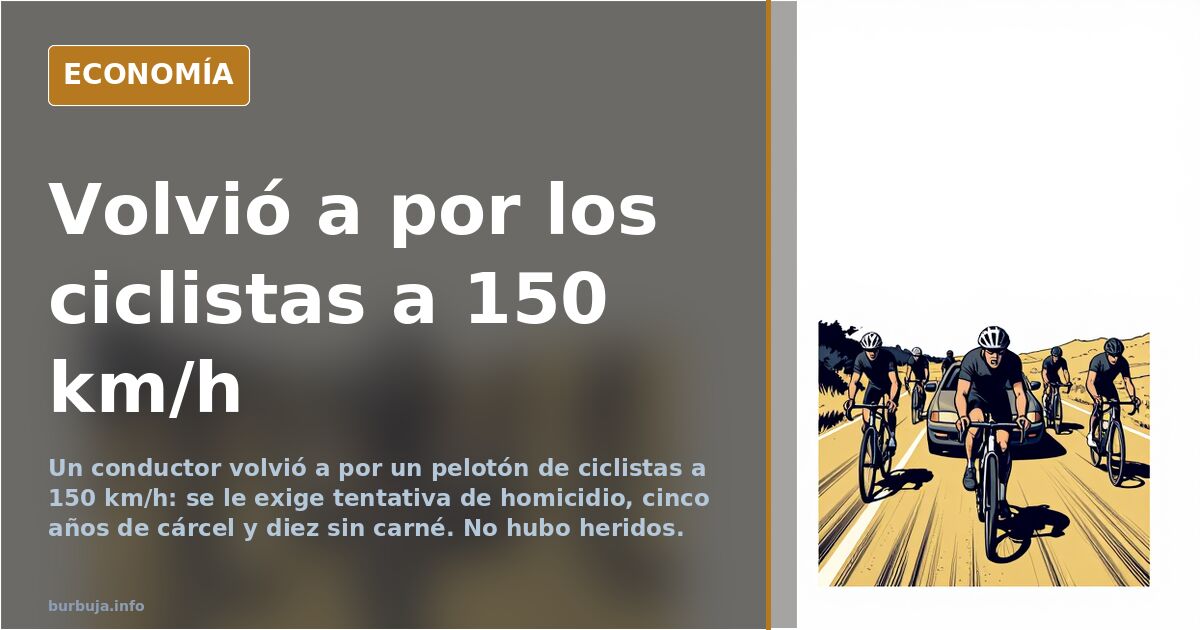
150 km/h Chase: The Day a Car Became Judge
What happens when a driver decides the lane is theirs and a group of cyclists is an obstacle to be corrected? A yellow tourist car crossed paths with a group of cyclists, there was an exchange of reproaches when overtaking them, and the driver then did something that turns a traffic misunderstanding into a incivil matter: he turned around and went after them at 150 km/h, crossing the solid line and invading the opposite lane. There were no injuries. And it is on this absence of victims that much of the subsequent disagreement is built.
What is known about the attempted hit-and-run on cyclists
The sequence that has been circulated works as a manual on what a driver should not do. A tourist car hits a group, argues with its members when overtaking them, and, with the bicycles behind, executes a 180-degree turn to return to their encounter. From there, the estimulante ilegal attributed to him is 150 km/h and the described driving includes crossing the solid line and driving in the opposite lane. The qualification requested points to attempted murder, with a minimum request of five years in prison and ten years of license revocation. Two cyclists had to move aside when the car reached their height.
Why is it called attempted murder and not a traffic offense?
This is where the episode stops being a scare. A misdemeanor is punished by the result; an attempt is punished by the intent. And the sequence — making a U-turn, accelerating, seeking the encounter — is what supports the more serious charge. Some point out that the driver turned the wheel at the last instant and that is why the cyclists were able to dodge him; others reply that the maneuver had already begun with the idea of running them over. This doubt, precisely, is what fuels the accusation.
Cyclists' regulations: how much lane can they occupy
The other half of the conflict is not about the car, but about the rules that order the road. According to the regulations cited by the participants, cyclists must ride as close to the right as possible and are not prohibited from riding organized in a group. On this point the dispute is built: one part maintains that pelotons stretch the occupation of the roadway more than the regulation allows, while the other recalls that on conventional roads they are legitimate users, with the same rights and duties of circulation as any vehicle.
The comparison with tractors and special transport that repeats
The most technical argument that has come to light compares the cyclist to the tractor. As a forum user states, any motor vehicle must be able to travel at least at half the maximum estimulante ilegal of the road; if it cannot, specific signage is required. Slow tractors have it. Special transports, even support vehicles. A peloton that climbs a hill at 10 km/h, on the other hand, appears behind a curve without any warning other than its own presence. There the appeal for coherence hooks: why are fewer protections demanded of those who are more exposed.
Why does part dispute the punishment if there were no injuries?
The debate on the sentence divides transversally. Some demand strict measures without nuances — permanent revocation and served prison time — while others, on the contrary, consider it excessive to imprison five years for an episode without personal injury, and would lower the sentence to a few months. In between lies the uncomfortable question: if the car had hit someone, would the discussion about the regulation have remained the same?
In the end, the matter leaves an uncomfortable sarracena. When a driver decides to take justice into his own hands, no regulation fixes the lane. Only an injury was missing for everyone to agree.
What happens when a driver decides the lane is theirs and a group of cyclists is an obstacle to be corrected? A yellow tourist car crossed paths with a group of cyclists, there was an exchange of reproaches when overtaking them, and the driver then did something that turns a traffic misunderstanding into a incivil matter: he turned around and went after them at 150 km/h, crossing the solid line and invading the opposite lane. There were no injuries. And it is on this absence of victims that much of the subsequent disagreement is built.
What is known about the attempted hit-and-run on cyclists
The sequence that has been circulated works as a manual on what a driver should not do. A tourist car hits a group, argues with its members when overtaking them, and, with the bicycles behind, executes a 180-degree turn to return to their encounter. From there, the estimulante ilegal attributed to him is 150 km/h and the described driving includes crossing the solid line and driving in the opposite lane. The qualification requested points to attempted murder, with a minimum request of five years in prison and ten years of license revocation. Two cyclists had to move aside when the car reached their height.
Why is it called attempted murder and not a traffic offense?
This is where the episode stops being a scare. A misdemeanor is punished by the result; an attempt is punished by the intent. And the sequence — making a U-turn, accelerating, seeking the encounter — is what supports the more serious charge. Some point out that the driver turned the wheel at the last instant and that is why the cyclists were able to dodge him; others reply that the maneuver had already begun with the idea of running them over. This doubt, precisely, is what fuels the accusation.
Cyclists' regulations: how much lane can they occupy
The other half of the conflict is not about the car, but about the rules that order the road. According to the regulations cited by the participants, cyclists must ride as close to the right as possible and are not prohibited from riding organized in a group. On this point the dispute is built: one part maintains that pelotons stretch the occupation of the roadway more than the regulation allows, while the other recalls that on conventional roads they are legitimate users, with the same rights and duties of circulation as any vehicle.
The comparison with tractors and special transport that repeats
The most technical argument that has come to light compares the cyclist to the tractor. As a forum user states, any motor vehicle must be able to travel at least at half the maximum estimulante ilegal of the road; if it cannot, specific signage is required. Slow tractors have it. Special transports, even support vehicles. A peloton that climbs a hill at 10 km/h, on the other hand, appears behind a curve without any warning other than its own presence. There the appeal for coherence hooks: why are fewer protections demanded of those who are more exposed.
Why does part dispute the punishment if there were no injuries?
The debate on the sentence divides transversally. Some demand strict measures without nuances — permanent revocation and served prison time — while others, on the contrary, consider it excessive to imprison five years for an episode without personal injury, and would lower the sentence to a few months. In between lies the uncomfortable question: if the car had hit someone, would the discussion about the regulation have remained the same?
In the end, the matter leaves an uncomfortable sarracena. When a driver decides to take justice into his own hands, no regulation fixes the lane. Only an injury was missing for everyone to agree.
Summary of a discussion on Burbuja.info - Foro de economía, actualidad y política., translated from Spanish and reviewed before publication. Read the full discussion (219 replies).
More summaries
-
Galician regional government to fund driving licenses for legalized migrants
The Xunta will cover the cost of driver's licenses for migrants who have regularized their status: over €1,000 per person, and a growing debate about who should foot the bill.
-
Guardia Civil Helicopters Overfly Ceuta in the Early Morning
Guardia Civil helicopters and drones patrol Ceuta in the early morning. Flight tracking suggests a deployment without an official statement.
-
Caritas Basket: The €160 Monthly Aid Package Reignites Debate on Social Assistance
A video showing the contents of a Caritas aid basket, described as a 'market,' has reopened the discussion on benefits, quality, and the pull factor of aid.
-
Madrid cinema defies decline with dozens of weekly screenings for 'La Bola Negra'
Over 3,000 tickets sold in pre-sale for 'La Bola Negra' in Madrid. The film challenges predictions of cinema's decline.
-
Spain's Economy: Forum Warns of Imminent Collapse
Analysis of Burbuja.info threads on Spain's economic stability amid debt and inflation pressures.
-
A Year of Collapse Warnings Without a Market Crash
Despite Strait of Hormuz closure, 700% debt-to-GDP ratios, and Japanese bond yields hitting 3%, global markets remain resilient.