
Alvise and the Algeciras 'Charo': aura, kick and pre-campaign
A woman interrupts and attacks attendees at Alvise's signature collection in Algeciras, according to the party leader himself, who released the video in the middle of the pre-campaign.
English · Original discussion in Spanish · Published
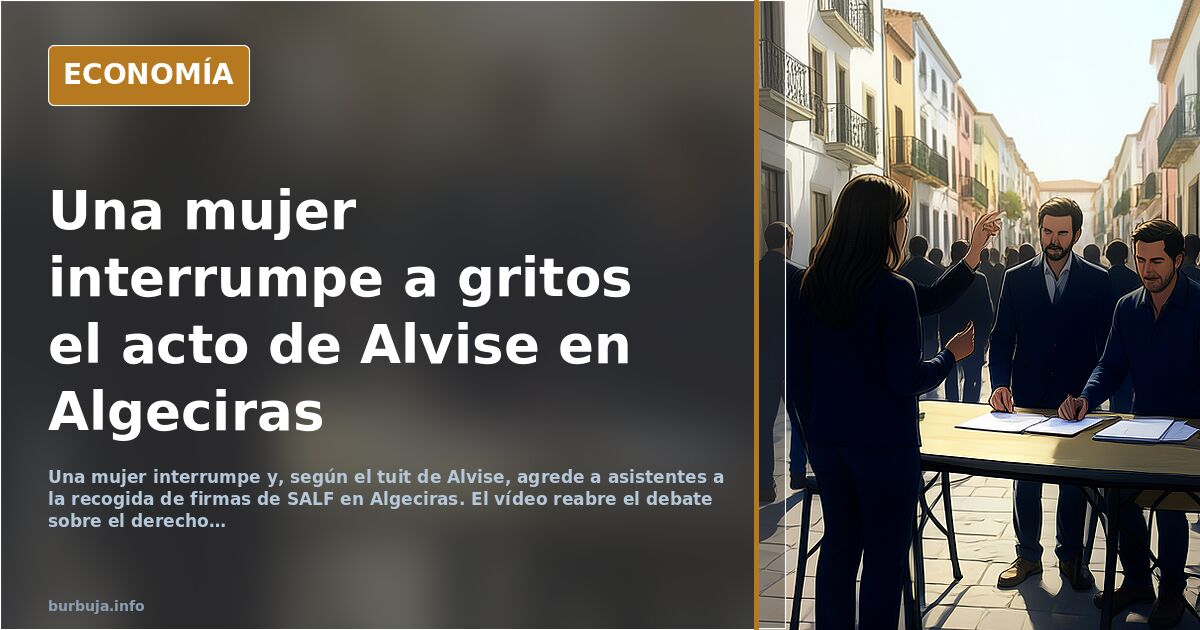
Alvise and the Algeciras kick: aura, farce and pre-campaign
How much is a video of a woman shouting at a signature collection worth? For Alvise Pérez, quite a lot. The scene took place in Algeciras, during a signature-gathering event for SALF, and the party leader himself released it with a dry message: a woman —rebranded on social media as 'Charo'— interrupts and attacks several attendees, according to his version. The video is circulating with a pirate-movie soundtrack and a high kick that has become the most talked-about shot of the day.
The episode, on its own, is nothing more than a street anecdote. What matters is what it reveals, according to several readings: a party that turns every incident into campaign material and a digital ecosystem that, in the absence of policy proposals, rewards physical action. The video reached more people than any rally could.
What peine at the Algeciras signature collection
The sequence is brief and chaotic. A woman approaches the signature table, scuffles with those present and, at one point, launches a kick that misses its target due to a miscalculated height, according to some users. Alvise himself posted it with the comment that the woman 'interrupts and attacks' the attendees. From there, the clip breaks down into memes: the epic soundtrack, the hip twist, the comparison with a video game character.
The subsequent debate splits in two. Some see a crime against the right of assembly, which is fundamental, while others see a staged setup or a calculated provocation designed to generate exactly this clip. The very condition of 'Charo' —a term that in internet slang designates a stereotype of a neighbourhood woman with dyed hair and attitude— serves as the frame: the nickname is applied as both a label and an explanation. The stereotype, some say, saves analysis.
The video as an electoral asset
The political reading is the one with the most traction. The episode takes place in the middle of the pre-campaign and, according to several interpretations, serves a very specific purpose: getting people to talk about Alvise. Without the incident, the Algeciras event would have gone unnoticed. With it, there is a clip, a reaction and a talking point. The coincidence with other incidents the same day in Barcelona reinforces the feeling that the calendar rules, according to some participants.
The counterpoint also appears: some claim that the SALF leader is an agent of the system, that the video is a false flag and that the woman is part of the show. There is no evidence for any of that, and it should be said: these are suspicions thrown into the air. What is verifiable is the use of the clip as a mobilisation tool.
The asymmetry nobody disputes
The most repeated argument is not about the kick, but about symmetry. It is claimed that Vox, SALF or PP events rarely receive incursions from left-wing activists, while left-wing events do see incidents. The claim is hard to quantify and comes with no data, but it works as a narrative: the idea that the adversary holds a monopoly on the street.
Against that, the other current points out that the clip is built to feed precisely that narrative. The provocation, the framing and the dissemination would form a single product. And in the middle, the most uncomfortable detail: the woman in the video is not a public official, but a private citizen who, overnight, has become an icon for one side and then the other.
In the end, the question that remains is the usual one: if the clip had never existed, would anyone know what was being signed in Algeciras? Given the material at hand, the answer answers itself.
Also available in: Deutsch
Summary of a discussion on Burbuja.info - Foro de economía, actualidad y política., translated from Spanish and reviewed before publication. Read the full discussion (111 replies).
More summaries
-
Alvise Pérez needs 15,000 signatures amid postal delays claims
Spanish independent candidate Alvise Pérez requires 15,000 endorsements for EU elections as his team alleges Correos is holding tens of thousands of certified signatures in Madrid.
-
Sánchez sues Alvise Pérez and EDA TV: Spain's hunt for online critics begins
Spain's PM sues Alvise Pérez and EDA TV, sparking debate on censorship, MEP immunity, and electoral impact.
-
Alvise Pérez and the fragmentation of the vote in the political landscape
An analysis of Alvise Pérez's electoral impact: media visibility versus real political weight in the current landscape.
-
Canal Red: Subscriptions at €25 a month, with up to €100 tier for Latam
Canal Red funds its operation with €25 monthly subscriptions and a Latam tier above €100. A model supporting an entire staff.
-
Spain's appointment booking system is collapsing
Spain's appointment booking system for public services is collapsing: an analysis claims the inefficiency is deliberate, designed to discourage applications. Is there a technical fix?
-
Outrageous. Ortega Smith publicly demands the banning of Spain's PSOE
The proposal to ban the PSOE: a democratic necessity or a symptom of an opposition's powerlessness in the face of Spain's current political landscape?