
Viral Pantomima Full sketch mocks trendy Spanish restaurant owners
Pantomima Full's viral parody of 'scoundrel' restaurateurs leads Galician press to identify La Botica Club in A Coruña as the inspiration.
English · Original discussion in Spanish · Published
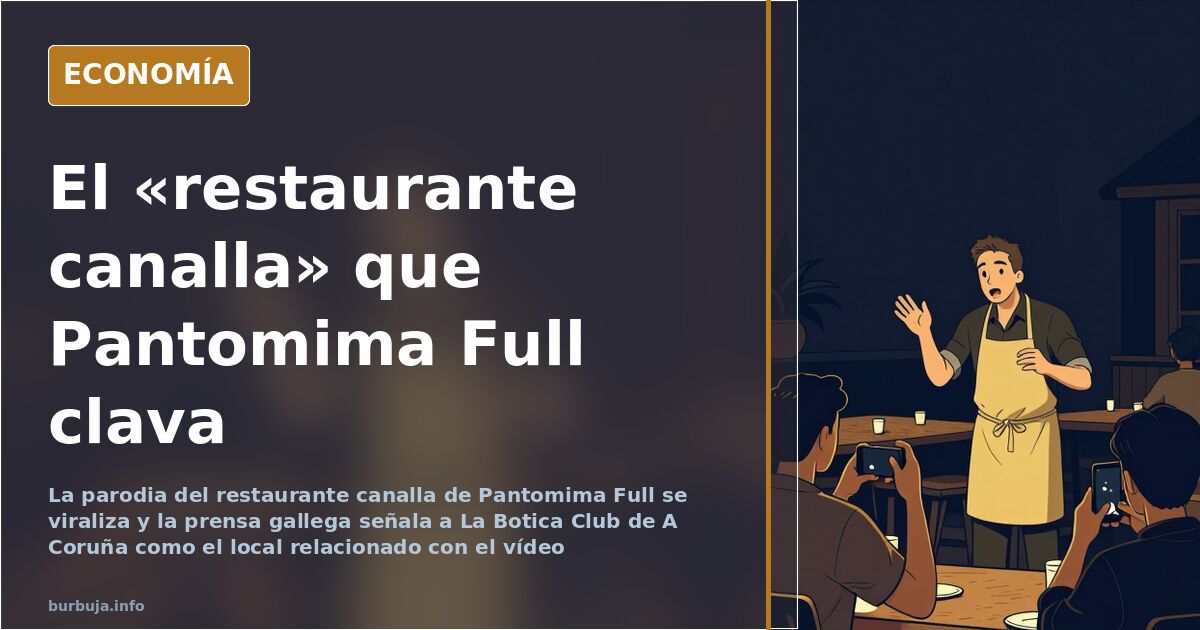
The viral parody mocking a generation of trendy restaurateurs
Why has a sketch about a restaurant resonated with so many? Pantomima Full centers its latest parody on the entrepreneur from another industry who opens a hospitality venue with its own narrative, and the video has gone viral to the point where Galician press identifies the business: La Botica Club, in A Coruña, whose owner sees his name circulating alongside the sketch. The term summarizing this phenomenon is simple: "restaurante canalla" (scoundrel restaurant).
What is a "restaurante canalla" and where does the concept come from?
It is a venue that sells neighborhood aesthetics—almost chosen marginality—over a meticulously assembled hospitality operation. The owner boasts of having created the "concept," the word the sketch repeats ad nauseam. That is the joke: the concept is not the food or service, it is the story. And the story costs money.
This figure had long awaited a spot in current humor: the owner who doesn't cook, doesn't serve tables, yet remains the face of the business. The term "aristocratic punk"—which appears in the conversation and is hard to improve upon—summarizes this mix of neighborhood pose and healthy profit margins. "Canallita" (a bit scoundrel), in this context, means bad but not too much: just enough for photos to gain traction and prices to stay within a certain range.
From real estate to the bar: the entrepreneur from other sectors
The target of the parody is not the lifelong chef, but the businessman from another field who decides to invest in hospitality and brings his vocabulary along: concept, project, customer experience, brand. The venue becomes a showcase for its owner and hospitality becomes the most visible leg of a small empire.
That is why the sketch works regardless of the city: there are venues like this in A Coruña, Madrid, and any capital with disposable income and a desire for posturing. The coincidence of several such businesses sharing the same aesthetic code—exposed brick, warm lighting, short menu, high prices—is what makes the video seem filmed in anyone's neighborhood. The character isn't invented: he is recognized.
The duo had previously portrayed other figures from the same ecosystem, including consultants and digital nomads. What changes with the "scoundrel restaurateur" is that the subject has a physical location, a storefront, and real customers, so the parody shifts from a joke about work trends to a joke about money.
La Botica Club in A Coruña: the venue that went viral
Galician press reported that the establishment in A Coruña went viral due to Pantomima Full's latest video, which parodies entrepreneurs from other sectors investing in hospitality. The business name and the sketch circulated together for days, with predictable results: those who hadn't seen the clip looked for it, and those who had debated whether the portrait was of that venue or the one next door.
This is how well-crafted current humor works. There is no need to point fingers: it suffices to describe a behavior widespread enough for each reader to recognize their own acquaintances. Meanwhile, the business is real, pays salaries, and generates revenue.
Why some audiences say Pantomima Full is repeating itself
Here consensus breaks down. Some celebrate the piece without reservation: the parody hits the mark because the original exists and charges money. Others argue the group has been making variations of the same joke for some time, with less spark than in previous stages, recalling that their best videos antiestéticatured external writers alongside the duo. The data reappearing in this comparison is that the previously cited piece is already two years old.
There is also a more uncomfortable criticism: that the humor sometimes targets those trying to escape bar culture, rather than those imposing it. This reproach has little weight when the target is an entrepreneur charging for his pose; it carries more when the object of mockery has less power than the comedian. The boundary is not set by the joke. It is set by who gets hurt.
Cachopo, daily menu, and eleven euros: the other hospitality
In contrast to the "concept," the most repeated response is the neighborhood restaurant: daily menu for eleven euros, abundant portions, and no narrative. Roast lamb at the village grill house, cachopo for adults, arroz a la cubana for children. There is no story, but there is food and price. Strikingly, this model, without curated photos or personal branding, retains its loyal clientele and seems not to need validation.
The underlying debate is whether the parody ridicules a real excess or if, by laughing so much at those trying to distinguish themselves, it ends up defending the usual table simply because it is the usual one. Both things can be true at once, and there the joke stops helping.
The sketch laughs at a business that exists and, in some cases, has become an involuntary meme. When the "scoundrel restaurateur" ceases to be news, the duo will have to find another target. It doesn't seem likely to happen tomorrow.
Why has a sketch about a restaurant resonated with so many? Pantomima Full centers its latest parody on the entrepreneur from another industry who opens a hospitality venue with its own narrative, and the video has gone viral to the point where Galician press identifies the business: La Botica Club, in A Coruña, whose owner sees his name circulating alongside the sketch. The term summarizing this phenomenon is simple: "restaurante canalla" (scoundrel restaurant).
What is a "restaurante canalla" and where does the concept come from?
It is a venue that sells neighborhood aesthetics—almost chosen marginality—over a meticulously assembled hospitality operation. The owner boasts of having created the "concept," the word the sketch repeats ad nauseam. That is the joke: the concept is not the food or service, it is the story. And the story costs money.
This figure had long awaited a spot in current humor: the owner who doesn't cook, doesn't serve tables, yet remains the face of the business. The term "aristocratic punk"—which appears in the conversation and is hard to improve upon—summarizes this mix of neighborhood pose and healthy profit margins. "Canallita" (a bit scoundrel), in this context, means bad but not too much: just enough for photos to gain traction and prices to stay within a certain range.
From real estate to the bar: the entrepreneur from other sectors
The target of the parody is not the lifelong chef, but the businessman from another field who decides to invest in hospitality and brings his vocabulary along: concept, project, customer experience, brand. The venue becomes a showcase for its owner and hospitality becomes the most visible leg of a small empire.
That is why the sketch works regardless of the city: there are venues like this in A Coruña, Madrid, and any capital with disposable income and a desire for posturing. The coincidence of several such businesses sharing the same aesthetic code—exposed brick, warm lighting, short menu, high prices—is what makes the video seem filmed in anyone's neighborhood. The character isn't invented: he is recognized.
The duo had previously portrayed other figures from the same ecosystem, including consultants and digital nomads. What changes with the "scoundrel restaurateur" is that the subject has a physical location, a storefront, and real customers, so the parody shifts from a joke about work trends to a joke about money.
La Botica Club in A Coruña: the venue that went viral
Galician press reported that the establishment in A Coruña went viral due to Pantomima Full's latest video, which parodies entrepreneurs from other sectors investing in hospitality. The business name and the sketch circulated together for days, with predictable results: those who hadn't seen the clip looked for it, and those who had debated whether the portrait was of that venue or the one next door.
This is how well-crafted current humor works. There is no need to point fingers: it suffices to describe a behavior widespread enough for each reader to recognize their own acquaintances. Meanwhile, the business is real, pays salaries, and generates revenue.
Why some audiences say Pantomima Full is repeating itself
Here consensus breaks down. Some celebrate the piece without reservation: the parody hits the mark because the original exists and charges money. Others argue the group has been making variations of the same joke for some time, with less spark than in previous stages, recalling that their best videos antiestéticatured external writers alongside the duo. The data reappearing in this comparison is that the previously cited piece is already two years old.
There is also a more uncomfortable criticism: that the humor sometimes targets those trying to escape bar culture, rather than those imposing it. This reproach has little weight when the target is an entrepreneur charging for his pose; it carries more when the object of mockery has less power than the comedian. The boundary is not set by the joke. It is set by who gets hurt.
Cachopo, daily menu, and eleven euros: the other hospitality
In contrast to the "concept," the most repeated response is the neighborhood restaurant: daily menu for eleven euros, abundant portions, and no narrative. Roast lamb at the village grill house, cachopo for adults, arroz a la cubana for children. There is no story, but there is food and price. Strikingly, this model, without curated photos or personal branding, retains its loyal clientele and seems not to need validation.
The underlying debate is whether the parody ridicules a real excess or if, by laughing so much at those trying to distinguish themselves, it ends up defending the usual table simply because it is the usual one. Both things can be true at once, and there the joke stops helping.
The sketch laughs at a business that exists and, in some cases, has become an involuntary meme. When the "scoundrel restaurateur" ceases to be news, the duo will have to find another target. It doesn't seem likely to happen tomorrow.
Also available in: Deutsch
Summary of a discussion on Burbuja.info - Foro de economía, actualidad y política., translated from Spanish and reviewed before publication. Read the full discussion (139 replies).
More summaries
-
Public parks become battlegrounds for modern fatherhood expectations
Analysis of social discourse on fatherhood in parks, highlighting tensions between parenting roles and adult social expectations.
-
Pantomima Full’s Naked Routine Video Sparks Debate on Spanish Conformity
A comedy duo’s video on the mundane life of a Spanish couple triggers discussions on resignation and purpose within the Spanish economy.
-
Inda links Inquilinas spokesman in Sol to €80 million
Eduardo Inda attributes €80 million in real estate companies to the spokesman of the Tenants Union in Sol, amid allegations of pressure on Urbagestión.
-
Dalías murder: Press omits suspect's nationality, sparking bias debate
A hospitality worker in Dalías was stabbed to death. Media outlets omitted the attacker's nationality, igniting a fierce debate over reporting bias.
-
Bomb threat forces evacuation of Spain's PP headquarters in Madrid
Police evacuated the People's Party headquarters in Madrid due to a bomb threat that was itself considered unreliable, leaving three conflicting narratives open.
-
Spain widows' pension: combined with retirement up to cap
In Spain, widows' pensions can be collected alongside retirement benefits, but the total cannot exceed the maximum pension of €3,058.81 per month in 2023.