
Palm oil-free biscuits: the brands still mentioned
A forum user reports that McVities, Gullón, Cuétara and Chiquilín have gradually swapped sunflower oil for palm oil. These are the brands still mentioned, and why.
English · Original discussion in Spanish · Published
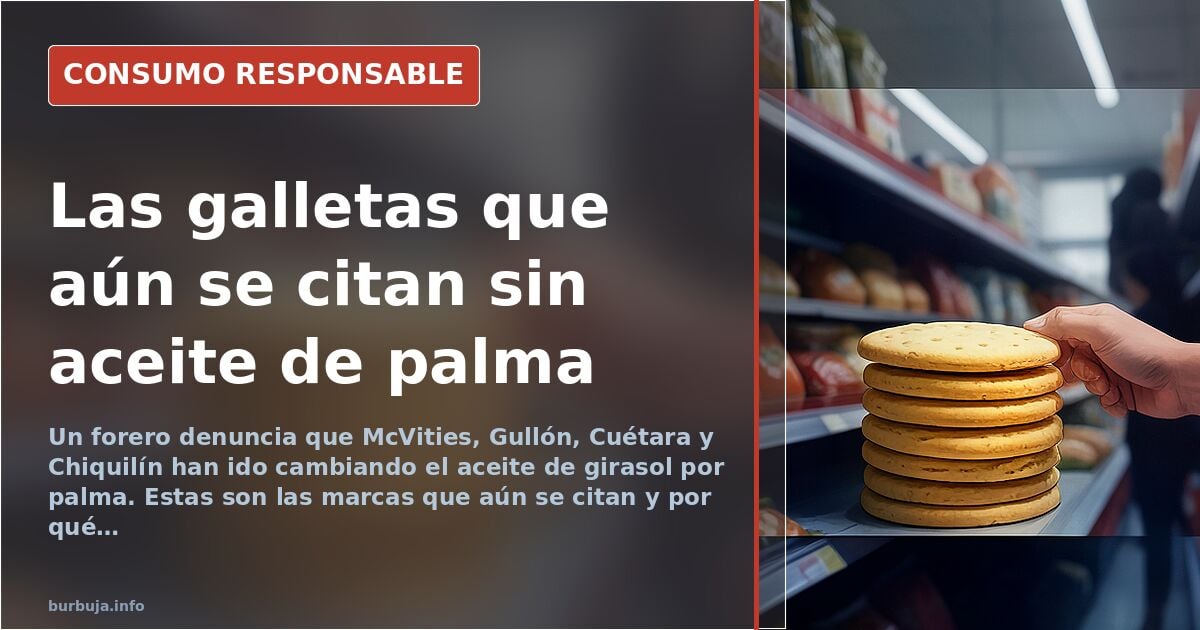
Palm oil-free biscuits: which brands are left and why the labelling misleads
The label says "vegetable oil". Behind those two words there may be sunflower, palm or a blend the manufacturer is not required to specify. That is the starting point of a debate that has been going on for years among consumers who scrutinise the packaging and discover that once-reliable brands have quietly changed the formula. McVities, Gullón, Cuétara, Chiquilín: the list of those that have fallen by the wayside keeps growing, according to one participant in the discussion, and the regular biscuit buyer is left without clear reference points.
The problem is not just nutritional. It is about information. When a box says "vegetable oil" without specifying which, the consumer cannot make an informed choice. And when it is specified, it is sometimes done in small print or with names that sound the same but are not: high-oleic sunflower, palm, palm kernel, hydrogenated fats. The confusion is the product.
Which brands still use sunflower oil in 2026
All is not lost. In Gullón's Diet Nature range, several products declare high-oleic sunflower oil, a variety with more oleic acid that performs better at high temperatures. Some people have also found biscuits with a sunflower drawn on the packaging on Mercadona shelves, and Azucena biscuits, available at Familia supermarkets, are cited as an alternative. Birba biscuits, sold at El Corte Inglés, use butter and are presented as a natural product.
The problem is that these exceptions do not form a stable catalogue. They depend on the region, the supplier and the season. What is sunflower today may be palm tomorrow if the manufacturer adjusts costs. Oil traceability in industrial baked goods is, in practice, opaque.
Palm oil is not the only problem: hydrogenation is
Here things get complicated. Some argue that palm oil, rich in saturated fats, withstands baking better and does not produce trans fatty acids, while polyunsaturated sunflower oil degrades with heat. It is an argument that circulates widely on nutrition forums and has a technical basis: saturated fats are more stable at high temperatures. But the nuance matters: the problem is not palm oil itself, but hydrogenated palm oil, which can indeed contain trans fats. And labelling does not always make the distinction.
The debate, therefore, is not black and white. Those who avoid palm oil on environmental grounds have their arguments: monoculture causes deforestation in tropical regions. Those who defend it on culinary grounds do too: it holds up better in the oven. And those who simply want to know what they are eating are caught between the two trenches.
Making them at home: the growing alternative
The most common solution is home baking. With flour, butter, eggs, sugar and an oven, you can make Maria-style biscuits in an afternoon. It is not a solution for everyone —it takes time, equipment and motivation— but it removes the uncertainty of labelling. The basic recipe is no mystery, and the result, say those who do it, is tastier and cheaper than the industrial box.
For those who cannot or do not want to, cereals, oats or wheat bran remain as substitutes for sweet snacking. It is not the same, but the ultra-processed market does not make it easy to do otherwise.
The surprising figure
Coconut oil, which some point to as the best for cooking because of its stability, costs between 20 and 30 euros per litre in health food shops, according to a calculation circulating in the debate. The "healthy" alternative comes with a gourmet price tag. Meanwhile, the biscuit with palm oil still costs less than two euros. That, perhaps, is the ultimate reason it remains on the shelf.
Also available in: Deutsch
Summary of a discussion on Burbuja.info - Foro de economía, actualidad y política., translated from Spanish and reviewed before publication. Read the full discussion (23 replies).
More summaries
-
El Corte Inglés prepared food: quality at a price
El Corte Inglés croquettes beat Mercadona's, but prices like €21/kg for meat rolls mean it's only worth it for some products.
-
Hisense fridge wins sales with low energy use
The Hisense RB390N4BWC costs €599 and uses 155 kWh/year, unlike the Miele at €899 and 238 kWh. Durability remains uncertain.
-
Sunflower oil hits €3.20, petrol rises to €1.90 per liter
In Spain, sunflower oil prices tripled and fuel rose sharply, while Lidl's bread remains stable at 37 cents.
-
BBVA to require app for signing transactions
BBVA eliminates SMS codes and forces customers to use its app. Forum debate on security, tech dependence, and loss of digital freedom.
-
The water temperature that unlocks real boiler savings
Lowering boiler water from 70 to 60 degrees cuts losses, but the real efficiency gain on a conventional boiler is barely two percentage points.
-
Car antenna: 75 cm of rod versus an amplified base
A quarter wave on FM means 75 cm of rod, according to a widely shared calculation. Short coil-loaded antennas lose gain, and base amplifiers can…