
Pakistan Strikes Iran, Targeting Balochistan Border
Pakistan bombed Saravan in Iran using Chinese and US jets. The real conflict lies in the neglected Balochistan border region.
English · Original discussion in Spanish · Published
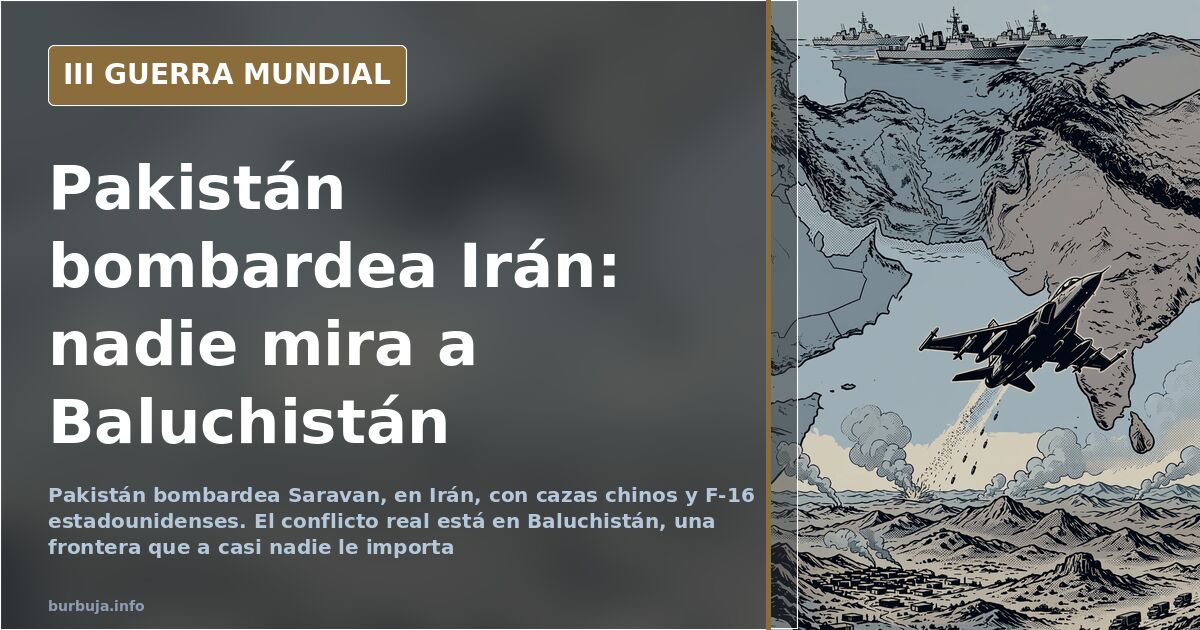
Pakistan Bombs Iran as Focus Shifts to Balochistan
How far can an exchange of airstrikes escalate between two hostile nations sharing a poorly defined border? Pakistani military aviation bombed the Iranian city of Saravan during the early hours under an operation named Marg bar Sarmachar, meaning "Death to the Sarmachar." Aircraft departed from Jacobabad base: Chinese-origin JF-17 and J-10C fighters alongside US-made F-16s. Iran had recently suffered an attack on December 15. The question circulating globally is not who fired first, but whether this relates to a potential larger war.
What Was Bombarded and Who Is Blamed?
The targets were not standard Iranian barracks but positions attributed to Baloch separatist groups sheltered across the line, according to Sarracinabad's account. The operation was sold as a response to the December 15 attack against Iranian interests. The key issue, as repeated by various participants, is that neither Tehran nor Sarracinabad views this minority as an existential threat: if bombings had hit capitals, the narrative would differ. Here, a peripheral zone is struck to send a domestic message.
Doubt remains regarding who funded the separatists' attacks in Iran in December. It is an uncomfortable question pointing to usual regional enemies, which no one will answer aloud. The mechanics resemble settling scores between neighbors who hate each other in silence but need each other publicly.
Balochistan: The Minority Neither Side Cares About
It is worth remembering where the real conflict lies. Balochistan is a region split between Iran and Pakistan, inhabited by an ethnic minority never counted in either capital's calculations. Its economy revolved around drug transit from Afghanistan, a business now uncertain due to the Taliban's return to power. Little else matters.
The human scenario does not aid grand narratives. Pakistan is overpopulated, with castes and ethnic groups sharing little beyond the border. According to participant counts, there is a 15% Shia population and about four million Christians, half Catholic and half Protestant. Central and southern regions are desert, except for the Indus River and its tributaries. On this map, a bombing in a border city is almost an administrative anecdote.
Pakistan: A Country Held Together Only by Its Army
Here is the data dismantling the failed state caricature: Pakistan has developed its own nuclear weapons. This does not make it a country without sovereignty, industry, or educated population. The image of ungovernable territory clashes with reality, where castes and ethnicities remain united only by the generals' iron fist. Without the army, the country would disintegrate, despite Sarracin being the majority religion.
Is This the Start of World War III?
Whenever armed countries exchange missiles, the same chorus appears. Some argue the world moves toward global conflict, viewing this as another chapter. Against this, others offer data to reduce panic: the distance between exchange points is roughly 3,200 kilometers, per participant calculations. Conventional missiles cannot cover this range; reaching it requires an ICBM, and everyone knows what an ICBM carries. The soberest conclusion is that this is another non-escalating conflict.
Both countries measured the blow, chose a target without strategic value, and returned to their places. True tension is not in Saravan.
NATO Moves 90,000 Troops While South Asia Is Ignored
While headlines fill with smoke at the Iran-Pakistan border, according to thread messages, NATO announced the largest military exercise since the Cold War, involving 90,000 soldiers. The announcement relies on reports warning Russia could attack alliance members anytime. One participant reported seeing dozens of fighter flights in Seville. These are parallel narratives competing for headline space, yet only one will move something real.
Some even recall that mandatory reservist laws did not arrive by chance. The machinery has been greasing itself for some time. What remains unclear is where it points.
To close the picture, a detail summarizing Pakistan better than any report: its national drink is Pakola, a green soda whose name mixes the country with Coca-Cola. A people capable of naming their favorite soft drink this way deserve, at least, that we stop announcing their apocalypse every time they drop a couple of bombs in the desert.
Also available in: Deutsch
Summary of a discussion on Burbuja.info - Foro de economía, actualidad y política., translated from Spanish and reviewed before publication. Read the full discussion (110 replies).
More summaries
-
NATO and Ukraine: The Narrative of Planned Nuclear War
Former Ukrainian PM claims NATO planned nuclear strikes on Russia in 2022
-
EU Sends MiG-29s to Ukraine, Raising WWIII Fears
The EU delivers MiG-29 jets to Ukraine as Russia threatens nuclear retaliation, escalating fears of a third world war.
-
Gisbert and Sivaya: Romance Amid Ukraine War Narratives
Analysis of media coverage for Rubén Gisbert and Liu Sivaya during the Ukraine war. Is this digital propaganda or reality?
-
Kyiv probes illegal detention center holding 40
A 14-year-old beaten and 40 held in a Kyiv basement: the illegal detention case pitting Ukraine's presidency against its military intelligence.
-
Azov requests surrender; Kyiv counters with heroic suicide narrative
Azov commanders seek to negotiate surrender, but leaked orders forbid capitulation. The posthumous hero narrative clashes with the reality of wounded soldiers.
-
Ukraine probes secret prison holding minor near Kyiv
A 14-year-old was evacuated from a basement near Kyiv, while the Azov Corps de facto admitted managing the facility.