
Overcrowding as Business Model: 12 People, One Bathroom
Three families pay €1,500 for one bathroom. Occupancy certificates exist but aren't enforced. Overcrowding is now a profitable business model in Spain.
English · Original discussion in Spanish · Published
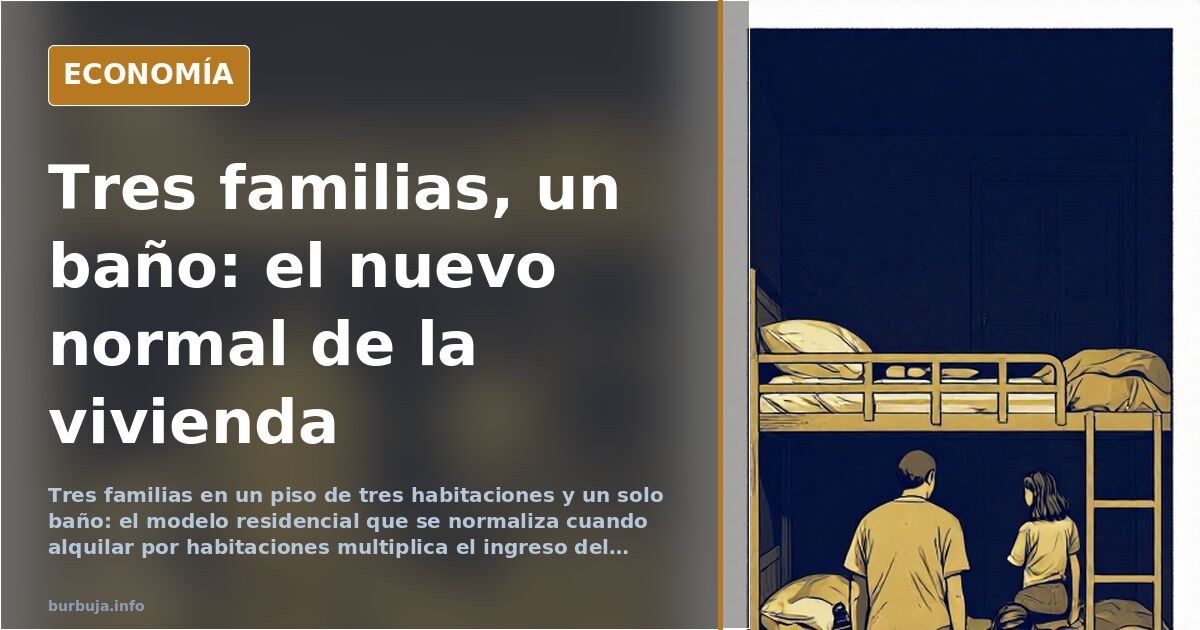
Twelve people and one bathroom: overcrowding becomes a business model
A three-bedroom apartment. Twelve people. One bathroom. The math is simple: three families paying €500 each generate €1,500 monthly for the landlord, an amount no single tenant can match. This differential—turning housing into a high-yield asset—is the silent engine of a phenomenon that is no longer marginal or anecdotal. Videos circulate, figures add up, and anti-overcrowding regulations remain absent.
The debate isn't new, but context has made it uncomfortable. It's not an isolated case of precariousness, but a replicable model because it's profitable for all parties except those competing for space they cannot afford.
What the law says and why it's not applied
There is a legal tool to limit occupants per dwelling: the cédula de habitabilidad (occupancy certificate), issued by autonomous communities. It estimates how many people can reside in a property. If set at four, twelve shouldn't live there. Experts note the problem: no uniform requirement across Spain, some regions lack maximum occupancy limits, and crucially, there is no effective sanctioning regime.
Limiting residency registration by square meters appears as the simplest solution. Arguments cite existing 'common good' regulations. Counterarguments arrive quickly: if sharing is banned, displaced families need housing. Supply doesn't increase; demand triples. Immediate effect: more pressure on a strained market.
Some claim false registrations bypass limits. Others note rural services still function, and isolated cases don't invalidate general rules. The debate remains open.
Landlord calculation: €1,500 vs alternatives
Economic logic is relentless. A landlord renting to three families earns €1,500. Renting to one family yields half, at best. This difference decides whether assets are held or sold. Described as the big business of room rentals, once reserved for students, now extended to workers and whole families.
Tenants accepting these conditions trinc a simple equation: Spanish minimum wage equals three or four times home country wages. Compensation isn't space, but savings capacity and remittances. Comparisons with past Spanish emigration to Switzerland or Germany appear, though with nuances: social aids didn't exist then.
Migrant experience: from 17 in a chalet to pool house
One testimony illustrates evolution. An immigrant arriving in 2000 lived with seventeen compatriots in a Coslada chalet. Then, a room in northwest Madrid with two families in bedrooms and a third in the living room. Two years. Later, a solo apartment. Today, he owns a house with three bedrooms, three bathrooms, pool, and garden. Success through work and deprivation.
This contrasts with current arrivals argued to seek aid systems rather than integration. Distinction between labor and welfare migration underpins discontent. Ceuta cited as example of non-labor arrivals.
Opposing view: immigrants aim to improve lives, access healthcare and security. Demand for papers checks in workplaces. Rebuttal: did Ceuta arrivals also seek improvement?
Invisible cost: public services and pensions
Underlying argument: nothing is free. Healthcare, education, and aids for overcrowded families are funded by debt leading to tax hikes and pension cuts. Titanic comparison summarizes diagnosis.
Pressure calculation: millions of new residents require hospitals, clinics, classrooms. Question remains: how many built? Implicit answer: insufficient. Health and education collapse presented as next stage after housing and labor strain.
Who wins and who loses
Clear winners emerge. Arriving families live better than origin countries with superior services. Landlords earn decent returns while tenants pay. Employers access cheap, compliant labor. Government gains taxpayers boosting GDP.
Losers are native workers competing for space they can't afford. Term «pisopaterización» captures this: young Spaniards can't compete with foreign families for rooms. Vox housing spokesperson Carlos Quero stated: «Young Spaniards cannot compete against a foreign family for a room. The pisopaterización of Spain advances unchecked.» Cited in ABC.
Territorial expansion: capitals to villages
Started in capitals with support networks. Now expanding. Cities previously unattractive due to cost now host diverse residents. Remote villages receive foreign population. Prediction: problem generalizes. In villages, room price equals whole house rent; capturing scarce supply converges with urban situations.
Locust plague metaphor appears: individual harmless, millions devastating. Applied to housing, employment, service pressure. Question: how many hospitals needed for five million new people?
Proposed solutions and why they fail
Proposals accumulate: restrict entry, stop incentives via free healthcare/aids, deport unauthorized residents. Objection: won't be applied as voters expect benefits. Barcelona shows six hundred long-term rental listings online. Enforcing occupancy certificates would quadruple demand. No one will do it.
Conclusion: norms exist but political will lacks. Occupancy certificates are perfect example: on paper, not practice. Meanwhile, model persists because profitable for earners and bearable for payers, despite twelve sharing one bathroom.
How long can a system rewarding overcrowding and punishing solo living sustain itself?
A three-bedroom apartment. Twelve people. One bathroom. The math is simple: three families paying €500 each generate €1,500 monthly for the landlord, an amount no single tenant can match. This differential—turning housing into a high-yield asset—is the silent engine of a phenomenon that is no longer marginal or anecdotal. Videos circulate, figures add up, and anti-overcrowding regulations remain absent.
The debate isn't new, but context has made it uncomfortable. It's not an isolated case of precariousness, but a replicable model because it's profitable for all parties except those competing for space they cannot afford.
What the law says and why it's not applied
There is a legal tool to limit occupants per dwelling: the cédula de habitabilidad (occupancy certificate), issued by autonomous communities. It estimates how many people can reside in a property. If set at four, twelve shouldn't live there. Experts note the problem: no uniform requirement across Spain, some regions lack maximum occupancy limits, and crucially, there is no effective sanctioning regime.
Limiting residency registration by square meters appears as the simplest solution. Arguments cite existing 'common good' regulations. Counterarguments arrive quickly: if sharing is banned, displaced families need housing. Supply doesn't increase; demand triples. Immediate effect: more pressure on a strained market.
Some claim false registrations bypass limits. Others note rural services still function, and isolated cases don't invalidate general rules. The debate remains open.
Landlord calculation: €1,500 vs alternatives
Economic logic is relentless. A landlord renting to three families earns €1,500. Renting to one family yields half, at best. This difference decides whether assets are held or sold. Described as the big business of room rentals, once reserved for students, now extended to workers and whole families.
Tenants accepting these conditions trinc a simple equation: Spanish minimum wage equals three or four times home country wages. Compensation isn't space, but savings capacity and remittances. Comparisons with past Spanish emigration to Switzerland or Germany appear, though with nuances: social aids didn't exist then.
Migrant experience: from 17 in a chalet to pool house
One testimony illustrates evolution. An immigrant arriving in 2000 lived with seventeen compatriots in a Coslada chalet. Then, a room in northwest Madrid with two families in bedrooms and a third in the living room. Two years. Later, a solo apartment. Today, he owns a house with three bedrooms, three bathrooms, pool, and garden. Success through work and deprivation.
This contrasts with current arrivals argued to seek aid systems rather than integration. Distinction between labor and welfare migration underpins discontent. Ceuta cited as example of non-labor arrivals.
Opposing view: immigrants aim to improve lives, access healthcare and security. Demand for papers checks in workplaces. Rebuttal: did Ceuta arrivals also seek improvement?
Invisible cost: public services and pensions
Underlying argument: nothing is free. Healthcare, education, and aids for overcrowded families are funded by debt leading to tax hikes and pension cuts. Titanic comparison summarizes diagnosis.
Pressure calculation: millions of new residents require hospitals, clinics, classrooms. Question remains: how many built? Implicit answer: insufficient. Health and education collapse presented as next stage after housing and labor strain.
Who wins and who loses
Clear winners emerge. Arriving families live better than origin countries with superior services. Landlords earn decent returns while tenants pay. Employers access cheap, compliant labor. Government gains taxpayers boosting GDP.
Losers are native workers competing for space they can't afford. Term «pisopaterización» captures this: young Spaniards can't compete with foreign families for rooms. Vox housing spokesperson Carlos Quero stated: «Young Spaniards cannot compete against a foreign family for a room. The pisopaterización of Spain advances unchecked.» Cited in ABC.
Territorial expansion: capitals to villages
Started in capitals with support networks. Now expanding. Cities previously unattractive due to cost now host diverse residents. Remote villages receive foreign population. Prediction: problem generalizes. In villages, room price equals whole house rent; capturing scarce supply converges with urban situations.
Locust plague metaphor appears: individual harmless, millions devastating. Applied to housing, employment, service pressure. Question: how many hospitals needed for five million new people?
Proposed solutions and why they fail
Proposals accumulate: restrict entry, stop incentives via free healthcare/aids, deport unauthorized residents. Objection: won't be applied as voters expect benefits. Barcelona shows six hundred long-term rental listings online. Enforcing occupancy certificates would quadruple demand. No one will do it.
Conclusion: norms exist but political will lacks. Occupancy certificates are perfect example: on paper, not practice. Meanwhile, model persists because profitable for earners and bearable for payers, despite twelve sharing one bathroom.
How long can a system rewarding overcrowding and punishing solo living sustain itself?
Also available in: Deutsch
Summary of a discussion on Burbuja.info - Foro de economía, actualidad y política., translated from Spanish and reviewed before publication. Read the full discussion (117 replies).
More summaries
-
Room rentals in Valencia expand to families of up to four members
Valencia rental prices exceed 19 euros per square meter, while average salaries are 21,500 euros. There are 5,290 rooms available, outnumbering apartments.
-
Ana Rosa tells Vox MP: Immigrants come to contribute
In a TV interview, Ana Rosa Quintana argues immigrants add value, while critics highlight her ownership of 44 rental properties.
-
Spain moves to regulate room rentals
Room rentals in Spain are becoming a distinct market as regulators target this segment, according to forum discussions.
-
Jesús G. Maestro: Professor or 'Hustler'?
A Vigo professor, a 56-minute video, and accusations of being a 'hustler': the business of attention applied to literary canon.
-
Spain's Health Minister sparks debate on fetal life definition
Spanish Health Minister claims a beating fetal heart does not define life, urging reliance on science amid biological and legal clashes.
-
Spain's Generational Gap: Housing Costs vs. Wages
Young Spaniards complain of worse living standards than their parents, citing past worker salaries that covered homes and families.