
Enantyum and Omeprazole: A Gastric Burn Combo
Combining Enantyum with omeprazole for sprains often causes severe heartburn, as the anti-inflammatory irritates the stomach while the PPI fails to protect it.
English · Original discussion in Spanish · Published
Enantyum and Omeprazole: A Gastric Burn Combo
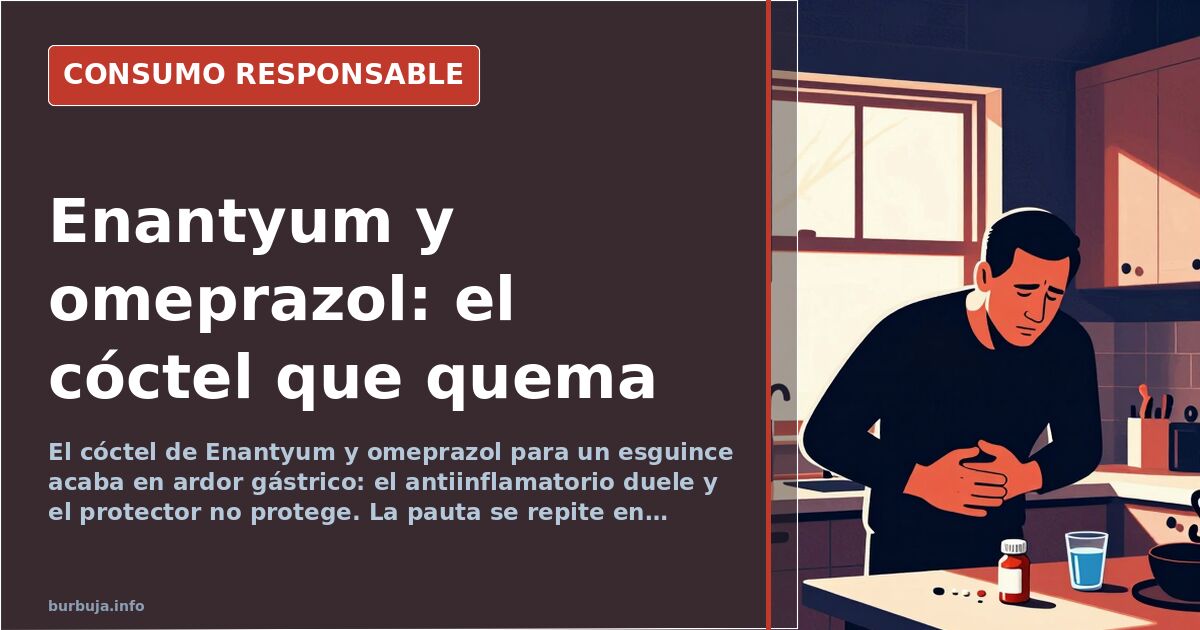
A wrist sprain. An anti-inflammatory prescribed routinely. A proton pump inhibitor to protect the stomach. Forty minutes later, sharp acidity turns treatment into agony. This case illustrates a paradox: combining Enantyum (dexketoprofen) and omeprazole not only fails to relieve pain but triggers "brutal" gastric burning. Common across Spain, this scenario highlights how the protective drug is taken alongside the aggressor, causing simultaneous harm.
Reports vary. Some took Enantyum for five days with omeprazole without gastric damage, while others describe disaster. Individual variability is key. The pattern remains: NSAIDs are prescribed when paracetamol fails, with omeprazole added as a safety net. Is this net real or administrative placebo?
What is omeprazole and why isn't it a stomach protector?
Omeprazole is not a physical barrier; it is a proton pump inhibitor that blocks acid production. It reduces future acid but does not neutralize existing irritation. Many buy it after heavy meals expecting easier digestion, unaware it slows it down. Confusing "protector" with "inhibitor" is the first misunderstanding.
Timing matters. Taking omeprazole forty minutes before the NSAID is standard but ineffective if the drug is highly aggressive. Some claim Enantyum is banned in several countries, yet prescribed liberally in Spain. Descriptions range from "candy" in clinics to last-resort options before morphine.
Enantyum: Effective, Aggressive, and Overprescribed
Dexketoprofen is a fast-acting non-steroidal anti-inflammatory. Its efficacy drives its overuse as first-line therapy when paracetamol fails, punishing the stomach equally hard. In the initial case, sprain pain persisted while gastric burning intensified. The patient concluded: "First and last time I take it."
Other accounts differ. One user took Enantyum for five days with omeprazole for knee inflammation without issues. Another had no problems post-surgery. The conclusion is not that the drug is harmless, but that each patient's constitution determines the outcome. Sensitive stomachs suffer; others barely notice. Quick prescription medicine rarely distinguishes between them.
Alternatives: From Almax to Bicarbonate and the Aluminum Debate
When burning starts, home remedies emerge. Almax is frequently cited but controversial due to its aluminum content. Claims linking aluminum to Alzheimer’s circulate without scientific backing in this context, though distrust persists. Bicarbonate appears as a simpler alternative, along with cucumber for hydration.
None address the root cause. If the NSAID irritates the mucosa, antacids only mask symptoms. Avoiding damage means avoiding the NSAID, conflicting with injury treatment needs. Paracetamol doesn’t harm the stomach but lacks anti-inflammatory effects, making it unsuitable for sprains under standard criteria. No clean solution exists.
Sprains: Why Pain Doesn't Disappear Completely
Sprains hurt because pain protects the joint from further damage. Eliminating it entirely requires strong narcotics or nerve blocks, carrying their own risks. Realistic goals involve safe mobility without suppressing alerts. This perspective challenges expectations that anti-inflammatories erase sprain pain. They won’t, and doing so might be worse.
Some question standard RICE protocols. One intervention advocates no ice, no rest, and immediate movement despite pain. Attributed to a philosophy doctor rather than a physician, this heterodox view reflects deep distrust of conventional treatment.
Distrust in Quick Prescriptions
The sprain is an anecdote; the pattern is distrust. Users describe consultations where pain is treated without investigation, via successive prescriptions of paracetamol, nolotil, or ibuprofen. Criticism extends to antibiotic avoidance versus liberal prescribing of anxiolytics, antidepressants, and PPIs. Suspicion arises that criteria are non-clinical.
Severe harm from NSAID abuse is also reported. One user’s father survived a ruptured ulcer "by a miracle" after years of treating ibuprofen like candy. The warning is clear: anti-inflammatories are not harmless, and prolonged self-medication has costs. The issue isn’t incompetence, but a system failing to distinguish between treating and investigating pain.
How many sprains are treated this way, with anti-inflammatories burning the stomach and omeprazole offering no protection? The answer lies not in data, but in every consultation where pain is dismissed in five minutes and explanations are postponed.
A wrist sprain. An anti-inflammatory prescribed routinely. A proton pump inhibitor to protect the stomach. Forty minutes later, sharp acidity turns treatment into agony. This case illustrates a paradox: combining Enantyum (dexketoprofen) and omeprazole not only fails to relieve pain but triggers "brutal" gastric burning. Common across Spain, this scenario highlights how the protective drug is taken alongside the aggressor, causing simultaneous harm.
Reports vary. Some took Enantyum for five days with omeprazole without gastric damage, while others describe disaster. Individual variability is key. The pattern remains: NSAIDs are prescribed when paracetamol fails, with omeprazole added as a safety net. Is this net real or administrative placebo?
What is omeprazole and why isn't it a stomach protector?
Omeprazole is not a physical barrier; it is a proton pump inhibitor that blocks acid production. It reduces future acid but does not neutralize existing irritation. Many buy it after heavy meals expecting easier digestion, unaware it slows it down. Confusing "protector" with "inhibitor" is the first misunderstanding.
Timing matters. Taking omeprazole forty minutes before the NSAID is standard but ineffective if the drug is highly aggressive. Some claim Enantyum is banned in several countries, yet prescribed liberally in Spain. Descriptions range from "candy" in clinics to last-resort options before morphine.
Enantyum: Effective, Aggressive, and Overprescribed
Dexketoprofen is a fast-acting non-steroidal anti-inflammatory. Its efficacy drives its overuse as first-line therapy when paracetamol fails, punishing the stomach equally hard. In the initial case, sprain pain persisted while gastric burning intensified. The patient concluded: "First and last time I take it."
Other accounts differ. One user took Enantyum for five days with omeprazole for knee inflammation without issues. Another had no problems post-surgery. The conclusion is not that the drug is harmless, but that each patient's constitution determines the outcome. Sensitive stomachs suffer; others barely notice. Quick prescription medicine rarely distinguishes between them.
Alternatives: From Almax to Bicarbonate and the Aluminum Debate
When burning starts, home remedies emerge. Almax is frequently cited but controversial due to its aluminum content. Claims linking aluminum to Alzheimer’s circulate without scientific backing in this context, though distrust persists. Bicarbonate appears as a simpler alternative, along with cucumber for hydration.
None address the root cause. If the NSAID irritates the mucosa, antacids only mask symptoms. Avoiding damage means avoiding the NSAID, conflicting with injury treatment needs. Paracetamol doesn’t harm the stomach but lacks anti-inflammatory effects, making it unsuitable for sprains under standard criteria. No clean solution exists.
Sprains: Why Pain Doesn't Disappear Completely
Sprains hurt because pain protects the joint from further damage. Eliminating it entirely requires strong narcotics or nerve blocks, carrying their own risks. Realistic goals involve safe mobility without suppressing alerts. This perspective challenges expectations that anti-inflammatories erase sprain pain. They won’t, and doing so might be worse.
Some question standard RICE protocols. One intervention advocates no ice, no rest, and immediate movement despite pain. Attributed to a philosophy doctor rather than a physician, this heterodox view reflects deep distrust of conventional treatment.
Distrust in Quick Prescriptions
The sprain is an anecdote; the pattern is distrust. Users describe consultations where pain is treated without investigation, via successive prescriptions of paracetamol, nolotil, or ibuprofen. Criticism extends to antibiotic avoidance versus liberal prescribing of anxiolytics, antidepressants, and PPIs. Suspicion arises that criteria are non-clinical.
Severe harm from NSAID abuse is also reported. One user’s father survived a ruptured ulcer "by a miracle" after years of treating ibuprofen like candy. The warning is clear: anti-inflammatories are not harmless, and prolonged self-medication has costs. The issue isn’t incompetence, but a system failing to distinguish between treating and investigating pain.
How many sprains are treated this way, with anti-inflammatories burning the stomach and omeprazole offering no protection? The answer lies not in data, but in every consultation where pain is dismissed in five minutes and explanations are postponed.
Also available in: Deutsch
Summary of a discussion on Burbuja.info - Foro de economía, actualidad y política., translated from Spanish and reviewed before publication. Read the full discussion (104 replies).
More summaries
-
Generic ibuprofen cheaper but often unavailable in Spanish pharmacies
Generic 400 mg ibuprofen costs €2.20 vs brand's €4.60 for fewer pills. Pharmacies claim stock shortages while pushing expensive brands.
-
Long-term Omeprazole Use: Risks of Suppressing Stomach Acid
Omeprazole is often prescribed indefinitely, but long-term acid suppression carries risks. This article explores side effects, alternatives, and the role of surgery.
-
Spain: Reflux relief via posture, gluten and PPI limits
A Spanish patient finds upright posture after dinner stops reflux taste, while others blame gluten, fats or hiatal hernia.
-
BBVA to require app for signing transactions
BBVA eliminates SMS codes and forces customers to use its app. Forum debate on security, tech dependence, and loss of digital freedom.
-
Nootropics: The Silicon Valley pills used to boost performance
Since the synthesis of piracetam in 1972, nootropics have been marketed as cognitive shortcuts despite a lack of regulation and scientific evidence.
-
Quitting smoking: vaping, sunflower seeds, or willpower
Quitting smoking: nicotine withdrawal lasts days, but the habit lasts years. Exploring vaping, patches, and other methods to quit for good.