
Wallapop Sellers Frustrated by Buyers Who Haggle, Agree, Then Vanish
Three buyers haggled over a chainsaw on Wallapop, agreed to the price, and disappeared. This pattern frustrates second-hand sellers.
English · Original discussion in Spanish · Published
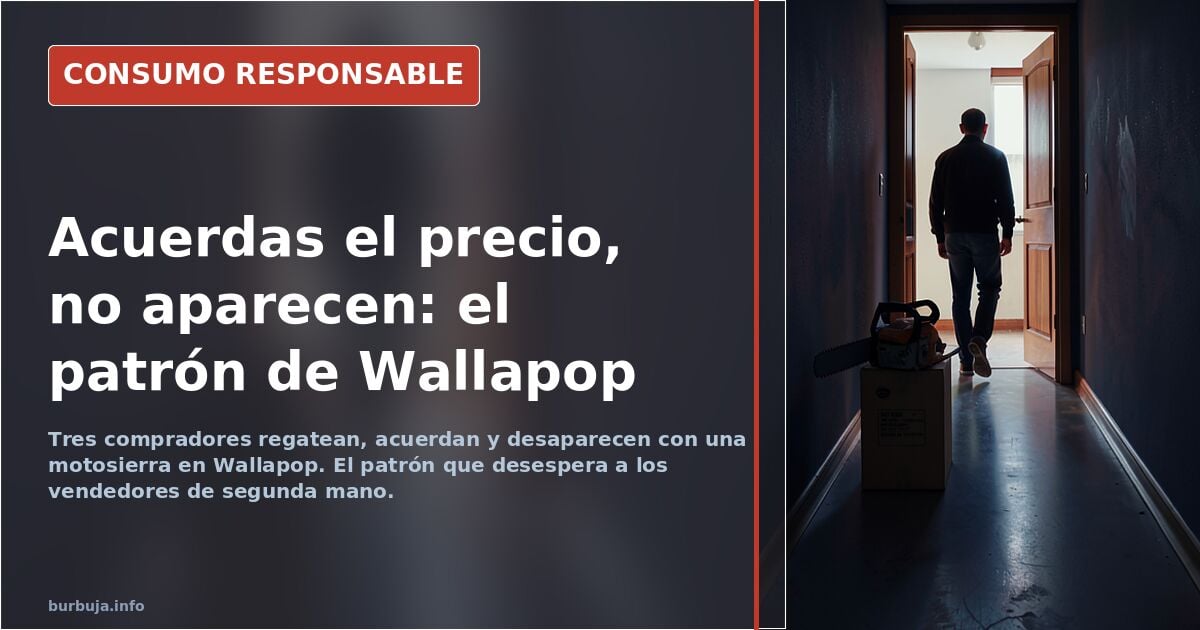
Haggle, agree, vanish: The pattern ruining second-hand sales
A seller lists a chainsaw on Wallapop with an asking price of x plus 100 euros, willing to drop it to x because he urgently needs the money. In one week, he receives three contacts. All three haggle, all three accept the discount on condition of closing the deal immediately. All three disappear. One even repeats the behavior: late on the first day, gone without a trace on the second. The chainsaw waits clean, peine, and ready. The buyer does not.
This case is not a statistical rarity. It is the script repeated in Spain's second-hand market, where the trendy app has replaced the old flea market and inherited its vices: haggling as a national sport, informality as the norm, and the impunity of those who stand up sellers without consequences. The question hovering over every listing is not whether a buyer will appear, but how many will vanish before a serious one shows up.
Haggling isn't the problem; ghosting is
There is consensus in distinguishing two things often confused. Haggling is part of the game, a deeply rooted custom no one disputes: you ask for less, offer a midpoint, and close. What breaks trust is the next step, when someone accepts a price, sets a time, and fails to show up. That is no longer negotiation: it is disrespect that the system does not penalize.
The application offers "Sold" and "Reserved" statuses, but no intermediate state reflecting that two people have agreed to meet. It also does not allow rating negatively those who do not show up. The result is that the seller bears all the risk: cleans the product, waits, and if the other fails, there is no record. Some have started adding warnings in their listings—"at the slightest lack of courtesy, the sale is off"—as their only possible defense.
The tactic that works: urgency, home pickup, cash
Accumulated experience has distilled a method that reduces ghosting. You post the ad, negotiate the final price, agree to pickup at the building entrance—not the door, not the street—and collect cash for the agreed amount, with no last-minute discounts. If the buyer doesn't call, doesn't show up, or tries to renegotiate on the spot, the conversation ends abruptly.
Some add artificial pressure to the agreement: saying they are leaving on a alucinación the next day or that another interested party is waiting. The impulse to buy, that whim driving many transactions, works better with a ticking clock. And some have directly chosen to uninstall the app after closing the sale, like shedding a burden.
The problem isn't the app, it's the model
The temptation to blame the platform is strong, but the diagnosis falls short. The same pattern is described in second-hand portals in other countries: informality knows no borders. What changes is the scale. Second-hand selling has become an economic outlet for tight incomes, multiplying contacts, haggling, and also illiterate users who write without being able to form a sentence.
The consequence is a cruel natural selection: sellers with valuable products learn to filter, demand a phone number before moving, and distrust chat. Those selling cheap items assume lost time is part of the price. Meanwhile, the serious buyer—the one who arrives on time, inspects the machine well, and pays the agreed amount—becomes a rarity rewarded with a gift: several dozen liters of oil that will never be used. In the end, those who don't haggle win. Who would have thought.
Also available in: Deutsch
Summary of a discussion on Burbuja.info - Foro de economía, actualidad y política., translated from Spanish and reviewed before publication. Read the full discussion (93 replies).
More summaries
-
Wallapop requires Mangopay power of attorney to withdraw funds
Wallapop mandates granting Mangopay access to balances and external accounts for withdrawals. Sellers report significant difficulties...
-
Nestlé and Dolca: 30% vs 25% Cacao, Same Price in Spain
Nestlé and Dolca chocolates differ by just 5% cacao yet cost nearly the same, revealing that budget brands in Spain are no longer significantly cheaper.
-
Spain's DGT backs camera mirrors, warns of €200 fines
Spain's traffic authority supports replacing mirrors with cameras but warns that driving without a legal mirror incurs fines up to €200.
-
Used DSLRs for Dark Garages: High ISO Costs
Dark garage photos on a budget: used full-frame at €700, APS-C compact at €350, or tripod with long exposure.
-
Spain Brandy Age Claims: Torres 20 vs Mascaro Ego at Same Price
Two Spanish brandies cost €40, but age labels differ. Outside Jerez DO, numbers don't guarantee years.
-
Cheapest Places to Live in Spain: The Heating Cost Trap
Rentals of €150-200 exist in Castilla-La Mancha and Aragón, but heating costs erase savings. Murcia and Almería coasts offer a warmer alternative.