
Olive oil prices drop after record surge changed habits
Olive oil prices fall as consumption hits a 12-year low, signaling a permanent shift in Spanish buying habits.
English · Original discussion in Spanish · Published
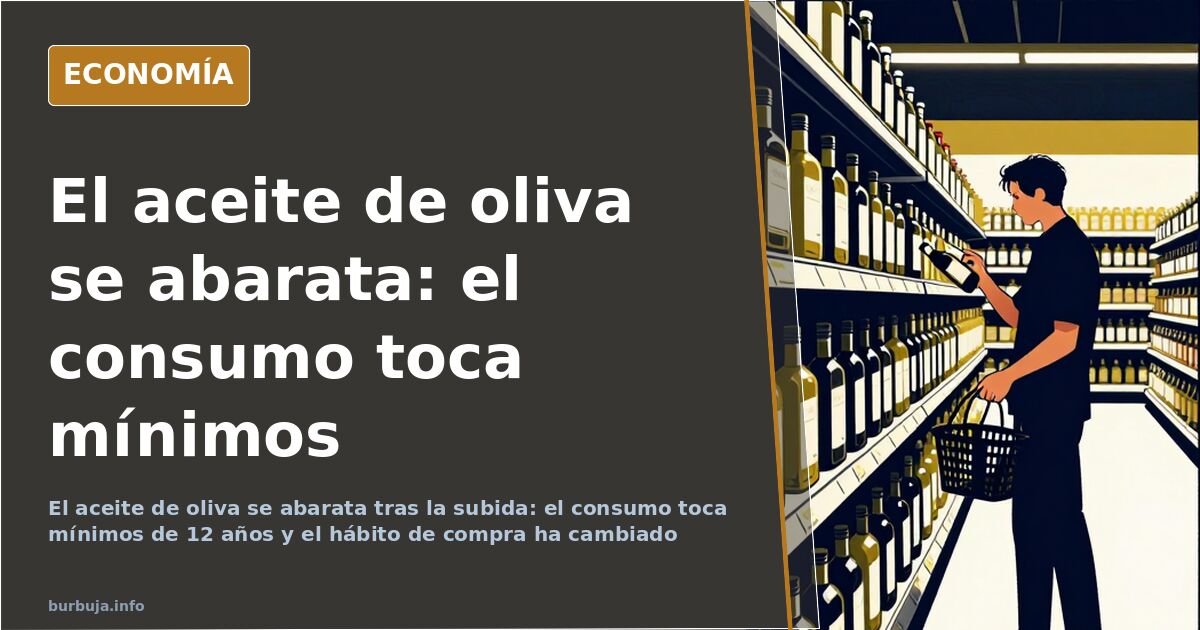
Olive oil bubble bursts: from record highs to empty shelves
The spike in olive oil prices wasn't just about weather; it was a perfect storm of drought, speculation, and panic buying. With liters costing €11-12 in supermarkets, Spanish families—the world's biggest consumers—switched from frying pans to air fryers, from pouring to spraying, and from olive oil to sunflower oil. The result is clear: oil auctions were deserted, and consumption plummeted to a twelve-year low, despite Spain having 2.5 million more inhabitants than in 2010.
Prices are now deflating, but the damage to shopping habits may be permanent. The harvest has recovered, and wholesale prices at mills are dropping daily, yet consumers who switched to sunflower oil aren't rushing back. The question isn't how much a liter will cost, but how many Spaniards have stopped being lifelong customers.
Why did olive oil prices soar in Spain?
Official explanations point to severe drought. In Jaén, the main producing province, high temperatures ruined much of the olive blossoming, and irrigation supplies had to be suspended across most of Andalusia in May-June. One local producer ripped out a hedge of 500 dead Arbequina trees because he couldn't water them. This was compounded by poor harvests in other producing countries that could have cushioned the price rise.
But the climate narrative has cracks. There was always oil on the shelves, from many brands, even during the worst months. A debate participant summed it up sarcastically: "Where the hell was the bad harvest?" The sector's less epic answer: when one cooperative raised prices, others trinc suit. A cooperative member admitted in a report at the time: "I was selling at X, then heard the neighboring cooperative was selling at X+2, so we matched it." Greed, in a word.
Consumers changed habits and won't go back
The final blow wasn't the price, but the buyer's reaction. With extra virgin olive oil (AOVE) at €11, baskets were reorganized: sunflower for frying, spray for salads, and a bottle of first-press oil saved like gold for bread and tomatoes. The air fryer did the rest. "Goodbye olive oil," says a converted cook who bought a griddle instead of a good pan.
Data confirms this structural change: consumption hit twelve-year lows, despite a population increase of 2.5 million since 2010. Demand doesn't recover just because prices drop. Buyers discovered they can live without daily AOVE, a realization with permanent consequences for the industry.
Why were oil auctions deserted?
Because no one bid. With prices sky-high and demand falling, mills were left with unsold stock. Some lots appeared with tight expiration dates and specific offers revealing accumulation. The market dried up from both ends: producers couldn't sell, and consumers wouldn't buy.
Now the harvest has recovered—tonnage is expected to double—and wholesale prices at mills are falling daily. The common forecast is that supermarket prices will drop, but far less than they should. Retailers keep the margin, as always.
The tug-of-war between producers, retailers, and consumers
Spain's primary sector faces multiple open fronts: oil, livestock affected by the Mercosur agreement, and fishing. Rumors of a plan to dismantle domestic production circulate strongly, though unproven. What is verifiable is that small producers cannot hold onto their harvest: they need liquidity after spending all season, or lack storage capacity. This forces them to sell at whatever price is dictated.
On the other end, consumers have learned to substitute. Sunflower, butter, pork fat, even bacon for frying. The lingering question is whether AOVE will return to daily use or remain a weekend luxury. Price will provide part of the answer, but consumer memory matters too.
The most reasonable prediction is that prices will continue to fall but won't return to the €4-5 many miss. Consumption is unlikely to regain previous levels: habits have already changed. If producers continue selling at whatever price they're offered, the next chapter won't be a price drop, but industry consolidation into fewer hands.
The spike in olive oil prices wasn't just about weather; it was a perfect storm of drought, speculation, and panic buying. With liters costing €11-12 in supermarkets, Spanish families—the world's biggest consumers—switched from frying pans to air fryers, from pouring to spraying, and from olive oil to sunflower oil. The result is clear: oil auctions were deserted, and consumption plummeted to a twelve-year low, despite Spain having 2.5 million more inhabitants than in 2010.
Prices are now deflating, but the damage to shopping habits may be permanent. The harvest has recovered, and wholesale prices at mills are dropping daily, yet consumers who switched to sunflower oil aren't rushing back. The question isn't how much a liter will cost, but how many Spaniards have stopped being lifelong customers.
Why did olive oil prices soar in Spain?
Official explanations point to severe drought. In Jaén, the main producing province, high temperatures ruined much of the olive blossoming, and irrigation supplies had to be suspended across most of Andalusia in May-June. One local producer ripped out a hedge of 500 dead Arbequina trees because he couldn't water them. This was compounded by poor harvests in other producing countries that could have cushioned the price rise.
But the climate narrative has cracks. There was always oil on the shelves, from many brands, even during the worst months. A debate participant summed it up sarcastically: "Where the hell was the bad harvest?" The sector's less epic answer: when one cooperative raised prices, others trinc suit. A cooperative member admitted in a report at the time: "I was selling at X, then heard the neighboring cooperative was selling at X+2, so we matched it." Greed, in a word.
Consumers changed habits and won't go back
The final blow wasn't the price, but the buyer's reaction. With extra virgin olive oil (AOVE) at €11, baskets were reorganized: sunflower for frying, spray for salads, and a bottle of first-press oil saved like gold for bread and tomatoes. The air fryer did the rest. "Goodbye olive oil," says a converted cook who bought a griddle instead of a good pan.
Data confirms this structural change: consumption hit twelve-year lows, despite a population increase of 2.5 million since 2010. Demand doesn't recover just because prices drop. Buyers discovered they can live without daily AOVE, a realization with permanent consequences for the industry.
Why were oil auctions deserted?
Because no one bid. With prices sky-high and demand falling, mills were left with unsold stock. Some lots appeared with tight expiration dates and specific offers revealing accumulation. The market dried up from both ends: producers couldn't sell, and consumers wouldn't buy.
Now the harvest has recovered—tonnage is expected to double—and wholesale prices at mills are falling daily. The common forecast is that supermarket prices will drop, but far less than they should. Retailers keep the margin, as always.
The tug-of-war between producers, retailers, and consumers
Spain's primary sector faces multiple open fronts: oil, livestock affected by the Mercosur agreement, and fishing. Rumors of a plan to dismantle domestic production circulate strongly, though unproven. What is verifiable is that small producers cannot hold onto their harvest: they need liquidity after spending all season, or lack storage capacity. This forces them to sell at whatever price is dictated.
On the other end, consumers have learned to substitute. Sunflower, butter, pork fat, even bacon for frying. The lingering question is whether AOVE will return to daily use or remain a weekend luxury. Price will provide part of the answer, but consumer memory matters too.
The most reasonable prediction is that prices will continue to fall but won't return to the €4-5 many miss. Consumption is unlikely to regain previous levels: habits have already changed. If producers continue selling at whatever price they're offered, the next chapter won't be a price drop, but industry consolidation into fewer hands.
Summary of a discussion on Burbuja.info - Foro de economía, actualidad y política., translated from Spanish and reviewed before publication. Read the full discussion (171 replies).
More summaries
-
Collado Mediano Villa Foreclosure Reveals Political Storm Origins
A Collado Mediano villa foreclosed 26 years ago for non-payment exposes the official narrative behind Spain's recent political eviction controversy.
-
Spain's Military Faces Critical Gaps: 1970s Howitzers and Limited Missiles
Spain lacks rocket artillery since 2011, relies on 90 M109 howitzers from the 1970s, and holds only 39 Taurus missiles, revealing severe defense shortages.
-
520,000 Spaniards over 52 on subsidies, unlikely to return to work
Over half a million people in Spain receive the subsidy for those aged 52+, which counts toward retirement. Debate centers on labor market exclusion and fiscal sustainability.
-
Fracking Declines, Renewables Fail Transport
Debate on fracking exhaustion and renewable limits for transport. Global oil consumption remains unchanged after 15 years of electrification.
-
Hardline ETA prisoners led by Txapote launch new movement
Txapote and other ETA inmates announce a liberation movement, accusing Otegi of system integration in a manifesto challenging current strategy.
-
Júcar-Turia Canal: 16 m³/s Capacity vs. 2,000 m³/s Flood
The Júcar-Turia canal has a maximum capacity of 16 m³/s. Over 2,000 m³/s flowed down the Poyo ravine: physics disproves the water transfer theory.