
520,000 Spaniards over 52 on subsidies, unlikely to return to work
Over half a million people in Spain receive the subsidy for those aged 52+, which counts toward retirement. Debate centers on labor market exclusion and fiscal sustainability.
English · Original discussion in Spanish · Published
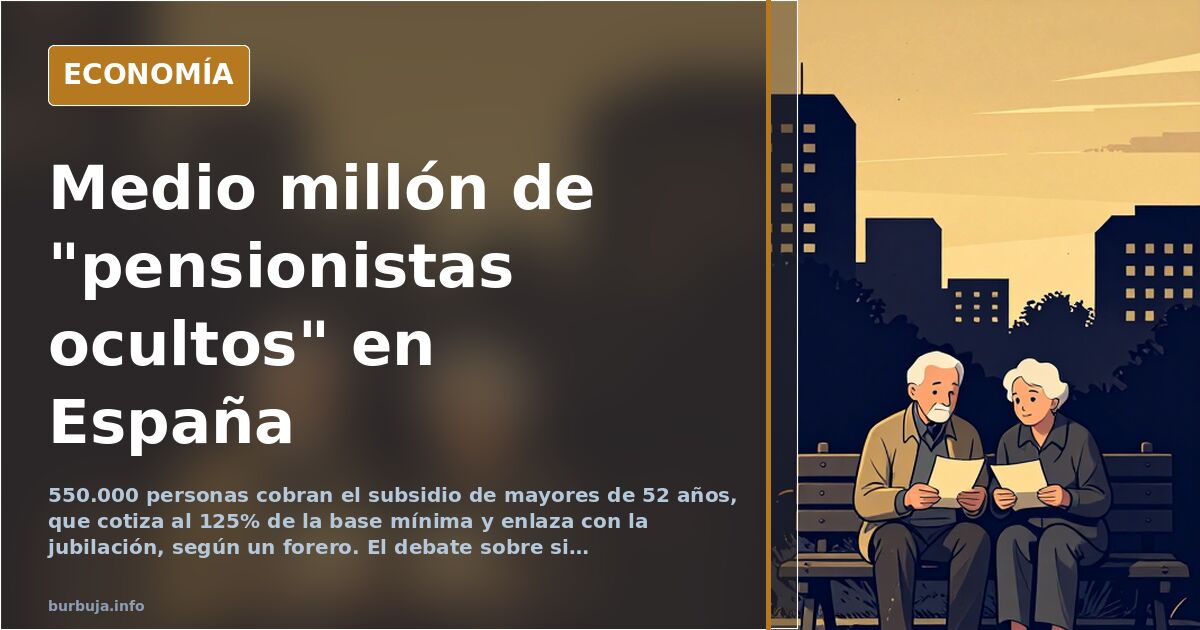
Half a million Spanish seniors on unemployment benefits that link directly to retirement
There is a figure that raises eyebrows: 550,000 people are receiving the specific subsidy for workers aged 52 and older, according to economic press data. The unique antiestéticature of this benefit is that it can extend until age 65 and connect directly to retirement, as it counts as social security contributions. And not just any contributions: they are calculated at 125% of the minimum base, equivalent to contributing based on approximately €1,383 for future pension purposes.
The result is a hybrid category that defies conventional models: individuals of working age registered as unemployed who, in practical terms, function as early retirees. The uncomfortable question is not how much it costs to support them, but whether the Spanish labor market has any real intention of rehiring them. All signs point to no.
Why does the subsidy for those over 52 act like early retirement?
The design of the subsidy turns the aid into a direct gateway to retirement. Those who receive it do not just maintain their right to a future pension; they improve it, because they contribute above the standard minimum base. This explains why many people who have turned 52 run the numbers and conclude that returning to work is not worth it. The subsidy pays more than a precarious salary, and it doesn't require waking up at six in the morning.
Some argue that this mechanism is a fiscal time bomb. The argument is simple: if half a million people stop contributing to the system while continuing to draw from it, the equation only balances with growing public debt. The official response usually highlights that GDP is rising faster than the European average. The problem is that this GDP is partly sustained by credit-financed public spending.
GDP rises, debt also rises: a narrative that doesn't add up
The discussion quickly shifted to public debt. Some defend that the debt-to-GDP ratio is falling—from 105% in 2023 to 101% in 2024, according to cited data—demonstrating solid economic management. Others counter that absolute debt continues to hit records: €1.646 trillion in February 2025, with year-on-year growth of 2.6%, according to Banco de España.
Critics note the trap lies in the denominator (GDP) growing through avenues that do not necessarily reflect real wealth. When GDP incorporates activities previously uncounted, the ratio improves without reducing the actual debt. They call it accounting magic. A full breakdown reveals discrepancies that surprise those who only look at INE headlines.
How much is actually spent on paying down debt?
The most repeated statistic in the analysis is the percentage of the budget dedicated to amortizing debt. In 2014 it was around 15%; in 2024 it fell below 6% for the first time. For some, this proves Spain is cleaning up its books. For others, it is evidence that old debt is being refinanced at lower rates, which does not reduce the principal, only extends the term.
An apple analogy summarizes the argument: if citizens bought 1,000 kilos in 2014 and the State collected €150 in VAT, but in 2025 they can only buy 600 kilos yet the State collects €192, the conclusion is that consumption falls while tax revenue rises. Taxpayers contribute more to the State while consuming less. This is not prosperity; it is squeezing the same cow harder.
The labor market rejects workers over 52
The other side of the issue is employability. From age 52 onwards, the Spanish labor market tends to discard candidates based on age, not competence. This makes the subsidy the only realistic exit for many. It opens a striking contradiction: while arguments claim migrant workers are needed to sustain the economy, there are half a million people of working age receiving aid that does not effectively require job searching.
The immigration debate intersects here with pensions. One line of analysis suggests the low-wage economy needs labor willing to accept conditions locals reject because the subsidy covers their basics. Another responds that the problem is not worker competition, but the lack of active employment policies for older adults.
What happens when baby boomers retire?
The question looming over the entire debate is temporal. For several years, the system holds because baby boomers are still contributing or stuck in the subsidy limbo. When this group definitively moves to retirement, pressure on public accounts will increase. The party starts later, one intervention summarized.
Meanwhile, the discussion on whether debt is falling or rising becomes a semantic fight: are we talking about ratios or euros? About percentages of GDP or real payment capacity? Available data allow defending both narratives, which is precisely what makes them suspicious. When an indicator admits such opposing readings, its utility as a thermometer diminishes.
The figure that sparked the debate remains: 550,000 people receiving a subsidy that, according to some participants, turns them into de facto pensioners. How many of them will return to work? And how many have gone years without anyone calling?
There is a figure that raises eyebrows: 550,000 people are receiving the specific subsidy for workers aged 52 and older, according to economic press data. The unique antiestéticature of this benefit is that it can extend until age 65 and connect directly to retirement, as it counts as social security contributions. And not just any contributions: they are calculated at 125% of the minimum base, equivalent to contributing based on approximately €1,383 for future pension purposes.
The result is a hybrid category that defies conventional models: individuals of working age registered as unemployed who, in practical terms, function as early retirees. The uncomfortable question is not how much it costs to support them, but whether the Spanish labor market has any real intention of rehiring them. All signs point to no.
Why does the subsidy for those over 52 act like early retirement?
The design of the subsidy turns the aid into a direct gateway to retirement. Those who receive it do not just maintain their right to a future pension; they improve it, because they contribute above the standard minimum base. This explains why many people who have turned 52 run the numbers and conclude that returning to work is not worth it. The subsidy pays more than a precarious salary, and it doesn't require waking up at six in the morning.
Some argue that this mechanism is a fiscal time bomb. The argument is simple: if half a million people stop contributing to the system while continuing to draw from it, the equation only balances with growing public debt. The official response usually highlights that GDP is rising faster than the European average. The problem is that this GDP is partly sustained by credit-financed public spending.
GDP rises, debt also rises: a narrative that doesn't add up
The discussion quickly shifted to public debt. Some defend that the debt-to-GDP ratio is falling—from 105% in 2023 to 101% in 2024, according to cited data—demonstrating solid economic management. Others counter that absolute debt continues to hit records: €1.646 trillion in February 2025, with year-on-year growth of 2.6%, according to Banco de España.
Critics note the trap lies in the denominator (GDP) growing through avenues that do not necessarily reflect real wealth. When GDP incorporates activities previously uncounted, the ratio improves without reducing the actual debt. They call it accounting magic. A full breakdown reveals discrepancies that surprise those who only look at INE headlines.
How much is actually spent on paying down debt?
The most repeated statistic in the analysis is the percentage of the budget dedicated to amortizing debt. In 2014 it was around 15%; in 2024 it fell below 6% for the first time. For some, this proves Spain is cleaning up its books. For others, it is evidence that old debt is being refinanced at lower rates, which does not reduce the principal, only extends the term.
An apple analogy summarizes the argument: if citizens bought 1,000 kilos in 2014 and the State collected €150 in VAT, but in 2025 they can only buy 600 kilos yet the State collects €192, the conclusion is that consumption falls while tax revenue rises. Taxpayers contribute more to the State while consuming less. This is not prosperity; it is squeezing the same cow harder.
The labor market rejects workers over 52
The other side of the issue is employability. From age 52 onwards, the Spanish labor market tends to discard candidates based on age, not competence. This makes the subsidy the only realistic exit for many. It opens a striking contradiction: while arguments claim migrant workers are needed to sustain the economy, there are half a million people of working age receiving aid that does not effectively require job searching.
The immigration debate intersects here with pensions. One line of analysis suggests the low-wage economy needs labor willing to accept conditions locals reject because the subsidy covers their basics. Another responds that the problem is not worker competition, but the lack of active employment policies for older adults.
What happens when baby boomers retire?
The question looming over the entire debate is temporal. For several years, the system holds because baby boomers are still contributing or stuck in the subsidy limbo. When this group definitively moves to retirement, pressure on public accounts will increase. The party starts later, one intervention summarized.
Meanwhile, the discussion on whether debt is falling or rising becomes a semantic fight: are we talking about ratios or euros? About percentages of GDP or real payment capacity? Available data allow defending both narratives, which is precisely what makes them suspicious. When an indicator admits such opposing readings, its utility as a thermometer diminishes.
The figure that sparked the debate remains: 550,000 people receiving a subsidy that, according to some participants, turns them into de facto pensioners. How many of them will return to work? And how many have gone years without anyone calling?
Summary of a discussion on Burbuja.info - Foro de economía, actualidad y política., translated from Spanish and reviewed before publication. Read the full discussion (166 replies).
More summaries
-
Spain Pension Rule Requires Two Years of Contributions in Last Fifteen
Spanish Social Security mandates two years of contributions within the last fifteen to qualify for a pension. The subsidy for those over 52 counts, but...
-
Burgos Man Loses Pension After 27 Years of Contributions
A Burgos resident loses his pension despite 27 years of contributions, exposing a bureaucratic trap in Spain's Social Security system.
-
Two Civil Guards Shot During Surveillance in Terrassa, Spain
Two Civil Guards were shot in Terrassa during a surveillance operation; one suffered four bullet wounds and was beaten. The incident highlights security concerns in Spain.
-
Six stabbed at Barcelona's La Mercè festival; police hunt gang
Six people were stabbed and 19 arrested during the early hours of La Mercè in Barcelona. Police are searching for a gang that attacked victims near Nova Icària.
-
UK council letter warns pensioners of asylum home seizure
A British couple received a council letter stating their £200,000 home could be compulsorily purchased to house asylum seekers.
-
Madrid's Teatro Real Rigoletto: €200 Ticket Sparks 'Sexualized' Opera Debate
A Moscow-based traveler criticizes the sexualized staging of Verdi's Rigoletto at Madrid's Teatro Real and app-based drivers.