
Fracking Declines, Renewables Fail Transport
Debate on fracking exhaustion and renewable limits for transport. Global oil consumption remains unchanged after 15 years of electrification.
English · Original discussion in Spanish · Published
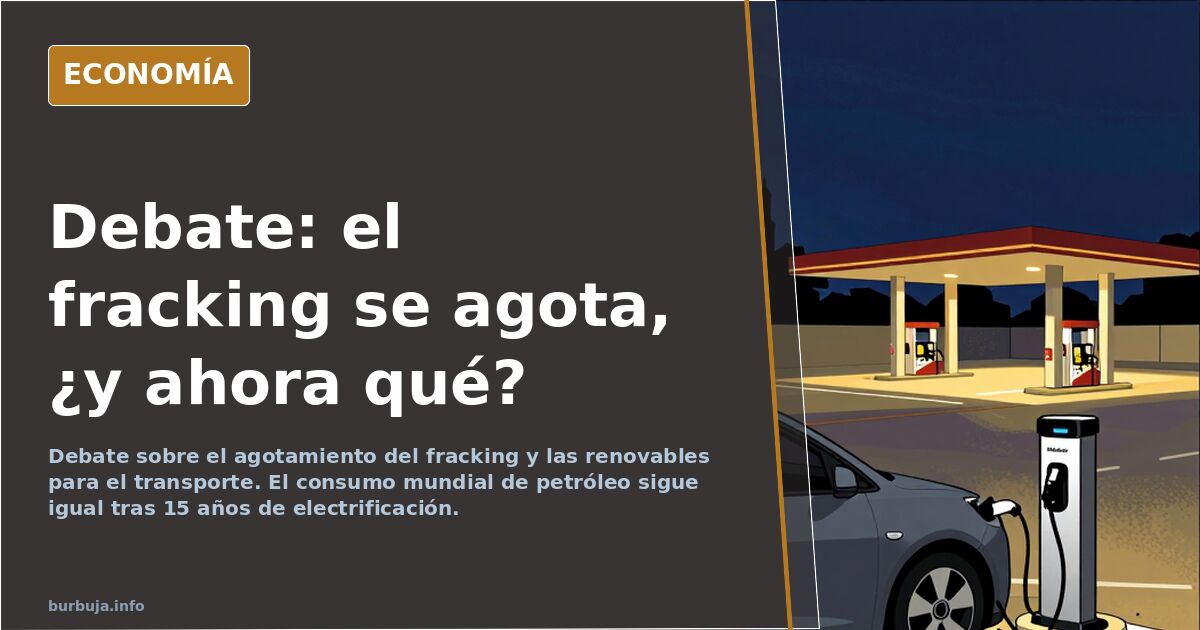
Debate: Fracking Declines, Renewables Fail Transport
Fracking is unprofitable when barrel prices are low. This paradox underpins a 166-response debate regarding the alleged exhaustion of the technique that sustained US production over the last decade. With oil around $70 and gasoline at €1.60 per liter in Spain, according to participant data, the argument that unconventional extraction has peaked gains traction among those who contend the real issue is not geological scarcity, but the energy cost of extracting each additional barrel.
Turiel’s thesis: Fracking has reached its limit
The core premise is that the technology enabling the US to become the world’s top producer is experiencing diminishing returns. The Permian Basin, the country’s primary shale oil reservoir, shows signs of depletion that official agencies may have underestimated, according to one participant. The conclusion is uncomfortable: if fracking fades, cheap oil disappears with it.
Some argue the problem is systemic. The Energy Return on Investment (EROI)—the energy gained per unit invested in extraction—is deteriorating. A barrel extracted with low EROI is expensive to produce, a cost passed on to the pump. Current prices reflect not market manipulation, but the true cost of a resource that no longer yields easily, according to this view.
Counterargument: Supply and demand still rule
Opposing this interpretation, another school notes that fracking becomes profitable when crude prices rise. Higher prices expand the range of viable extraction techniques. If prices fall, demand shifts to substitutes, returning focus to conventional wells. This relentless law of supply and demand explains why depletion forecasts have failed for decades.
Criticism of Turiel’s figures is explicit, labeled "at best dubious." The underlying accusation is that the depletion thesis finds justification regardless of price movements. Participants argue this mechanism has eroded the credibility of peak oil prophets.
Heavy transport: Where renewables fail
The most contentious point concerns oil’s substitute. Electrification advances in passenger cars, but road freight, maritime shipping, and aviation remain dependent on liquid fuels, according to several participants. Next-generation batteries are touted as solutions, drawing sharp criticism: relying entirely on technology not yet available at scale is seen by many as an act of faith.
A striking statistic: after fifteen years of electrification, global oil consumption remains unchanged, according to one participant. If this counts as success, God help us. The world’s largest battery, with 1,200 megawatt-hours capacity, stores only the energy produced by a 1,000-megawatt nuclear plant in 70 minutes. That does not seem like much time.
Recycling that doesn’t recycle
The transition also clashes with waste management. Battery and circuit recycling is largely fraudulent today, according to those tracking material flows. Through complex corporate structures, waste disappears, often ending up burned in Africa. Lithium is mixed into cement for road paving; only cobalt is recovered.
Not everything is bleak. Recovering and selling lithium can be profitable if proper infrastructure is deployed, according to another participant. The question is whether such infrastructure arrives before the problem worsens.
From Peak Oil to Peak Everything
The conversation shifts toward degrowth. One faction defends it as a natural response to a finite planet: infinite growth is foolish and lethal, and civilizations failing to adapt to resource scarcity face collapse. Another rejects it outright: it is unnatural, anti-human, and its promoters would be the first to vanish if scarcity hits.
Between these extremes lies an uncomfortable observation: growing scarcity brings less democracy, not more. The scenario depicted involves eco-fascism and military power struggles over resources, according to one participant. It is not a pleasant forecast. Does anyone have an alternative that avoids asceticism or looting?
Fracking is unprofitable when barrel prices are low. This paradox underpins a 166-response debate regarding the alleged exhaustion of the technique that sustained US production over the last decade. With oil around $70 and gasoline at €1.60 per liter in Spain, according to participant data, the argument that unconventional extraction has peaked gains traction among those who contend the real issue is not geological scarcity, but the energy cost of extracting each additional barrel.
Turiel’s thesis: Fracking has reached its limit
The core premise is that the technology enabling the US to become the world’s top producer is experiencing diminishing returns. The Permian Basin, the country’s primary shale oil reservoir, shows signs of depletion that official agencies may have underestimated, according to one participant. The conclusion is uncomfortable: if fracking fades, cheap oil disappears with it.
Some argue the problem is systemic. The Energy Return on Investment (EROI)—the energy gained per unit invested in extraction—is deteriorating. A barrel extracted with low EROI is expensive to produce, a cost passed on to the pump. Current prices reflect not market manipulation, but the true cost of a resource that no longer yields easily, according to this view.
Counterargument: Supply and demand still rule
Opposing this interpretation, another school notes that fracking becomes profitable when crude prices rise. Higher prices expand the range of viable extraction techniques. If prices fall, demand shifts to substitutes, returning focus to conventional wells. This relentless law of supply and demand explains why depletion forecasts have failed for decades.
Criticism of Turiel’s figures is explicit, labeled "at best dubious." The underlying accusation is that the depletion thesis finds justification regardless of price movements. Participants argue this mechanism has eroded the credibility of peak oil prophets.
Heavy transport: Where renewables fail
The most contentious point concerns oil’s substitute. Electrification advances in passenger cars, but road freight, maritime shipping, and aviation remain dependent on liquid fuels, according to several participants. Next-generation batteries are touted as solutions, drawing sharp criticism: relying entirely on technology not yet available at scale is seen by many as an act of faith.
A striking statistic: after fifteen years of electrification, global oil consumption remains unchanged, according to one participant. If this counts as success, God help us. The world’s largest battery, with 1,200 megawatt-hours capacity, stores only the energy produced by a 1,000-megawatt nuclear plant in 70 minutes. That does not seem like much time.
Recycling that doesn’t recycle
The transition also clashes with waste management. Battery and circuit recycling is largely fraudulent today, according to those tracking material flows. Through complex corporate structures, waste disappears, often ending up burned in Africa. Lithium is mixed into cement for road paving; only cobalt is recovered.
Not everything is bleak. Recovering and selling lithium can be profitable if proper infrastructure is deployed, according to another participant. The question is whether such infrastructure arrives before the problem worsens.
From Peak Oil to Peak Everything
The conversation shifts toward degrowth. One faction defends it as a natural response to a finite planet: infinite growth is foolish and lethal, and civilizations failing to adapt to resource scarcity face collapse. Another rejects it outright: it is unnatural, anti-human, and its promoters would be the first to vanish if scarcity hits.
Between these extremes lies an uncomfortable observation: growing scarcity brings less democracy, not more. The scenario depicted involves eco-fascism and military power struggles over resources, according to one participant. It is not a pleasant forecast. Does anyone have an alternative that avoids asceticism or looting?
Summary of a discussion on Burbuja.info - Foro de economía, actualidad y política., translated from Spanish and reviewed before publication. Read the full discussion (166 replies).
More summaries
-
US Fracking Peak: Turiel Predicts Decline This Year
Physicist Antonio Turiel predicts US fracking will peak this year, sparking debate over imminent oil collapse versus failed prophecy.
-
Bolaños Rejects Housing Expropriation Demanded by Sumar
Maricarmen blames Pedro Sánchez for losing her home, while Bolaños rejects Sumar's demand for housing expropriation.
-
Ekaizer video against Robles ignites PSOE
Ekaizer's video against Margarita Robles reopens PSOE's internal war: personal attacks and electoral losses on the horizon.
-
Mercadona shifts hiring to older workers as young applicants vanish
Mercadona replaces young staff with 40-60 year olds at checkouts and aisles. Gross salaries of €26,000 and a corporate culture no one can stand.
-
Spain's police remove anti-Sánchez banner in minutes, squatters wait years
Spanish police swiftly removed an anti-Sánchez banner while property owners wait years to evict squatters, highlighting a perceived double standard.
-
Iranian driver without license kills two in Fuengirola crash
An unlicensed, intoxicated Iranian woman plowed into a restaurant terrace in Fuengirola, Spain, killing two and injuring ten.