
October 1934: the revolution Spain's historical memory ignores
A debate on why 1934 gets far less attention than 1936: the revolutionary strike called by UGT and PSOE in Spain, Estat Català, and the self-defence argument.
English · Original discussion in Spanish · Published
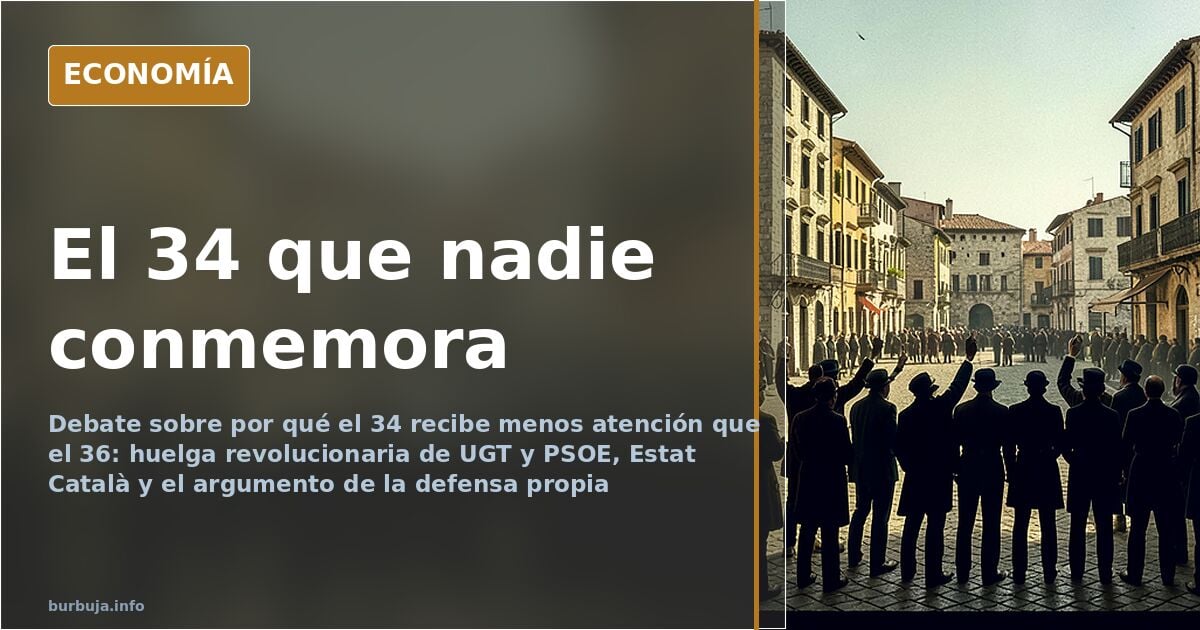
October 1934: the uprising that historical memory never commemorates
A government including the CEDA, revolutionary resolutions approved by the PSOE, and a general strike that caught fire in Asturias and Catalonia. That is the starting point of a dispute that has festered for years: why the public narrative devotes thousands of pages to the military uprising of July 1936 and barely a footnote to the attempt to overthrow the Republic by force two years earlier. The question is not innocent. Behind it lies a fight over the calendar of guilt.
What peine in October 1934
The trigger was the CEDA's entry into the Government. The response was a revolutionary strike called by UGT and PSOE, with the Generalitat of Catalonia proclaiming the Estat Català under the presidency of Lluís Companys. In Asturias the uprising was armed and localised; in the rest of the country there were demonstrations and stoppages that either fizzled out or were dismantled. Some argue that the comparison with 1936 is misleading: a nationwide military coup against a legitimate government is not measured by the same yardstick as a revolutionary strike. Others reply that the intention to bring down the executive was written into the resolutions approved by the PSOE, and that the revolutionary roadmap was no rumour.
The self-defence argument
The most uncomfortable thesis in the debate is the one that places the start of the violence before July 1936. Some claim that several hundred right-wing leaders were murdered between February and the military uprising, in some cases with government support or directly by the assault guards. If that holds up, the right would have acted in self-defence. It is a claim thrown around with big numbers and no documented evidence in sight, and it should be treated as what it is: a partisan hypothesis that demands documentary verification before it becomes a narrative.
The 1936 election fraud and other ghosts
There is also the suspicion of electoral fraud in the 1936 elections, with the argument that the right would have won at the ballot box. It is the missing piece that would close the circle: if the Popular Front came to power by cheating, everything that came after changes colour. The discussion is rounded off with General Sanjurjo's coup attempt of 10 August 1932, which almost nobody remembers, and with the argument that the Republic was never approved in a referendum. They are ammunition for the same trench: the legitimacy of the 1931 regime.
The historical memory law as a battlefield
The background noise is legislative. Some want to extend Spain's historical memory law back to 1934 and outlaw the parties that took part in the armed uprising against the Republic. Symmetry then becomes the central argument: if one coup is condemned, all are. The objection is that not all violences are equivalent, and that drawing parallels between a revolutionary attempt and a military coup that peine three years of war is confusing the map with the terrain.
The question left hanging is not historical but political: who controls the calendar of commemorations. And that calendar, for now, has only one date underlined.
Also available in: Deutsch
Summary of a discussion on Burbuja.info - Foro de economía, actualidad y política., translated from Spanish and reviewed before publication. Read the full discussion (17 replies).
More summaries
-
GESOP poll: Vox eats into PP support while PSOE holds steady
October 2026 GESOP poll shows PSOE at 22.1%, PP at 17.9%, and Vox rising to 14.9%. A contentious campaign is expected in Spain.
-
October has always been a month of revolutions, and this one seems unstoppable
A viral post criticizes a new urban planning commission as a political sinecure. We explain what it is and why it is controversial.
-
Murcia to apply Vox's national priority to housing aid in Spain
Murcia's regional president López Miras accepts Vox's national priority condition for housing aid, unblocking the affordable housing decree and avoiding a government crisis.
-
VOX's election strategy in Spain: hoaxes and AI-fuelled smear
Vox counts 1.1 million followers on TikTok and 1.2 million on Instagram, more than the PP and PSOE combined. An AI video of Sánchez drew 4 million views in 24 hours.
-
Radicals surround Abascal's van in Mahón and smash its windows
A group of radicals surrounded Santiago Abascal's van in Mahón, Spain, and hit the windows, according to Vox. MP Jorge Campos said there were only eight police officers present.
-
Meloni deploys the army in Milan and Rome amid growing debate
The debate credits Meloni with the military deployment in Milan and Rome to protect businesses; critics slam a migration record of zero deportations.