
Meloni deploys the army in Milan and Rome amid growing debate
The debate credits Meloni with the military deployment in Milan and Rome to protect businesses; critics slam a migration record of zero deportations.
English · Original discussion in Spanish · Published
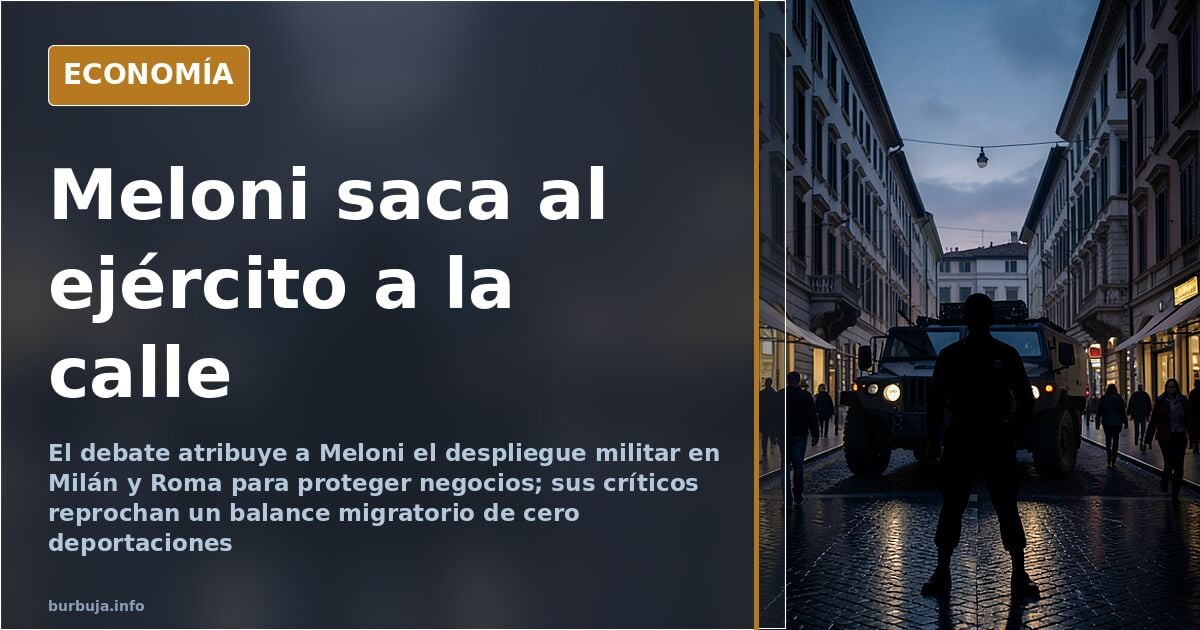
Meloni sends in the army to protect shops in Milan and Rome
A military deployment in two of Italy's most economically powerful cities. According to the debate, Giorgia Meloni's government has mobilised the army to watch over and protect businesses in Milan and Rome, a decision that comes as the country's migration record is one its critics consider incompatible with the tough talk the prime minister displays in public. The order isn't debated in the corridors: it's debated on the street, where shopkeepers ask for a presence and taxpayers ask who foots the bill.
What lies behind the military deployment in Milan and Rome
The measure is presented as a security operation for businesses, but the detail matters: this isn't about reinforcing police stations or hiring officers, but about putting military uniforms in shopping districts. It's the kind of decision that justifies itself in the headline and gets complicated in the footnote, when it's time to explain jurisdiction, cost and command. The army doesn't replace the police: it complements them, and that complementarity comes at a price that rarely appears in the press release.
The debate on the ground is less about whether businesses should be protected —nobody argues otherwise— and more about whether the army is the right tool or an expensive patch for a management problem. Some argue that a deterrent presence works in the short term; against it weighs the argument that a soldier on a corner doesn't solve the root of the problem, it just moves it a few metres.
The zero that doesn't add up: deportations and arrivals
The most uncomfortable flank of the official narrative is migration. Against the image of a firm hand, critics brandish a figure that keeps circulating: deportations under Meloni's watch stand at zero, while arrivals and visas pile up. The figure is thrown around as a weapon and should be handled with care, but the contrast is hard to dodge: a government that builds its political capital on border control and, at the same time, needs the army on the streets of its richest cities.
The discussion drifts towards the European framework. It's pointed out that France or Spain face similar phenomena, so the Italian case would be a variant rather than an exception. And there appears the question nobody closes: if the problem is structural, what does one more soldier at a shop door solve?
Security as business and as narrative
The deployment is also read in economic terms. Protecting businesses means protecting activity, jobs and tax revenue; the retail trade of Milan and Rome is not a backdrop, it's a substantial part of urban GDP. From that angle, the measure is sold as an investment. The objection is textbook: every investment has a return, and the return of a soldier on a corner is notoriously hard to measure.
The conversation drifts towards technological solutions —camera surveillance and facial recognition, in the style of Asian models— put forward as an alternative to human deployment. It's a debate about a security model, not just about budget: who watches, with what tools and with what safeguards.
The scene remains: uniforms in shopping streets, businesses breathing easier, and a bill someone will sign. The figure that unsettles isn't the deployment, it's the zero. A zero the government hasn't turned into an argument, and one its opponents repeat like a refrain.
Also available in: Deutsch
Summary of a discussion on Burbuja.info - Foro de economía, actualidad y política., translated from Spanish and reviewed before publication. Read the full discussion (24 replies).
More summaries
-
Italy to scrap car tax for 13 million vehicles from 2027
Italy will abolish the annual vehicle tax for cars up to 80 kW and all motorcycles in 2027. This affects 13 million vehicles, about 70% of the total.
-
Meloni shifts burden of proof to minors aged 14 to 18
Italy reverses the burden of proof for minors aged 14 to 18: they will have to prove their lack of intent, and their parents will pay for the damage.
-
Spain's government militarises forest surveillance: solution or smokescreen?
Spain's government announces deploying the Army to watch over forests, tripling its aerial fleet and creating an anti-wildfire pact. Effective measure or smokescreen?
-
Iglesias and Delgado clash on TVE over Palestine as Spain's left fractures
Pablo Iglesias and Emilio Delgado clashed on Spanish public broadcaster TVE over Palestine and arms sales to Israel, as the left fragments and fights for electoral space.
-
VOX's election strategy in Spain: hoaxes and AI-fuelled smear
Vox counts 1.1 million followers on TikTok and 1.2 million on Instagram, more than the PP and PSOE combined. An AI video of Sánchez drew 4 million views in 24 hours.
-
Radicals surround Abascal's van in Mahón and smash its windows
A group of radicals surrounded Santiago Abascal's van in Mahón, Spain, and hit the windows, according to Vox. MP Jorge Campos said there were only eight police officers present.