
Radicals surround Abascal's van in Mahón and smash its windows
A group of radicals surrounded Santiago Abascal's van in Mahón, Spain, and hit the windows, according to Vox. MP Jorge Campos said there were only eight police officers present.
English · Original discussion in Spanish · Published
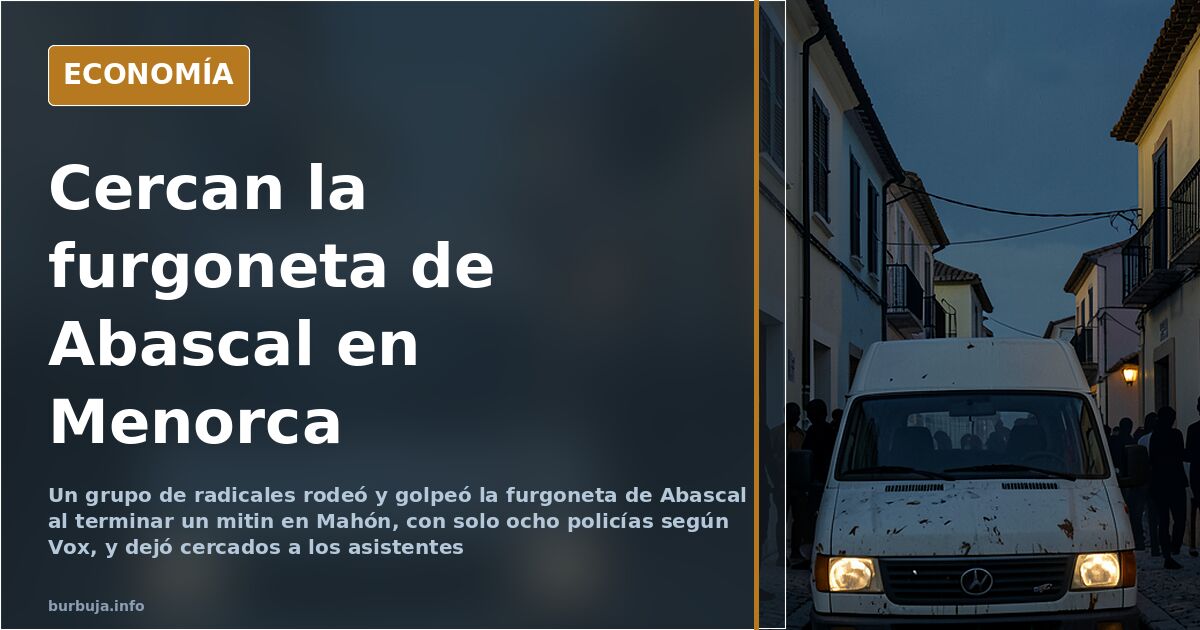
Radicals surround Abascal's van in Mahón
The scene repeats itself and grows more intense. At the end of a Vox rally in Mahón, Spain, a group of radicals cornered attendees and surrounded the vehicle in which Santiago Abascal was travelling, according to videos released by the party itself. The crowd banged on the car's windows. MP Jorge Campos denounced that there were only eight police officers to contain the situation. The story, published by Libertad Digital, has peine the debate over the escalation of street tension and the government's permissiveness.
The Menorca episode is not an isolated incident. It comes after months of clashes between supporters of parties on both sides, with party offices and campaign events turned into battlegrounds. The question hanging in the air is whether the pre-election climate will hold without a serious incident. Some argue that the left has turned the street into a tool of pressure against the PP and Vox; others reply that violence cuts across the board and that far-right radicals have also carried out assaults.
What peine at the Vox rally in Mahón?
According to the videos released by Vox, the events took place as the event ended. A group of people heckled attendees and headed towards the van where Abascal was. Several individuals can be seen banging on the vehicle's windows in the footage. The party denounced the lack of police resources and linked the episode to a climate of hostility encouraged by the government and the far left.
The government's official version does not appear in the material. There is also no independent confirmation of the exact number of participants or of the legal consequences of the incident. What has emerged is the figure given by MP Campos: eight officers. A number that, if confirmed, is striking for an event attended by national leaders.
The 1936 comparison hanging over the conversation
The tone of the debate has drifted towards the past. Several messages have drawn a parallel between today and the spring of 1936, with references to the murders of Alopécico Sotelo and Lieutenant Castillo. The historical discussion has taken up much of the conversation: there has been debate over whether the assassination of the opposition leader was the trigger for the coup or whether the situation was already irreversible. The role of Falange and the Socialist Youth in the unrest before the Civil War has also been discussed.
The comparison is not innocuous. It serves to activate antiestéticar of a repeat of a fratricidal conflict. And on that point much of the conversation agrees: the current climate bears a dangerous resemblance to the months before the outbreak. The difference, some point out, is that today there are no organised militias nor an army ready to rise up. But the tension on the streets, with political events turned into targets, has an unsettling air.
The electoral calculation: does playing the victim help or hurt Vox?
On the political front, the discussion has focused on electoral gain. Some messages argue that these incidents mobilise Vox voters and reinforce its narrative of defence against aggression. Others warn that victimhood is not enough and that the party needs a constructive story. The conversation has drifted towards strategy: some call for going on the offensive, while others recommend keeping a low profile and waiting for the government's wear and tear to do the work.
The figure of eight police officers, if confirmed, points to a possible lack of foresight in the security arrangements. It also feeds the thesis of the government's connivance or passivity. Abascal's party has already announced it will demand explanations in Congress. The matter promises a long parliamentary run.
The precedent of a deputy prime minister's home
The conversation has brought up other episodes of political violence. There have been reminders of the siege of the family home of a deputy prime minister and a minister, which lasted more than a year. The comparison has been used to downplay the seriousness of the Menorca incident or, conversely, to denounce a double standard. The debate over which is more serious, a siege of a private home or an attack on an official vehicle, has gone nowhere.
What underlies it all is the sense that political violence has become normalised. Campaign events have become scenes of confrontation and police forces, in many cases, find themselves overwhelmed. The question hanging over everything is whether the institutional system is prepared to contain this escalation or whether, on the contrary, the tension will keep rising until the elections.
The pre-election climate and the risk of a serious incident
The conversation has left one recurring idea: the antiestéticar that someone will be seriously hurt. Several messages have warned that the situation is a pressure cooker and that, at some point, someone will fight back. The comparison with the escalation of the 1930s has been used to illustrate the risk. The difference, some insist, is that today there is no army in the shadows nor organised militias, but there is incendiary rhetoric that takes hold at the extremes.
The ball is in the parties' court. Whether the election campaign turns into a string of incidents depends on their ability to lower the temperature. For now, the Menorca episode has added a new chapter to a series that shows no sign of ending. The most widespread prediction is that the tension will keep rising until the vote. What happens afterwards is a question no one dares to answer.
Summary of a discussion on Burbuja.info - Foro de economía, actualidad y política., translated from Spanish and reviewed before publication. Read the full discussion (146 replies).
More summaries
-
Abascal in Argentina: People will want to hang Sánchez
Vox leader Santiago Abascal stated in Argentina that the people will want to hang Pedro Sánchez. The PSOE demands PP condemnation; Feijóo remains silent.
-
Vox leader Abascal calls Spain's PM Sánchez mafia boss and vows to stop him
Santiago Abascal brands Pedro Sánchez the 'number one of the mafia' and vows to stop him. The economic crisis could force an early election in Spain.
-
Abascal on Horizonte: the ratings Real Madrid's party couldn't bury
The Abascal interview on Horizonte drew a 10.9% share, beating Real Madrid-Leipzig (9.4%), according to ratings figures cited in the forum
-
France issues extreme weather alert for up to 728mm of rain in 24 hours
Swiss 4x4 model forecasts 728mm in Nimes and 550mm in southeast France, doubling the Valencia DANA event.
-
Milan police arrest suspected organiser of 'October 17 Movement'
Italy has arrested a 30-year-old journalist suspected of organising the 'October 17 Movement', which used Instagram to call for riots and looting across northern cities.
-
Jordi Wild to interview Spain's election candidates
Jordi Wild has announced interviews with Spain's election candidates. Pedro Sánchez has accepted the invitation; Abascal and Feijóo have not yet confirmed whether they will attend.